Australian Crake

Australian Crake

Porzana fluminea

Silhouette: Sheatherius · PhyloPic

LCLeast ConcernNTVUENCR Endemic
Daily sighting probability <5% · Rare
at Grampians National Park

In 3 days <5% in a week ~10%

8 Verified sightings at Grampians National Park From 2019 to 2026
71 In all 2 parks
December Best month
☀️ Diurnal When it's spotted

About the Australian Crake

The Australian crake (Porzana fluminea), also known as Australian spotted crake, or spotted crake is a species of bird in the family Rallidae. It is the only species of Australian crake in the genus Porzana. The Australian crake was formally described in 1843 by the English ornithologist John Gould and given the binomial name Porzana fluminea. He specified the type locality as New South Wales. The specific epithet is from Latin flumineus meaning "riverine" (from flumen meaning "river"). The species is monotypic: no subspecies are recognised.

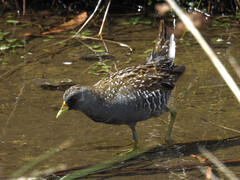
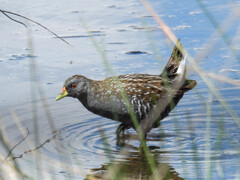
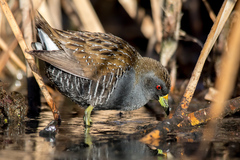
The Australian crake measures 19–23 cm (7.5–9.1 in) in length, weighs 55–70 g (1.9–2.5 oz) and has a wingspan of 27–33 cm (11–13 in). It is similar in appearance and behaviour to Baillon's crake (Porzana pusilla), but the Australian crake is stockier and darker overall and lacks the distinctive barred undertail of the Baillon's crake (Porzana pusilla). The Australian crake has a sooty face with steel-blue/dark grey breast, belly and throat. Brown upperparts, including the crown, are streaked black and white, with barred black and white flanks. Shorter undertail coverts are black and longer undertail coverts are white... Wikipedia →

Sounds

Recording0:46

Australia · 2021

© Richard Boon · XC619899 · CC BY-NC-SA 4.0

Call0:10

Australia · 2016

© Andrew Spencer · XC311784 · CC BY-NC-ND 4.0

Call0:32

Australia · 2023

© Peter Boesman · XC860116 · CC BY-NC-ND 4.0

Global Distribution

Parks Where Found

# Park Country Daily sighting probability
1 Great Otway National Park 🇦🇺 Australia
<5%
2 Grampians National Park 🇦🇺 Australia
<5%

Cities Where Found

# City Country Daily sighting probability
1 Melbourne 🇦🇺 Australia
<5%
2 Perth 🇦🇺 Australia
<5%
3 Sydney 🇦🇺 Australia
<5%

Before you go

What are the chances of seeing an Australian Crake in Grampians National Park?

Rare

Under 5% of wildlife watchers report an Australian Crake sighting in Grampians National Park on a given day, based on 8 verified sightings from GBIF citizen-science data from 2019 to 2026. It is the 122nd most-seen of the 145 birds we can rate there. Over three days the chance rises to under 5%, and over a week to about 10%, if each day is a fresh chance.

When is the best time to see an Australian Crake in Grampians National Park?

December

In that month about 10% of wildlife watchers report an Australian Crake in Grampians National Park on a given day, against under 5% in January to November, the lowest months.

What time of day is best to see an Australian Crake?

Between 9 am and noon

Across all the parks we cover, that three-hour window holds the most Australian Crake sightings with a recorded time, and about 8 in 10 of them come between 6 am and 6 pm: it is a daytime animal.

Is Grampians National Park the best place to see an Australian Crake?

Among the best

Of the 2 parks where we can rate Australian Crake sightings, Grampians National Park ranks 2nd at under 5%, level with the leaders once rounded. The best odds are in Great Otway National Park (Australia, under 5%).

Where does the Australian Crake sighting chance come from?

GBIF citizen-science records

It is estimated from how often the Australian Crake is recorded against all the birds logged in Grampians National Park (8 verified sightings from 2019 to 2026), calibrated against known sighting rates. Figures are rounded to the nearest 10% because citizen-science data supports honest approximations, not decimals, and months with records from fewer than five people show "—". How it works.

← Back to Grampians National Park