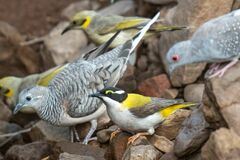

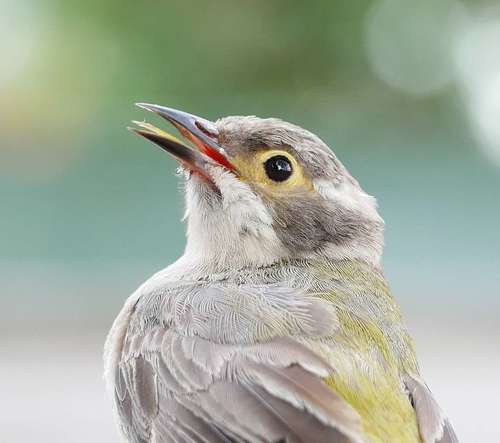
Black-chinned Honeyeater

Black-chinned Honeyeater

Melithreptus gularis

Silhouette: Rachael Joakim · PhyloPic

LCLeast ConcernNTVUENCR Endemic
Daily sighting probability <5% · Rare
at Grampians National Park

In 3 days <5% in a week ~10%

9 Verified sightings at Grampians National Park From 2019 to 2026
9 In 1 park
September Best month
☀️ Diurnal When it's spotted

About the Black-chinned Honeyeater

The black-chinned honeyeater (Melithreptus gularis) is a species of passerine bird in the family Meliphagidae. It is endemic to Australia. Two subspecies are recognised. Its natural habitats are temperate forests and subtropical or tropical dry forests.

The black-chinned honeyeater was first described by John Gould in 1837 as Haematops gularis. He also described what he called the golden-backed honeyeater (as Melithreptus laetior) of northern Australia in 1875. Frederick George Waterhouse of the South Australian Museum had sent him four skins, writing of their beauty. Gould noted that it was clearly closely related to M. gularis, but differed in its plumage and smaller size. Richard Schodde united them into a single species in 1975, though Hugh Ford queried this in 1986, as he felt the two forms were as distinct as the yellow-tinted and fuscous honeyeaters that had similar ranges. Schodde countered that the black-chinned and golden-backed honeyeaters shared a much broader zone of hybridization. Since then they have been maintained as two subspecies of M. gularis, though Christidis and Boles noted in 2008 that data was limited and more fieldwork and genetic investigation... Wikipedia →

Sounds

Call0:14

Australia · 2017

© Greg McLachlan · XC372852 · CC BY-NC-SA 4.0

Song0:17

Australia · 2013

© Marc Anderson · XC171937 · CC BY-NC-ND 4.0

Call0:16

Australia · 2025

© Nick Talbot · XC993331 · CC BY-NC-SA 4.0

Global Distribution

Parks Where Found

# Park Country Daily sighting probability
1 Grampians National Park 🇦🇺 Australia
<5%

More parks will be added in future updates.

Closest Relatives at Grampians National Park

Before you go

What are the chances of seeing a Black-chinned Honeyeater in Grampians National Park?

Rare

Under 5% of wildlife watchers report a Black-chinned Honeyeater sighting in Grampians National Park on a given day, based on 9 verified sightings from GBIF citizen-science data from 2019 to 2026. It is the 122nd most-seen of the 145 birds we can rate there. Over three days the chance rises to under 5%, and over a week to about 10%, if each day is a fresh chance.

When is the best time to see a Black-chinned Honeyeater in Grampians National Park?

Any time of year

In every month with enough records, under 5% of wildlife watchers report a Black-chinned Honeyeater in Grampians National Park on a given day, so our monthly data shows no clear season.

What time of day is best to see a Black-chinned Honeyeater?

Between 9 am and noon

Across all the parks we cover, that three-hour window holds the most Black-chinned Honeyeater sightings with a recorded time, and about 9 in 10 of them come between 6 am and 6 pm: it is a daytime animal.

Where else can you see a Black-chinned Honeyeater?

Only Grampians National Park, in our data

Grampians National Park is the only park on Wallace's Line with enough records to rate Black-chinned Honeyeater sightings: under 5% of wildlife watchers there report one on a given day.

Which relatives of the Black-chinned Honeyeater live in Grampians National Park?

Same genus: Melithreptus

The closest relatives of the Black-chinned Honeyeater that you can see in Grampians National Park (genus Melithreptus, Dark-headed Honeyeaters) are White-naped Honeyeater (about 30%) and Brown-headed Honeyeater (about 20%), with each one's daily chance of a sighting.

Where does the Black-chinned Honeyeater sighting chance come from?

GBIF citizen-science records

It is estimated from how often the Black-chinned Honeyeater is recorded against all the birds logged in Grampians National Park (9 verified sightings from 2019 to 2026), calibrated against known sighting rates. Figures are rounded to the nearest 10% because citizen-science data supports honest approximations, not decimals, and months with records from fewer than five people show "—". How it works.

← Back to Grampians National Park