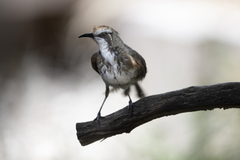
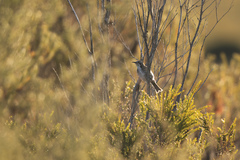
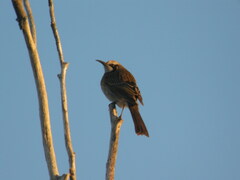

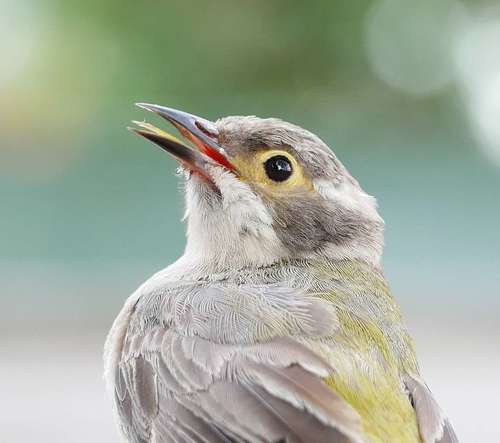
Tawny-crowned Honeyeater

Tawny-crowned Honeyeater

Gliciphila melanops

Silhouette: Rachael Joakim · PhyloPic

LCLeast ConcernNTVUENCR Endemic
Daily sighting probability ~10% · With luck
at Grampians National Park

In 3 days ~20% in a week ~40%

59 Verified sightings at Grampians National Park From 2019 to 2026
317 In all 7 parks
February Best month
☀️ Diurnal When it's spotted

About the Tawny-crowned Honeyeater

The tawny-crowned honeyeater (Gliciphila melanops) is a passerine bird native to southern Australia. The tawny-crowned honeyeater was originally described by ornithologist John Latham in 1801 as Certhia melanops. Its specific epithet is derived from the Ancient Greek terms melano- 'black' and ōps 'face'. It was previously classified in the genus Phylidonyris but a molecular study has shown it to be more distantly related to members of that genus. It was assigned to a new genus Gliciphila by Gregory Mathews in 1912.

Two subspecies are recognised: A species of the honeyeater family, perching birds that feed on insects and nectar. Tawny-crowned honeyeaters are sometimes observed hopping amongst plants on the ground to feed, considered as unusual behaviour amongst its near relations. It resembles the eastern and western spinebills and crescent honeyeater, but is distinguished... Wikipedia →

Sounds

Call0:11

Australia · 2026

© Marc Anderson · XC1086696 · CC BY-NC-ND 4.0

Dawn song1:25

Australia · 2024

© Khristos Nizamis · XC1025272 · CC BY-NC-ND 4.0

Song0:09

Australia · 2023

© Peter Boesman · XC859887 · CC BY-NC-ND 4.0

Global Distribution

Parks Where Found

# Park Country Daily sighting probability
1 Flinders Chase 🇦🇺 Australia
~30%
2 Grampians National Park 🇦🇺 Australia
~10%
3 Royal National Park 🇦🇺 Australia
~10%
4 Booderee National Park 🇦🇺 Australia
<5%
5 Wilsons Promontory National Park 🇦🇺 Australia
<5%
6 Great Otway National Park 🇦🇺 Australia
<5%
7 Blue Mountains National Park 🇦🇺 Australia
<5%

Cities Where Found

# City Country Daily sighting probability
1 Perth 🇦🇺 Australia
<5%

Closest Relatives at Grampians National Park

Before you go

What are the chances of seeing a Tawny-crowned Honeyeater in Grampians National Park?

With luck

About 10% of wildlife watchers report a Tawny-crowned Honeyeater sighting in Grampians National Park on a given day, based on 59 verified sightings from GBIF citizen-science data from 2019 to 2026. It is the 77th most-seen of the 145 birds we can rate there. Over three days the chance rises to about 20%, and over a week to about 40%, if each day is a fresh chance.

When is the best time to see a Tawny-crowned Honeyeater in Grampians National Park?

February and May–October

In those months about 10% of wildlife watchers report a Tawny-crowned Honeyeater in Grampians National Park on a given day, against under 5% in March–April and November–January, the lowest months.

What time of day is best to see a Tawny-crowned Honeyeater?

Between 9 am and noon

Across all the parks we cover, that three-hour window holds the most Tawny-crowned Honeyeater sightings with a recorded time, and about 9 in 10 of them come between 6 am and 6 pm: it is a daytime animal.

Is Grampians National Park the best place to see a Tawny-crowned Honeyeater?

2nd of 7

Of the 7 parks where we can rate Tawny-crowned Honeyeater sightings, Grampians National Park ranks 2nd at about 10%. The best odds are in Flinders Chase (Australia, about 30%).

Which relatives of the Tawny-crowned Honeyeater live in Grampians National Park?

Same family: Meliphagidae

The closest relatives of the Tawny-crowned Honeyeater that you can see in Grampians National Park (family Meliphagidae, Honeyeaters) are Red Wattlebird (about 70%), New Holland Honeyeater (about 60%) and Yellow-faced Honeyeater (about 50%), with each one's daily chance of a sighting.

Where does the Tawny-crowned Honeyeater sighting chance come from?

GBIF citizen-science records

It is estimated from how often the Tawny-crowned Honeyeater is recorded against all the birds logged in Grampians National Park (59 verified sightings from 2019 to 2026), calibrated against known sighting rates. Figures are rounded to the nearest 10% because citizen-science data supports honest approximations, not decimals, and months with records from fewer than five people show "—". How it works.

← Back to Grampians National Park