Abert's Squirrel

Abert's Squirrel

Sciurus aberti

Silhouette: Chloé Schmidt · PhyloPic

LCLeast ConcernNTVUENCR
Daily sighting probability ~30% · Possible
at Grand Canyon National Park

In 3 days ~70% in a week ~90%

99 Verified sightings at Grand Canyon National Park From 2019 to 2026
172 In all 2 parks
September Best month
☀️ Diurnal When it's spotted

About the Abert's Squirrel

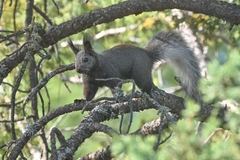
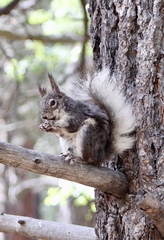
Abert's squirrel or the tassel-eared squirrel (Sciurus aberti) is a tree squirrel in the genus Sciurus native to the southern Rocky Mountains from the United States to the northern Sierra Madre Occidental of Mexico, with concentrations found in Arizona, New Mexico, and southwestern Colorado. It is closely associated with, and largely confined to, mature ponderosa pine forests. It is named in honor of the American naturalist John James Abert; nine subspecies are recognised. It is recognizable by its tufted ears, gray color, pale underparts and rufous patch on the lower back. The squirrel feeds on the seeds and cones of the Mexican pinyon and the ponderosa pine when they are available, but will also take fungi, buds, bark, and carrion. Breeding normally occurs in summer, with a spherical nest being built high in the canopy.

Abert's squirrel is named after Colonel John James Abert, an American naturalist and military officer who headed the Corps of Topographical Engineers and organized the effort to map the American West in the 19th century.

The currently accepted scientific name for Abert's squirrel is Sciurus aberti Woodhouse, 1853. Woodhouse had initially... Wikipedia →

Sounds

Recording0:29

United States · 2026

© Conor and Alexandra · iNaturalist · CC BY-NC 4.0

Recording0:16

United States · 2022

© ellen hildebrandt · iNaturalist · CC BY-NC 4.0

Global Distribution

Parks Where Found

# Park Country Daily sighting probability
1 Grand Canyon National Park 🇺🇸 United States
~30%
2 Rocky Mountain National Park 🇺🇸 United States
~20%

Before you go

What are the chances of seeing an Abert's Squirrel in Grand Canyon National Park?

Possible

About 30% of wildlife watchers report an Abert's Squirrel sighting in Grand Canyon National Park on a given day, based on 99 verified sightings from GBIF citizen-science data from 2019 to 2026. It is the 6th most-seen of the 18 mammals we can rate there. Over three days the chance rises to about 70%, and over a week to about 90%, if each day is a fresh chance.

When is the best time to see an Abert's Squirrel in Grand Canyon National Park?

January and August–October

In those months about 40% of wildlife watchers report an Abert's Squirrel in Grand Canyon National Park on a given day, against about 10% in March–April and December, the lowest months.

What time of day is best to see an Abert's Squirrel?

Between 8 and 11 am

Across all the parks we cover, that three-hour window holds the most Abert's Squirrel sightings with a recorded time, and about 9 in 10 of them come between 6 am and 6 pm: it is a daytime animal.

Is Grand Canyon National Park the best place to see an Abert's Squirrel?

Yes

Of the 2 parks where we can rate Abert's Squirrel sightings, Grand Canyon National Park has the highest daily chance: about 30%. Next come Rocky Mountain National Park (United States, about 20%).

Which relatives of the Abert's Squirrel live in Grand Canyon National Park?

Same family: Sciuridae

The closest relatives of the Abert's Squirrel that you can see in Grand Canyon National Park (family Sciuridae, Squirrels) are Rock Squirrel (about 80%), Cliff Chipmunk (about 50%) and White-tailed Antelope Squirrel (about 20%), with each one's daily chance of a sighting.

Where does the Abert's Squirrel sighting chance come from?

GBIF citizen-science records

It is estimated from how often the Abert's Squirrel is recorded against all the mammals logged in Grand Canyon National Park (99 verified sightings from 2019 to 2026), calibrated against known sighting rates. Figures are rounded to the nearest 10% because citizen-science data supports honest approximations, not decimals, and months with records from fewer than five people show "—". How it works.

← Back to Grand Canyon National Park