
Golden-mantled Ground Squirrel

Golden-mantled Ground Squirrel

Callospermophilus lateralis

Silhouette: Amanda Kuhlman · PhyloPic

LCLeast ConcernNTVUENCR
Daily sighting probability ~10% · With luck
at Grand Canyon National Park

In 3 days ~30% in a week ~60%

19 Verified sightings at Grand Canyon National Park From 2019 to 2026
5,013 In all 10 parks
July Best month
☀️ Diurnal When it's spotted

About the Golden-mantled Ground Squirrel

The golden-mantled ground squirrel (Callospermophilus lateralis) is a ground squirrel native to western North America. It is distributed in the Rocky Mountains of British Columbia and Alberta, and through much of the western United States.

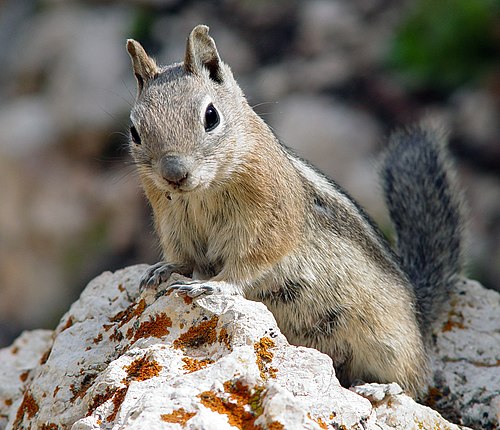
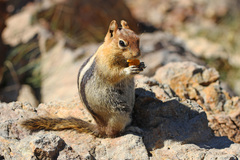
This ground squirrel is generally about 23 to 29 cm (9.1 to 11.4 in) in length. The weight range for adults is between 120 and 394 grams (0.26 to 0.86 lbs.) It has whitish or yellow-gray underparts. The tail is brown to black with buff edges and a yellowish to reddish underside. It has pale rings around the eyes. The "mantle" across the shoulders is tawny to reddish, with males having a deeper reddish tinge. This species is distinguished from similar ground squirrels by a black-bordered white stripe down each side of the back and is distinguished from similar looking chipmunks by its lack of facial stripes.

Some authors describe many subspecies of this taxon. This species occurs in forests, chaparral, meadow margins, and sagebrush, especially in areas with many rocks or forest litter that provides shelter. It is associated with many kinds of coniferous trees, aspen, and manzanita.

It is omnivorous, feeding... Wikipedia →

Sounds

Recording0:05

Canada · 2022

© Caleb Catto · iNaturalist · CC BY 4.0

Recording6:35

United States · 2023

yklenner · iNaturalist · CC0

Global Distribution

Parks Where Found

# Park Country Daily sighting probability
1 Rocky Mountain National Park 🇺🇸 United States
~80%
2 Banff National Park 🇨🇦 Canada
~70%
3 Sequoia and Kings Canyon National Parks 🇺🇸 United States
~70%
4 Glacier National Park 🇺🇸 United States
~60%
5 Grand Teton National Park 🇺🇸 United States
~50%
6 Jasper National Park 🇨🇦 Canada
~50%
7 Yellowstone National Park 🇺🇸 United States
~40%
8 Yosemite National Park 🇺🇸 United States
~40%
9 Grand Canyon National Park 🇺🇸 United States
~10%
10 Zion National Park 🇺🇸 United States
~10%

Before you go

What are the chances of seeing a Golden-mantled Ground Squirrel in Grand Canyon National Park?

With luck

About 10% of wildlife watchers report a Golden-mantled Ground Squirrel sighting in Grand Canyon National Park on a given day, based on 19 verified sightings from GBIF citizen-science data from 2019 to 2026. It is the 14th most-seen of the 18 mammals we can rate there. Over three days the chance rises to about 30%, and over a week to about 60%, if each day is a fresh chance.

When is the best time to see a Golden-mantled Ground Squirrel in Grand Canyon National Park?

June to September

In those months about 20% of wildlife watchers report a Golden-mantled Ground Squirrel in Grand Canyon National Park on a given day, against under 5% in October to April, the lowest months.

What time of day is best to see a Golden-mantled Ground Squirrel?

Between 10 am and 1 pm

Across all the parks we cover, that three-hour window holds the most Golden-mantled Ground Squirrel sightings with a recorded time, and about 9 in 10 of them come between 6 am and 6 pm: it is a daytime animal.

Which relatives of the Golden-mantled Ground Squirrel live in Grand Canyon National Park?

Same family: Sciuridae

The closest relatives of the Golden-mantled Ground Squirrel that you can see in Grand Canyon National Park (family Sciuridae, Squirrels) are Rock Squirrel (about 80%), Cliff Chipmunk (about 50%) and Abert's Squirrel (about 30%), with each one's daily chance of a sighting.

Where does the Golden-mantled Ground Squirrel sighting chance come from?

GBIF citizen-science records

It is estimated from how often the Golden-mantled Ground Squirrel is recorded against all the mammals logged in Grand Canyon National Park (19 verified sightings from 2019 to 2026), calibrated against known sighting rates. Figures are rounded to the nearest 10% because citizen-science data supports honest approximations, not decimals, and months with records from fewer than five people show "—". How it works.

← Back to Grand Canyon National Park