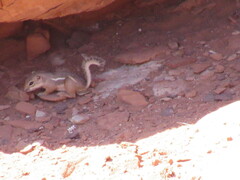
White-tailed Antelope Squirrel

White-tailed Antelope Squirrel

Ammospermophilus leucurus

Silhouette: Joseph Smit · PhyloPic

LCLeast ConcernNTVUENCR
Daily sighting probability ~20% · Possible
at Grand Canyon National Park

In 3 days ~50% in a week ~80%

59 Verified sightings at Grand Canyon National Park From 2019 to 2026
926 In all 7 parks
January Best month
☀️ Diurnal When it's spotted

About the White-tailed Antelope Squirrel

The white-tailed antelope squirrel (Ammospermophilus leucurus) is a diurnal species of ground squirrel, scientifically classified in the order Rodentia and family Sciuridae, found in arid regions of the southwestern United States and the Baja California Peninsula of northwestern Mexico.

The white-tailed antelope squirrel's geographical range extends north to south from southwestern Oregon to New Mexico, and east to west from western Colorado to Baja California, Mexico. This species of squirrel has an average home range of 14.9 acres (60,000 m2), and utilizes approximately 4 acres (16,000 m2) in its daily activities. Throughout much of the squirrel's range, especially in Utah, the population density fluctuates greatly, with periods of high density followed by periods of low density. Average population density also varies by season, with higher density in autumn relative to late spring.

The white-tailed antelope squirrel is commonly spotted in arid habitats throughout the southwestern United States. Throughout this range, A. leucurus is omnivorous, feeding primarily on foliage (10%-60% of its diet), seeds (20%-50... Wikipedia →

Global Distribution

Parks Where Found

# Park Country Daily sighting probability
1 Joshua Tree National Park 🇺🇸 United States
~70%
2 Death Valley National Park 🇺🇸 United States
~30%
3 El Vizcaíno Biosphere Reserve 🇲🇽 Mexico
~20%
4 Cabo Pulmo National Park 🇲🇽 Mexico
~20%
5 Grand Canyon National Park 🇺🇸 United States
~20%
6 Bahía de Loreto National Park 🇲🇽 Mexico
~10%
7 Zion National Park 🇺🇸 United States
~10%

Cities Where Found

# City Country Daily sighting probability
1 Las Vegas 🇺🇸 United States
~20%

Before you go

What are the chances of seeing a White-tailed Antelope Squirrel in Grand Canyon National Park?

Possible

About 20% of wildlife watchers report a White-tailed Antelope Squirrel sighting in Grand Canyon National Park on a given day, based on 59 verified sightings from GBIF citizen-science data from 2019 to 2026. It is the 8th most-seen of the 18 mammals we can rate there. Over three days the chance rises to about 50%, and over a week to about 80%, if each day is a fresh chance.

When is the best time to see a White-tailed Antelope Squirrel in Grand Canyon National Park?

January

In that month about 40% of wildlife watchers report a White-tailed Antelope Squirrel in Grand Canyon National Park on a given day, against about 10% in June and July, the lowest months. That is one of Grand Canyon National Park's wettest months, with about 35 mm of rain against almost none in June.

What time of day is best to see a White-tailed Antelope Squirrel?

Between 8 and 11 am

Across all the parks we cover, that three-hour window holds the most White-tailed Antelope Squirrel sightings with a recorded time, and about 9 in 10 of them come between 6 am and 6 pm: it is a daytime animal.

Which relatives of the White-tailed Antelope Squirrel live in Grand Canyon National Park?

Same family: Sciuridae

The closest relatives of the White-tailed Antelope Squirrel that you can see in Grand Canyon National Park (family Sciuridae, Squirrels) are Rock Squirrel (about 80%), Cliff Chipmunk (about 50%) and Abert's Squirrel (about 30%), with each one's daily chance of a sighting.

Where does the White-tailed Antelope Squirrel sighting chance come from?

GBIF citizen-science records

It is estimated from how often the White-tailed Antelope Squirrel is recorded against all the mammals logged in Grand Canyon National Park (59 verified sightings from 2019 to 2026), calibrated against known sighting rates. Figures are rounded to the nearest 10% because citizen-science data supports honest approximations, not decimals, and months with records from fewer than five people show "—". How it works.

← Back to Grand Canyon National Park