Douglas' Squirrel

Douglas' Squirrel

Tamiasciurus douglasii

Silhouette: PhyloPic

LCLeast ConcernNTVUENCR
Daily sighting probability ~10% · With luck
at Great Bear Rainforest

In 3 days ~20% in a week ~40%

9 Verified sightings at Great Bear Rainforest From 2019 to 2026
1,159 In all 5 parks
August Best month
☀️ Diurnal When it's spotted

About the Douglas' Squirrel

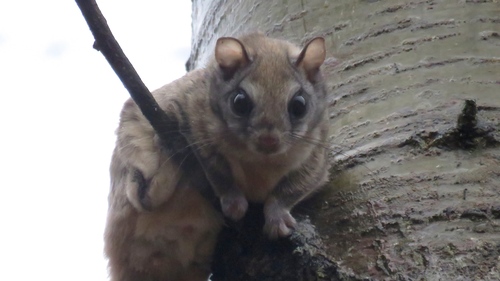
The Douglas squirrel (Tamiasciurus douglasii) is a pine squirrel found in western North America, from the Pacific Northwest (including the northwestern coastal states of the United States as well as the southwestern coast of British Columbia in Canada) to central California, with an isolated subspecies in northern Baja California, Mexico. It is sometimes known as the chickaree or pine squirrel, although these names are also used for the American red squirrel. Variant spellings of the common name are Douglas' squirrel and Douglas's squirrel. The Native Americans of Kings River called it the "Pillillooeet", in imitation of its characteristic alarm call.

John Muir described the Douglas squirrel as "by far the most interesting and influential of the California Sciuridæ". At full maturity, it is about 33 cm (13 in) in length (including its tail, which is about 13 cm (5 in) long), and weighs between 150 and 300 g (5.3 and 10.6 oz). Its appearance varies according to the season. In the summer, it is greyish or almost greenish-brown on its back, and pale orange on the chest and belly, while legs and feet appear brown. In the winter, the coat is browner and the underside... Wikipedia →

Sounds

Call1:04

United States · 2026

© Greg Irving · XC1104233 · CC BY-NC-SA 4.0

Alarm call0:28

United States · 2019

© Daan Drukker · XC959772 · CC BY-NC-ND 4.0

Call0:06

United States · 2026

© Ed Pandolfino · XC1147907 · CC BY-NC-SA 4.0

Global Distribution

Parks Where Found

# Park Country Daily sighting probability
1 Sequoia and Kings Canyon National Parks 🇺🇸 United States
~60%
2 Olympic National Park 🇺🇸 United States
~40%
3 Yosemite National Park 🇺🇸 United States
~40%
4 Redwood National Park 🇺🇸 United States
~30%
5 Great Bear Rainforest 🇨🇦 Canada
~10%

Cities Where Found

# City Country Daily sighting probability
1 Vancouver 🇨🇦 Canada
~30%
2 Portland 🇺🇸 United States
~20%
3 Seattle 🇺🇸 United States
~10%

Zoos & Centres Where Found

# Zoo / Centre Country
1 Point Defiance Zoo & Aquarium 🇺🇸 United States In captivity

Before you go

What are the chances of seeing a Douglas' Squirrel in Great Bear Rainforest?

With luck

About 10% of wildlife watchers report a Douglas' Squirrel sighting in Great Bear Rainforest on a given day, based on 9 verified sightings from GBIF citizen-science data from 2019 to 2026. It is the 23rd most-seen of the 35 mammals we can rate there. Over three days the chance rises to about 20%, and over a week to about 40%, if each day is a fresh chance.

When is the best time to see a Douglas' Squirrel in Great Bear Rainforest?

June to August

In those months about 10% of wildlife watchers report a Douglas' Squirrel in Great Bear Rainforest on a given day, against under 5% in September to May, the lowest months. Those are among Great Bear Rainforest's driest months, with about 150 mm of rain a month against 480 mm in November.

What time of day is best to see a Douglas' Squirrel?

Between 5 and 8 pm

Across all the parks we cover, that three-hour window holds the most Douglas' Squirrel sightings with a recorded time, and about 8 in 10 of them come between 6 am and 6 pm: it is a daytime animal.

Where does the Douglas' Squirrel sighting chance come from?

GBIF citizen-science records

It is estimated from how often the Douglas' Squirrel is recorded against all the mammals logged in Great Bear Rainforest (9 verified sightings from 2019 to 2026), calibrated against known sighting rates. Figures are rounded to the nearest 10% because citizen-science data supports honest approximations, not decimals, and months with records from fewer than five people show "—". How it works.

← Back to Great Bear Rainforest