Southern Brown Bandicoot

Southern Brown Bandicoot

Isoodon obesulus

Silhouette: Kawinwit Kittipalawattanapol · PhyloPic

LCLeast ConcernNTVUENCR Endemic
Daily sighting probability ~10% · With luck
at Great Otway National Park

In 3 days ~30% in a week ~50%

17 Verified sightings at Great Otway National Park From 2019 to 2026
152 In all 2 parks
July Best month
☀️ Diurnal When it's spotted

About the Southern Brown Bandicoot

The southern brown bandicoot (Isoodon obesulus) is a short-nosed bandicoot, a type of marsupial, found mostly in southern Australia. A subspecies in Western Australia is also known as the quenda in South Western Australia (from the Noongar word kwinda). This subspecies was elevated to species in 2018.

The species was first described as Didelphis obesula by George Shaw in 1797. There are three subspecies recognised by the Atlas of Living Australia: Isoodon obesulus affinus – Tasmania and Bass Strait Islands Isoodon obesulus nauticus – Restricted to the Nuyts Archipelago

Isoodon obesulus obesulus – NSW, Victoria, SA The quenda (Isoodon fusciventer) and the Cape York brown bandicoot (Isoodon peninsulae) were previously considered subspecies of the southern brown bandicoot before being elevated to full species status.

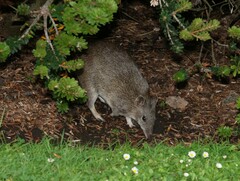
Southern brown bandicoots have a stocky body with a short snout and short, rounded ears. They show sexual dimorphism, with females being smaller than males. On average, males measure 50 cm (20 in) in total length, and weigh up to 1.2 kg (2.6 lb), while females measure 40 cm (16 in) and weigh no more than 1 kg (2.2 lb). They have coarse, bristly... Wikipedia →

Sounds

Recording0:08

Australia · 2024

© chicken-salt · iNaturalist · CC BY-NC 4.0

Global Distribution

Parks Where Found

# Park Country Daily sighting probability
1 Maria Island National Park 🇦🇺 Australia
~80%
2 Great Otway National Park 🇦🇺 Australia
~10%

Cities Where Found

# City Country Daily sighting probability
1 Hobart 🇦🇺 Australia
~10%

Zoos & Centres Where Found

# Zoo / Centre Country
1 East Coast Natureworld 🇦🇺 Australia In captivity

Before you go

What are the chances of seeing a Southern Brown Bandicoot in Great Otway National Park?

With luck

About 10% of wildlife watchers report a Southern Brown Bandicoot sighting in Great Otway National Park on a given day, based on 17 verified sightings from GBIF citizen-science data from 2019 to 2026. It is the 14th most-seen of the 30 mammals we can rate there. Over three days the chance rises to about 30%, and over a week to about 50%, if each day is a fresh chance.

When is the best time to see a Southern Brown Bandicoot in Great Otway National Park?

March–May and July

In those months about 20% of wildlife watchers report a Southern Brown Bandicoot in Great Otway National Park on a given day, against under 5% in June, September and November–February, the lowest months.

What time of day is best to see a Southern Brown Bandicoot?

Between noon and 3 pm

Across all the parks we cover, that three-hour window holds the most Southern Brown Bandicoot sightings with a recorded time, and about 9 in 10 of them come between 6 am and 6 pm: it is a daytime animal.

Is Great Otway National Park the best place to see a Southern Brown Bandicoot?

2nd of 2

Of the 2 parks where we can rate Southern Brown Bandicoot sightings, Great Otway National Park ranks 2nd at about 10%. The best odds are in Maria Island National Park (Australia, about 80%).

Where does the Southern Brown Bandicoot sighting chance come from?

GBIF citizen-science records

It is estimated from how often the Southern Brown Bandicoot is recorded against all the mammals logged in Great Otway National Park (17 verified sightings from 2019 to 2026), calibrated against known sighting rates. Figures are rounded to the nearest 10% because citizen-science data supports honest approximations, not decimals, and months with records from fewer than five people show "—". How it works.

← Back to Great Otway National Park
