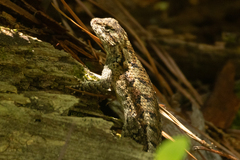
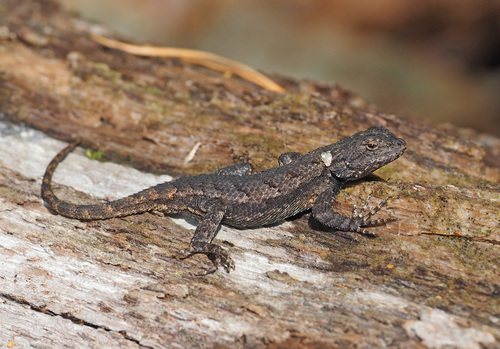
Eastern Fence Lizard

Eastern Fence Lizard

Sceloporus undulatus

Silhouette: SeismicShrimp · PhyloPic

LCLeast ConcernNTVUENCR Endemic
Daily sighting probability ~40% · Likely
at Great Smoky Mountains National Park

In 3 days ~70% in a week >90%

233 Verified sightings at Great Smoky Mountains National Park From 2019 to 2026
261 In all 2 parks
August Best month
☀️ Diurnal When it's spotted

About the Eastern Fence Lizard

The eastern fence lizard (Sceloporus undulatus) is a medium-sized species of lizard in the family Phrynosomatidae. The species is found along forest edges, rock piles, and rotting logs or stumps in the eastern United States. It is sometimes referred to as the fence swift, gray lizard, gravid lizard, northern fence lizard or pine lizard. It is also referred to colloquially as the horn-billed lizard. One of its most notable behaviors is that of its escape behavior when encountering fire ants, which have been known to invade and negatively affect many of their populations.

The generic name, Sceloporus, is derived from the Greek skelos/σκελος, meaning "leg", and the Latin porus, meaning "hole", referring to the enlarged femoral pores found in this genus of lizards. The specific name, undulatus, is Latin for "wave", referring to the transverse dark crossbars on the backs of these lizards.

Until 2002, 10 subspecies of S. undulatus were recognized, but re-evaluation showed paraphyly between the subspecies. These were reclassified as four distinct evolutionary species (the three new species being S. consobrinus, S. tristichus, and S. cowlesi). The narrowed redefinition of... Wikipedia →
Global Distribution

Parks Where Found

# Park Country Daily sighting probability
1 Great Smoky Mountains National Park 🇺🇸 United States
~40%
2 Shenandoah National Park 🇺🇸 United States
~20%

Cities Where Found

# City Country Daily sighting probability
1 Washington 🇺🇸 United States
<5%

Zoos & Centres Where Found

# Zoo / Centre Country
1 Cincinnati Zoo and Botanical Garden 🇺🇸 United States In captivity
2 North Carolina Zoo 🇺🇸 United States In captivity
3 Fort Worth Zoo 🇺🇸 United States In captivity

Closest Relatives at Great Smoky Mountains National Park

No species of the same family or order lives in Great Smoky Mountains National Park, so these are its closest relatives here: other reptiles.

Before you go

What are the chances of seeing an Eastern Fence Lizard in Great Smoky Mountains National Park?

Likely

About 40% of wildlife watchers report an Eastern Fence Lizard sighting in Great Smoky Mountains National Park on a given day, based on 233 verified sightings from GBIF citizen-science data from 2019 to 2026. It is the 4th most-seen of the 27 reptiles we can rate there. Over three days the chance rises to about 70%, and over a week to over 90%, if each day is a fresh chance.

When is the best time to see an Eastern Fence Lizard in Great Smoky Mountains National Park?

August

In that month about 50% of wildlife watchers report an Eastern Fence Lizard in Great Smoky Mountains National Park on a given day, against under 5% in November to February, the lowest months.

What time of day is best to see an Eastern Fence Lizard?

Between 11 am and 2 pm

Across all the parks we cover, that three-hour window holds the most Eastern Fence Lizard sightings with a recorded time, and about 9 in 10 of them come between 6 am and 6 pm: it is a daytime animal.

Is Great Smoky Mountains National Park the best place to see an Eastern Fence Lizard?

Yes

Of the 2 parks where we can rate Eastern Fence Lizard sightings, Great Smoky Mountains National Park has the highest daily chance: about 40%. Next come Shenandoah National Park (United States, about 20%).

Where does the Eastern Fence Lizard sighting chance come from?

GBIF citizen-science records

It is estimated from how often the Eastern Fence Lizard is recorded against all the reptiles logged in Great Smoky Mountains National Park (233 verified sightings from 2019 to 2026), calibrated against known sighting rates. Figures are rounded to the nearest 10% because citizen-science data supports honest approximations, not decimals, and months with records from fewer than five people show "—". How it works.

← Back to Great Smoky Mountains National Park