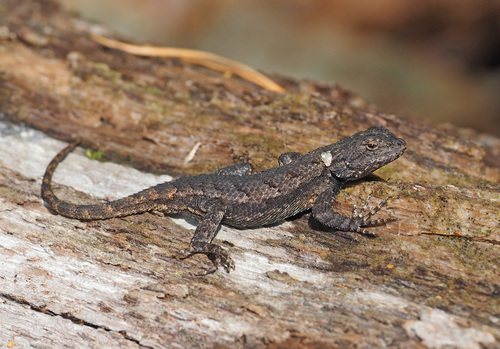
Eastern Copperhead

Eastern Copperhead

Agkistrodon contortrix

Silhouette: Steven Traver · PhyloPic

LCLeast ConcernNTVUENCR Endemic
Daily sighting probability ~30% · Possible
at Great Smoky Mountains National Park

In 3 days ~70% in a week ~90%

180 Verified sightings at Great Smoky Mountains National Park From 2019 to 2026
373 In all 3 parks
July Best month
☀️🌙 Day & Night When it's spotted

About the Eastern Copperhead

The eastern copperhead (Agkistrodon contortrix), also known simply as the copperhead, is a widespread species of venomous snake, a pit viper, endemic to eastern United States of America; it is a member of the subfamily Crotalinae in the family Viperidae.

The eastern copperhead has distinctive, dark brown, hourglass-shaped markings, overlaid on a light reddish brown or brown/gray background. The body type is heavy, rather than slender. Neonates are born with green or yellow tail tips, which progress to a darker brown or black within one year. Adults grow to a typical length (including tail) of 50–95 cm (20–37 in).

In most of the United States of America, the eastern copperhead favors deciduous forest and mixed woodlands. It may occupy rock outcroppings and ledges, but is also found in low-lying, swampy regions. During the winter, it hibernates in dens or limestone crevices, often together with timber rattlesnakes and black rat snakes. The eastern copperhead is known to feed on a wide variety of prey, including invertebrates (primarily arthropods) and vertebrates. Like most pit vipers, the eastern copperhead is generally an ambush predator; it takes up a promising position and waits for suitable prey to arrive.

As a common species within its range, it may be encountered by humans. Unlike other viperids, it often "freezes" instead of slithering away and fleeing, due to its habit of relying on excellent camouflage. Bites occur due to people unknowingly stepping on or near them. Copperhead bites account for half of the treated snake bites in the United States.

Five subspecies have been recognized in the past, but recent genetic analysis has yielded new species information. Wikipedia →

Global Distribution

Parks Where Found

# Park Country Daily sighting probability
1 Shenandoah National Park 🇺🇸 United States
~40%
2 Congaree National Park 🇺🇸 United States
~30%
3 Great Smoky Mountains National Park 🇺🇸 United States
~30%

Cities Where Found

# City Country Daily sighting probability
1 Dallas 🇺🇸 United States
~10%
2 Washington 🇺🇸 United States
~10%
3 Houston 🇺🇸 United States
~10%

Zoos & Centres Where Found

# Zoo / Centre Country
1 Busch Gardens Tampa 🇺🇸 United States In captivity
2 Moscow Zoo 🇷🇺 Russia In captivity
3 National Zoological Park 🇺🇸 United States In captivity
4 Cincinnati Zoo and Botanical Garden 🇺🇸 United States In captivity
5 California Academy of Sciences 🇺🇸 United States In captivity
6 North Carolina Zoo 🇺🇸 United States In captivity
7 Greensboro Science Center 🇺🇸 United States In captivity
8 Columbus Zoo and Aquarium 🇺🇸 United States In captivity
9 Baton Rouge Zoo 🇺🇸 United States In captivity
10 Sedgwick County Zoo 🇺🇸 United States In captivity
11 Milwaukee County Zoo 🇺🇸 United States In captivity
12 Jacksonville Zoo and Gardens 🇺🇸 United States In captivity
13 Central Florida Zoo and Botanical Gardens 🇺🇸 United States In captivity
14 Louisville Zoo 🇺🇸 United States In captivity
15 Audubon Zoo 🇺🇸 United States In captivity
16 Oklahoma City Zoo and Botanical Garden 🇺🇸 United States In captivity
17 West Virginia State Wildlife Center 🇺🇸 United States In captivity
18 Dickerson Park Zoo 🇺🇸 United States In captivity
19 Indianapolis Zoo 🇺🇸 United States In captivity
20 Zoo Knoxville 🇺🇸 United States In captivity
21 Memphis Zoo 🇺🇸 United States In captivity
22 Houston Zoo 🇺🇸 United States In captivity
23 Claws 'N' Paws Wild Animal Park 🇺🇸 United States In captivity
24 Zoo Aquarium de Madrid 🇪🇸 Spain In captivity
25 Zoo Atlanta 🇺🇸 United States In captivity
26 Budapest Zoo & Botanical Garden 🇭🇺 Hungary In captivity
27 Pittsburgh Zoo & Aquarium 🇺🇸 United States In captivity
28 Riverbanks Zoo 🇺🇸 United States In captivity
29 Little Rock Zoo 🇺🇸 United States In captivity
30 Western North Carolina Nature Center 🇺🇸 United States In captivity
31 North Carolina Aquarium at Fort Fisher 🇺🇸 United States In captivity
32 Reptile Gardens 🇺🇸 United States In captivity
33 Chattanooga Zoo at Warner Park 🇺🇸 United States In captivity
34 Greenville Zoo 🇺🇸 United States In captivity
35 Adventure Aquarium 🇺🇸 United States In captivity
36 Blue Hills Trailside Museum Habitats 🇺🇸 United States In captivity
37 Wonders of Wildlife Museum & Aquarium 🇺🇸 United States In captivity
38 North Carolina Aquarium at Pine Knoll Shores 🇺🇸 United States In captivity
39 North Carolina Aquarium on Roanoke Island 🇺🇸 United States In captivity
40 South Carolina Aquarium 🇺🇸 United States In captivity
41 Children's Aquarium at Fair Park 🇺🇸 United States In captivity
42 UGA Marine Education Center and Aquarium 🇺🇸 United States In captivity
43 Glen Echo Park Aquarium 🇺🇸 United States In captivity
44 Città della Domenica 🇮🇹 Italy In captivity
45 Edisto Island Serpentarium 🇺🇸 United States In captivity
46 Maymont Farm 🇺🇸 United States In captivity
47 Museum of Life and Science 🇺🇸 United States In captivity
48 Reptilandia 🇺🇸 United States In captivity

Before you go

What are the chances of seeing an Eastern Copperhead in Great Smoky Mountains National Park?

Possible

About 30% of wildlife watchers report an Eastern Copperhead sighting in Great Smoky Mountains National Park on a given day, based on 180 verified sightings from GBIF citizen-science data from 2019 to 2026. It is the 8th most-seen of the 27 reptiles we can rate there. Over three days the chance rises to about 70%, and over a week to about 90%, if each day is a fresh chance.

When is the best time to see an Eastern Copperhead in Great Smoky Mountains National Park?

July

In that month about 50% of wildlife watchers report an Eastern Copperhead in Great Smoky Mountains National Park on a given day, against under 5% in November to February, the lowest months.

What time of day is best to see an Eastern Copperhead?

Between 7 and 10 pm

Across all the parks we cover, that three-hour window holds the most Eastern Copperhead sightings with a recorded time, and about 6 in 10 of them come between 6 am and 6 pm: it is seen both by day and at night.

Is Great Smoky Mountains National Park the best place to see an Eastern Copperhead?

3rd of 3

Of the 3 parks where we can rate Eastern Copperhead sightings, Great Smoky Mountains National Park ranks 3rd at about 30%. The best odds are in Shenandoah National Park (United States, about 40%) and Congaree National Park (United States, about 30%).

Where does the Eastern Copperhead sighting chance come from?

GBIF citizen-science records

It is estimated from how often the Eastern Copperhead is recorded against all the reptiles logged in Great Smoky Mountains National Park (180 verified sightings from 2019 to 2026), calibrated against known sighting rates. Figures are rounded to the nearest 10% because citizen-science data supports honest approximations, not decimals, and months with records from fewer than five people show "—". How it works.

← Back to Great Smoky Mountains National Park