
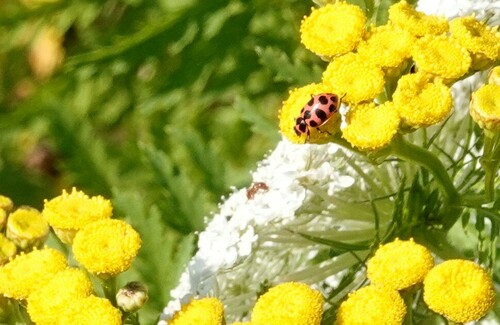

Short-Winged Blister Beetle

Short-Winged Blister Beetle

Meloe angusticollis

Daily sighting probability <5% · Rare
at Great Smoky Mountains National Park

In 3 days ~10% in a week ~20%

6 Verified sightings at Great Smoky Mountains National Park From 2019 to 2026
6 In 1 park
April Best month
☀️ Diurnal When it's spotted

About the Short-Winged Blister Beetle

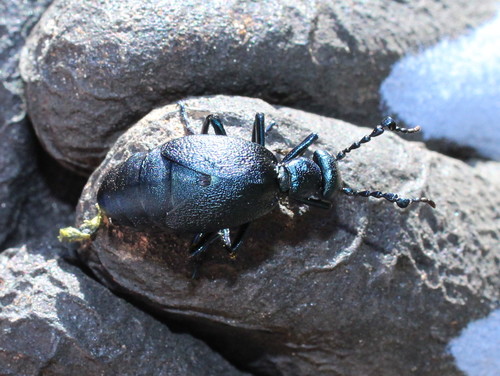
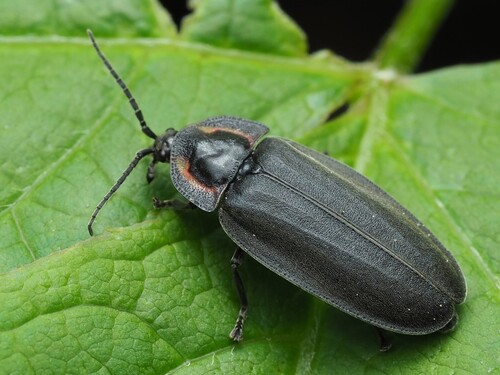
Meloe angusticollis, commonly known as the short-winged blister beetle or oil beetle, is a species of blister beetle, native to North America. They average 9-19 mm (0.35-0.75 inches) in length — females are much larger than males. When disturbed the adult releases oily droplets of hemolymph from its body to repel potential predators, which may cause blistering on human skin.

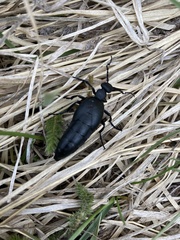
Meloe angusticollis is black or metallic blue. Extremely short and sparse setae matching integument color. Head is moderately to densely punctate. Pronotum is moderately to densely punctate; scutellum conically produced. Elytra are short, not reaching end of abdomen. Legs each have an outer metathoracic tibial spur with apical portion produced anteriorly.

The moderate to dense punctation on the head and pronotun, and the presence of a conically produced scutellum readily distinguishes M. angusticollis from the other Meloe species. Blister beetles release a toxic secretion called cantharidin, which causes skin blisters and deters predators. Cantharidin is highly toxic to humans, with just 100 milligrams being potentially fatal if ingested. Historically used in medicine as the aphrodisiac Spanish... Wikipedia →

Global Distribution

Parks Where Found

# Park Country Daily sighting probability
1 Great Smoky Mountains National Park 🇺🇸 United States
<5%

More parks will be added in future updates.

Before you go

What are the chances of seeing a Short-Winged Blister Beetle in Great Smoky Mountains National Park?

Rare

Under 5% of wildlife watchers report a Short-Winged Blister Beetle sighting in Great Smoky Mountains National Park on a given day, based on 6 verified sightings from GBIF citizen-science data from 2019 to 2026. It is the 628th most-seen of the 822 insects we can rate there. Over three days the chance rises to about 10%, and over a week to about 20%, if each day is a fresh chance.

When is the best time to see a Short-Winged Blister Beetle in Great Smoky Mountains National Park?

April and May

In those months about 10% of wildlife watchers report a Short-Winged Blister Beetle in Great Smoky Mountains National Park on a given day, against under 5% in June to March, the lowest months.

What time of day is best to see a Short-Winged Blister Beetle?

Between noon and 3 pm

Across all the parks we cover, that three-hour window holds the most Short-Winged Blister Beetle sightings with a recorded time, and about 8 in 10 of them come between 6 am and 6 pm: it is a daytime animal.

Where else can you see a Short-Winged Blister Beetle?

Only Great Smoky Mountains National Park, in our data

Great Smoky Mountains National Park is the only park on Wallace's Line with enough records to rate Short-Winged Blister Beetle sightings: under 5% of wildlife watchers there report one on a given day.

Where does the Short-Winged Blister Beetle sighting chance come from?

GBIF citizen-science records

It is estimated from how often the Short-Winged Blister Beetle is recorded against all the insects logged in Great Smoky Mountains National Park (6 verified sightings from 2019 to 2026), calibrated against known sighting rates. Figures are rounded to the nearest 10% because citizen-science data supports honest approximations, not decimals, and months with records from fewer than five people show "—". How it works.

← Back to Great Smoky Mountains National Park