





Eastern Eyed Click Beetle

Eastern Eyed Click Beetle

Alaus oculatus

Daily sighting probability ~20% · Possible
at Great Smoky Mountains National Park

In 3 days ~40% in a week ~70%

99 Verified sightings at Great Smoky Mountains National Park From 2019 to 2026
240 In all 6 parks
June Best month
☀️ Diurnal When it's spotted

About the Eastern Eyed Click Beetle

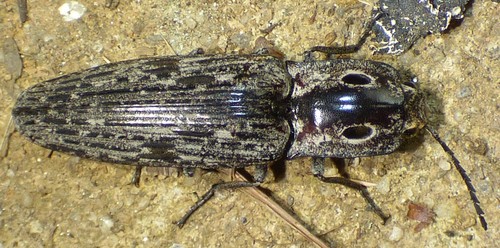
Alaus oculatus, commonly called the eastern eyed click beetle or eyed elater, is a species of click beetle. Alaus oculatus can reach a length of about 25–45 millimetres (1.0–1.8 in). They have an elongated body, black in color throughout. The pronotum exhibits a large oval patch of darker scales, framed in white, on each side - the common name of the beetle derives from this feature. The elytra are striated and mottled with silvery whitish scales. The depiction of a large pair of eyes on the pronotum is a defensive adaptation that has evolved because of its advantage in confusing or frightening potential predators. These “eyespots” are a form of self-mimicry, in which one part of the body has adapted to mimic another body part. Like all click beetles, A. oculatus is also capable of suddenly catapulting itself out of danger by releasing the energy stored by a click mechanism, which consists of a stout spine on the prosternum and a matching groove in the mesosternum.

Eggs are laid in soil or on standing deadwood. Many larvae from the click beetle family Elateridae are commonly referred to as wireworms and are prominent agricultural pests that feast on... Wikipedia →

Global Distribution

Parks Where Found

# Park Country Daily sighting probability
1 Congaree National Park 🇺🇸 United States
~20%
2 Shenandoah National Park 🇺🇸 United States
~20%
3 Great Smoky Mountains National Park 🇺🇸 United States
~20%
4 Point Pelee National Park 🇨🇦 Canada
~10%
5 Merritt Island National Wildlife Refuge 🇺🇸 United States
<5%
6 Everglades National Park 🇺🇸 United States
<5%

Cities Where Found

# City Country Daily sighting probability
1 Baltimore 🇺🇸 United States
~10%
2 Washington 🇺🇸 United States
~10%
3 Philadelphia 🇺🇸 United States
~10%
4 Orlando 🇺🇸 United States
~10%
5 Toronto 🇨🇦 Canada
~10%
6 New York City 🇺🇸 United States
~10%
7 Montreal 🇨🇦 Canada
<5%
8 Minneapolis [Saint Paul] 🇺🇸 United States
<5%
9 Boston 🇺🇸 United States
<5%
10 Chicago 🇺🇸 United States
<5%

Before you go

What are the chances of seeing an Eastern Eyed Click Beetle in Great Smoky Mountains National Park?

Possible

About 20% of wildlife watchers report an Eastern Eyed Click Beetle sighting in Great Smoky Mountains National Park on a given day, based on 99 verified sightings from GBIF citizen-science data from 2019 to 2026. It is the 45th most-seen of the 822 insects we can rate there. Over three days the chance rises to about 40%, and over a week to about 70%, if each day is a fresh chance.

When is the best time to see an Eastern Eyed Click Beetle in Great Smoky Mountains National Park?

June

In that month about 30% of wildlife watchers report an Eastern Eyed Click Beetle in Great Smoky Mountains National Park on a given day, against under 5% in August–September and November–February, the lowest months.

What time of day is best to see an Eastern Eyed Click Beetle?

Between 1 and 4 pm

Across all the parks we cover, that three-hour window holds the most Eastern Eyed Click Beetle sightings with a recorded time, and about 9 in 10 of them come between 6 am and 6 pm: it is a daytime animal.

Is Great Smoky Mountains National Park the best place to see an Eastern Eyed Click Beetle?

Among the best

Of the 6 parks where we can rate Eastern Eyed Click Beetle sightings, Great Smoky Mountains National Park ranks 3rd at about 20%, level with the leaders once rounded. The best odds are in Congaree National Park (United States, about 20%) and Shenandoah National Park (United States, about 20%).

Where does the Eastern Eyed Click Beetle sighting chance come from?

GBIF citizen-science records

It is estimated from how often the Eastern Eyed Click Beetle is recorded against all the insects logged in Great Smoky Mountains National Park (99 verified sightings from 2019 to 2026), calibrated against known sighting rates. Figures are rounded to the nearest 10% because citizen-science data supports honest approximations, not decimals, and months with records from fewer than five people show "—". How it works.

← Back to Great Smoky Mountains National Park