
Masked Shrew

Masked Shrew

Sorex cinereus

Silhouette: Becky Barnes · PhyloPic

LCLeast ConcernNTVUENCR
Daily sighting probability ~10% · With luck
at Gros Morne National Park

In 3 days ~30% in a week ~60%

6 Verified sightings at Gros Morne National Park From 2019 to 2026
6 In 1 park
October Best month
☀️ Diurnal When it's spotted

About the Masked Shrew

The cinereus shrew or masked shrew (Sorex cinereus) is a small shrew found in Alaska, Canada, and the northern United States. This is the most widely distributed shrew in North America, where it is also known as the common shrew.

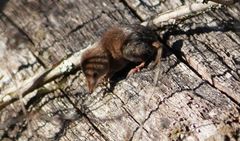
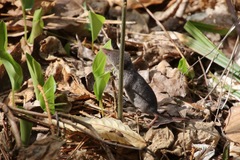
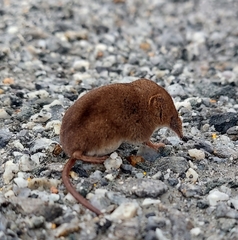
It is grey-brown in colour with a light grey underside and a pointed snout. It has a long tail that is brown on top and pale underneath with a dark tip. Its body is about 9 cm (3.5 in) in length including a 4 cm (1.6 in) long tail. It weighs about 5 g (0.18 oz). It has darker colouring than other shrews. Masked shrews can live up to two years, but, on average, only survive eighteen months.

In a long-term study done in Alaska, Yom-Tov and colleagues (2005) found that the masked shrew's body size contradicts Bergmann's rule. The study, done on 650 specimens and spanning from 1950 to 2003, examined body size in relation to ambient temperature. Measurements of body weight and the length of the tail, ear, hind foot, and body were taken. Results yielded that the masked shrew's body size decreased with high latitudes and with lower mean January temperatures, a trend that opposed Bergmann's Rule. It was suggested that this may be a coping mechanism... Wikipedia →

Global Distribution

Parks Where Found

# Park Country Daily sighting probability
1 Gros Morne National Park 🇨🇦 Canada
~10%

More parks will be added in future updates.

Cities Where Found

# City Country Daily sighting probability
1 Edmonton 🇨🇦 Canada
<5%
2 Chicago 🇺🇸 United States
<5%
3 Vancouver 🇨🇦 Canada
<5%

Before you go

What are the chances of seeing a Masked Shrew in Gros Morne National Park?

With luck

About 10% of wildlife watchers report a Masked Shrew sighting in Gros Morne National Park on a given day, based on 6 verified sightings from GBIF citizen-science data from 2019 to 2026. It is the 14th most-seen of the 16 mammals we can rate there. Over three days the chance rises to about 30%, and over a week to about 60%, if each day is a fresh chance.

When is the best time to see a Masked Shrew in Gros Morne National Park?

October

In that month about 30% of wildlife watchers report a Masked Shrew in Gros Morne National Park on a given day, against under 5% in September and November–May, the lowest months.

What time of day is best to see a Masked Shrew?

Between 11 am and 2 pm

Across all the parks we cover, that three-hour window holds the most Masked Shrew sightings with a recorded time, and about 9 in 10 of them come between 6 am and 6 pm: it is a daytime animal.

Where else can you see a Masked Shrew?

Only Gros Morne National Park, in our data

Gros Morne National Park is the only park on Wallace's Line with enough records to rate Masked Shrew sightings: about 10% of wildlife watchers there report one on a given day.

Where does the Masked Shrew sighting chance come from?

GBIF citizen-science records

It is estimated from how often the Masked Shrew is recorded against all the mammals logged in Gros Morne National Park (6 verified sightings from 2019 to 2026), calibrated against known sighting rates. Figures are rounded to the nearest 10% because citizen-science data supports honest approximations, not decimals, and months with records from fewer than five people show "—". How it works.

← Back to Gros Morne National Park