Asian Sunbeam Snake

Asian Sunbeam Snake

Xenopeltis unicolor

Silhouette: SeismicShrimp · PhyloPic

LCLeast ConcernNTVUENCR
Daily sighting probability ~10% · With luck
at Gunung Leuser National Park

In 3 days ~40% in a week ~70%

6 Verified sightings at Gunung Leuser National Park From 2019 to 2026
30 In all 4 parks
January Best month
🌅 Crepuscular When it's spotted

About the Asian Sunbeam Snake

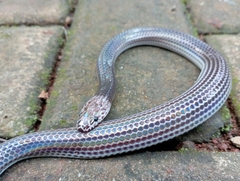
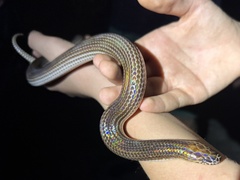
Xenopeltis unicolor, commonly known as the sunbeam snake, common sunbeam snake or iridescent snake, is a non-venomous sunbeam snake species found in Southeast Asia and some regions of Indonesia. This is a primitive snake known for both its highly iridescent scales and its ability to reproduce quickly, as it is oviparous and as such can lay up to 10 eggs at a time. No subspecies are currently recognized.

Grows to an average of about 1 m (3 ft 3 in). The color is reddish brown, brown or blackish with an unpatterned withish-grey venter. A fossorial species, the head is wedge-shaped and narrow with little neck delineation, which makes it easy to push through the soil. Its most defining characteristic is its iridescent, highly polished scales that give this snake its common name. They have a layer of dark pigmentation just below the surface on each scale that enhances the iridescence. The young look very similar to the adults, except that they have a strong white "collar" of scales evident just below the head. This coloration fades within the first year. They have two cone opsins allowing for the potential of dichromatic color vision.

Xenopeltis unicolor has two postocular... Wikipedia →

Global Distribution

Parks Where Found

# Park Country Daily sighting probability
1 Khao Sok National Park 🇹🇭 Thailand
~20%
2 Gunung Leuser National Park 🇮🇩 Indonesia
~10%
3 Cat Tien National Park 🇻🇳 Vietnam
~10%
4 Kinabalu Park 🇲🇾 Malaysia
~10%

Cities Where Found

# City Country Daily sighting probability
1 Denpasar 🇮🇩 Indonesia
~20%
2 Ho Chi Minh City 🇻🇳 Vietnam
~20%
3 Jakarta 🇮🇩 Indonesia
~10%
4 Bangkok 🇹🇭 Thailand
~10%
5 Singapore 🇸🇬 Singapore
<5%

Zoos & Centres Where Found

# Zoo / Centre Country
1 Siam Serpentarium 🇹🇭 Thailand In captivity
2 Snake Farm of Queen Saovabha Memorial Institute 🇹🇭 Thailand In captivity

Closest Relatives at Gunung Leuser National Park

No species of the same family or order lives in Gunung Leuser National Park, so these are its closest relatives here: other reptiles.

Before you go

What are the chances of seeing an Asian Sunbeam Snake in Gunung Leuser National Park?

With luck

About 10% of wildlife watchers report an Asian Sunbeam Snake sighting in Gunung Leuser National Park on a given day, based on 6 verified sightings from GBIF citizen-science data from 2019 to 2026. It is the 33rd most-seen of the 47 reptiles we can rate there. Over three days the chance rises to about 40%, and over a week to about 70%, if each day is a fresh chance.

When is the best time to see an Asian Sunbeam Snake in Gunung Leuser National Park?

January, August and November

In those months about 30% of wildlife watchers report an Asian Sunbeam Snake in Gunung Leuser National Park on a given day, against under 5% in February, May–July, September–October and December, the lowest months.

What time of day is best to see an Asian Sunbeam Snake?

Between 2 and 5 pm

Across all the parks we cover, that three-hour window holds the most Asian Sunbeam Snake sightings with a recorded time, and about 6 in 10 of them come between 6 am and 6 pm: it is most active around dawn and dusk.

Is Gunung Leuser National Park the best place to see an Asian Sunbeam Snake?

2nd of 4

Of the 4 parks where we can rate Asian Sunbeam Snake sightings, Gunung Leuser National Park ranks 2nd at about 10%. The best odds are in Khao Sok National Park (Thailand, about 20%).

Where does the Asian Sunbeam Snake sighting chance come from?

GBIF citizen-science records

It is estimated from how often the Asian Sunbeam Snake is recorded against all the reptiles logged in Gunung Leuser National Park (6 verified sightings from 2019 to 2026), calibrated against known sighting rates. Figures are rounded to the nearest 10% because citizen-science data supports honest approximations, not decimals, and months with records from fewer than five people show "—". How it works.

← Back to Gunung Leuser National Park