About the Chestnut-rumped Thornbill
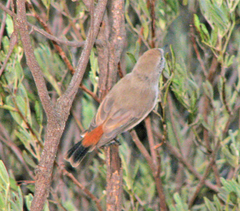
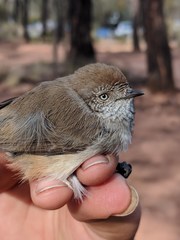
The chestnut-rumped thornbill (Acanthiza uropygialis) is a small passerine bird in the family Acanthizidae, endemic to Australia. Specially named for its pale-chestnut rump from mediaeval Latin uropygium, the rump. Its other names include chestnut-tailed or chestnut-backed thornbill, tit or tit-warbler, chestnut-rumped tit or tit-warbler.
A plain, pale thornbill, with pale eyes, it is widespread throughout inland Australia, west of the Great Dividing Range to the West Australian coast but is absent in the far north and humid southwest Western Australia. It is a cooperative breeder like some of the other thornbills
Described and classified by John Gould in 1838 in Synopsis of Birds of Australia, from a specimen collected in Liverpool Plains NSW. Type, male, No17602 (525) is in the Academy of Natural Sciences, Philadelphia, United States. A specimen from the Gould collection is in the British Museum.
Mathews (1912) recognised a number of different subspecies of Acanthiza Uropygialis: A.u.ruthergleni, mellori, augusta, nea, murchisoni and condora, with A.u.kycheringi added in 1922. Campbell (1925) added subspecies Geobasilus uropygialis moora and G.u. erema... Wikipedia →