'Oma'o

'Oma'o

Myadestes obscurus

LCNTNear ThreatenedVUENCR Endemic
Daily sighting probability ~50% · Likely
at Hawaii Volcanoes National Park

In 3 days ~90% in a week >90%

464 Verified sightings at Hawaii Volcanoes National Park From 2019 to 2026
464 In 1 park
October Best month
☀️ Diurnal When it's spotted

About the 'Oma'o

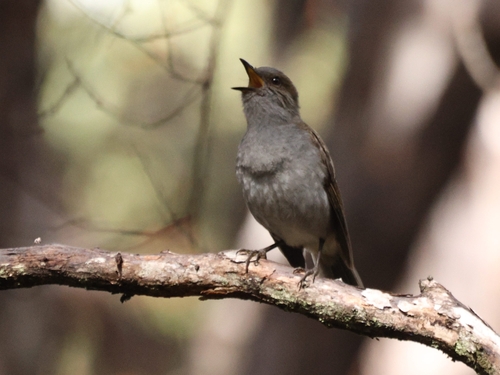
The ʻōmaʻo (Myadestes obscurus), also called the Hawaiian thrush, is an endemic species of robin-like bird found only on the island of Hawaii. ʻŌmaʻo are closely related to the other endemic thrushes of the Hawaiian Islands, the kāmaʻo, the olomaʻo, and the puaiohi. ʻŌmaʻo are found primarily in rainforests in the eastern and southeastern regions of the Big Island. Population estimates approximate 170,000 birds, making it the most common of the Hawaiian thrushes. It appears to have a stable population, but because the entire population exists on a small range and is endemic to a single island, it is considered near threatened.

The ʻōmaʻo was formally described in 1789 by the German naturalist Johann Friedrich Gmelin in his revised and expanded edition of Carl Linnaeus's Systema Naturae. He placed it with the flycatchers in the genus Muscicapa and coined the binomial name Muscicapa obscura. The specific epithet is from Latin and means "dark" or "dusky". Gmelin based his account on the "Dusky fly-catcher" that had been described in 1783 by the English ornithologist John Latham in his book A General Synopsis of Birds. Latham had examined a specimen from the "Sandwich Islands...
Wikipedia →

Sounds

Uncertain0:21

United States · 2023

© Viral joshi · XC794968 · CC BY-NC-SA 4.0

Song0:07

United States · 2017

© Paul Buckley · XC359187 · CC BY-NC-SA 4.0

Call0:28

United States · 2011

© Ryan P. O'Donnell · XC91475 · CC BY-NC-ND 2.5

Global Distribution

Parks Where Found

# Park Country Daily sighting probability
1 Hawaii Volcanoes National Park 🇺🇸 United States
~50%

More parks will be added in future updates.

Before you go

What are the chances of seeing a 'Oma'o in Hawaii Volcanoes National Park?

Likely

About 50% of wildlife watchers report a 'Oma'o sighting in Hawaii Volcanoes National Park on a given day, based on 464 verified sightings from GBIF citizen-science data from 2019 to 2026. It is the 7th most-seen of the 29 birds we can rate there. Over three days the chance rises to about 90%, and over a week to over 90%, if each day is a fresh chance.

When is the best time to see a 'Oma'o in Hawaii Volcanoes National Park?

October

In that month about 70% of wildlife watchers report a 'Oma'o in Hawaii Volcanoes National Park on a given day, against about 50% in February–April, June–September and November, the lowest months.

What time of day is best to see a 'Oma'o?

Between 10 am and 1 pm

Across all the parks we cover, that three-hour window holds the most 'Oma'o sightings with a recorded time, and about 9 in 10 of them come between 6 am and 6 pm: it is a daytime animal.

Where else can you see a 'Oma'o?

Only Hawaii Volcanoes National Park, in our data

Hawaii Volcanoes National Park is the only park on Wallace's Line with enough records to rate 'Oma'o sightings: about 50% of wildlife watchers there report one on a given day.

Which relatives of the 'Oma'o live in Hawaii Volcanoes National Park?

Same order: Passeriformes

The closest relatives of the 'Oma'o that you can see in Hawaii Volcanoes National Park (order Passeriformes, Perching Birds) are ʻApapane (over 90%), Warbling White-eye (about 90%) and Hawaii 'Amakihi (about 70%), with each one's daily chance of a sighting.

Where does the 'Oma'o sighting chance come from?

GBIF citizen-science records

It is estimated from how often the 'Oma'o is recorded against all the birds logged in Hawaii Volcanoes National Park (464 verified sightings from 2019 to 2026), calibrated against known sighting rates. Figures are rounded to the nearest 10% because citizen-science data supports honest approximations, not decimals, and months with records from fewer than five people show "—". How it works.

← Back to Hawaii Volcanoes National Park

