


Completed

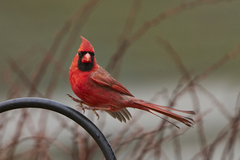

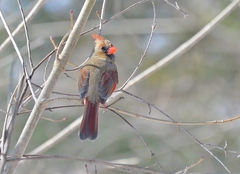

Northern Cardinal
Cardinalis cardinalis
Silhouette: Scott Hartman · PhyloPic
- KingdomAnimalia (Animals)
- PhylumChordata (Chordates)
- ClassAves (Birds)
- OrderPasseriformes (Perching Birds)
- FamilyCardinalidae (Cardinals and Allies)
- GenusCardinalis (Typical Cardinals)
- SpeciesCardinalis cardinalis (Northern Cardinal)
In 3 days >90%
507 Verified sightings at Hawaii Volcanoes National Park From 2019 to 2026
56,575 In all 24 parks
May Best month
☀️ Diurnal When it's spotted
About the Northern Cardinal
The northern cardinal (Cardinalis cardinalis), also commonly known as the common cardinal, red cardinal, or simply cardinal, is a bird in the genus Cardinalis. It can be found in southeastern Canada, through the eastern United States from Maine to Minnesota to Texas, New Mexico, southern Arizona, southern California and south through Mexico, Belize, and Guatemala. It is also an introduced species in a few locations such as Bermuda and all major islands of Hawaii since its introduction in 1929. Its habitat includes woodlands, gardens, shrublands, and wetlands. It is the state bird of Illinois, Indiana, Kentucky, North Carolina, Ohio, Virginia, and West Virginia.
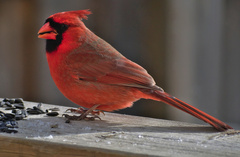
The northern cardinal is a mid-sized perching songbird with a body length of 21–23 cm (8.3–9.1 in) and a crest on the top of its head. The species expresses sexual dimorphism: Females are a reddish olive color, and have a gray mask around the beak, while males are a vibrant red color, and have a black mask on the face, as well as a larger crest. Juvenile cardinals do not have the distinctive red-orange beak seen in adult birds until they are almost fully mature. On hatching, their beaks are grayish-black and they do not become the typical orange-red color until they acquire their final adult plumage in the fall.
The northern cardinal is mainly granivorous but also feeds on insects and fruit. The male behaves territorially, marking out his territory with song. During courtship, the male feeds seed to the female beak-to-beak. The northern cardinal's clutch typically contains three to four eggs, with two to four clutches produced each year. It was once prized as a pet, but its sale was banned in the United States by the Migratory Bird Treaty Act of 1918.
Recent sightings of Northern Cardinal in Hawaii Volcanoes National Park
LIVEiNaturalistGlobal Distribution
Parks Where Found
Cities Where Found
| # | City | Country | Daily sighting probability |
|---|---|---|---|
| 1 | Washington | 🇺🇸 United States | |
| 2 | San Antonio | 🇺🇸 United States | |
| 3 | Philadelphia | 🇺🇸 United States | |
| 4 | Orlando | 🇺🇸 United States | |
| 5 | Houston | 🇺🇸 United States | |
| 6 | Montreal | 🇨🇦 Canada | |
| 7 | Austin | 🇺🇸 United States | |
| 8 | Toronto | 🇨🇦 Canada | |
| 9 | Baltimore | 🇺🇸 United States | |
| 10 | Dallas | 🇺🇸 United States |
Zoos & Centres Where Found
| # | Zoo / Centre | Country | |
|---|---|---|---|
| 1 | San Diego Zoo | 🇺🇸 United States | |
| 2 | Barcelona Zoo | 🇪🇸 Spain | |
| 3 | Columbus Zoo and Aquarium | 🇺🇸 United States | |
| 4 | Parque Zoológico de León - Zooleón | 🇲🇽 Mexico | |
| 5 | Xcaret | 🇲🇽 Mexico | |
| 6 | Oklahoma City Zoo and Botanical Garden | 🇺🇸 United States | |
| 7 | Zacango Zoo | 🇲🇽 Mexico | |
| 8 | ZooTampa | 🇺🇸 United States | |
| 9 | Arizona-Sonora Desert Museum | 🇺🇸 United States | |
| 10 | Cologne Zoological Garden | 🇩🇪 Germany | |
| 11 | Hanover Zoo | 🇩🇪 Germany | |
| 12 | Zoo Atlanta | 🇺🇸 United States | |
| 13 | Budapest Zoo & Botanical Garden | 🇭🇺 Hungary | |
| 14 | Hogle Zoo | 🇺🇸 United States | |
| 15 | Aquarama Barcelona | 🇪🇸 Spain | |
| 16 | Zoológico Los Coyotes | 🇲🇽 Mexico | |
| 17 | Paphos Zoo | 🇨🇾 Cyprus | |
| 18 | Santillana Zoo | 🇪🇸 Spain | |
| 19 | Central Park Zoo | 🇺🇸 United States | |
| 20 | Zoo Lagos | 🇵🇹 Portugal | |
| 21 | Parque museo La Venta | 🇲🇽 Mexico | |
| 22 | Vogelpark Heiligenkirchen | 🇩🇪 Germany | |
| 23 | Selwo Marina | 🇪🇸 Spain | |
| 24 | Virginia Aquarium | 🇺🇸 United States | |
| 25 | Eureka Orchideeën en Vogelbush | 🇳🇱 Netherlands | |
| 26 | Cologne Zoo Aquarium | 🇩🇪 Germany |
Closest Relatives at Hawaii Volcanoes National Park




Before you go
What are the chances of seeing a Northern Cardinal in Hawaii Volcanoes National Park?
Very likely
About 70% of wildlife watchers report a Northern Cardinal sighting in Hawaii Volcanoes National Park on a given day, based on 507 verified sightings from GBIF citizen-science data from 2019 to 2026. It is the 5th most-seen of the 29 birds we can rate there. Over three days the chance rises to over 90%, if each day is a fresh chance.
When is the best time to see a Northern Cardinal in Hawaii Volcanoes National Park?
April–June and October
In those months about 80% of wildlife watchers report a Northern Cardinal in Hawaii Volcanoes National Park on a given day, against about 60% in August and September, the lowest months.
What time of day is best to see a Northern Cardinal?
Between 9 am and noon
Across all the parks we cover, that three-hour window holds the most Northern Cardinal sightings with a recorded time, and about 7 in 10 of them come between 6 am and 6 pm: it is a daytime animal.
Is Hawaii Volcanoes National Park the best place to see a Northern Cardinal?
3rd of 24
Of the 24 parks where we can rate Northern Cardinal sightings, Hawaii Volcanoes National Park ranks 3rd at about 70%. The best odds are in Congaree National Park (United States, about 90%) and Point Pelee National Park (Canada, about 80%). All parks ranked.
Which relatives of the Northern Cardinal live in Hawaii Volcanoes National Park?
Same order: Passeriformes
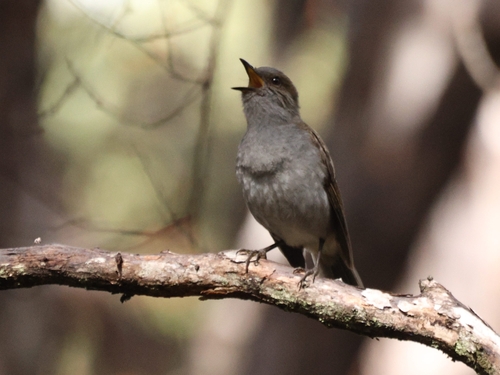
The closest relatives of the Northern Cardinal that you can see in Hawaii Volcanoes National Park (order Passeriformes, Perching Birds) are ʻApapane (over 90%), Warbling White-eye (about 90%) and Hawaii 'Amakihi (about 70%), with each one's daily chance of a sighting.
Where does the Northern Cardinal sighting chance come from?
GBIF citizen-science records
It is estimated from how often the Northern Cardinal is recorded against all the birds logged in Hawaii Volcanoes National Park (507 verified sightings from 2019 to 2026), calibrated against known sighting rates. Figures are rounded to the nearest 10% because citizen-science data supports honest approximations, not decimals, and months with records from fewer than five people show "—". How it works.
