Hawaii 'Amakihi

Hawaii 'Amakihi

Chlorodrepanis virens

LCLeast ConcernNTVUENCR Endemic
Daily sighting probability ~70% · Very likely
at Hawaii Volcanoes National Park

In 3 days >90%

782 Verified sightings at Hawaii Volcanoes National Park From 2019 to 2026
1,960 In all 2 parks
September Best month
☀️ Diurnal When it's spotted

About the Hawaii 'Amakihi

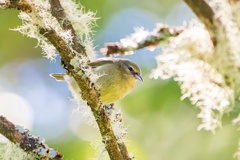
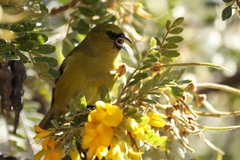
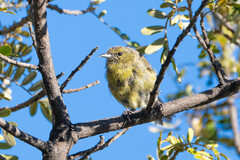
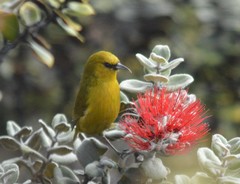
The Hawaiʻi ʻamakihi (Chlorodrepanis virens), also known as the common ʻamakihi, is a species of Hawaiian honeycreeper. The Hawaiʻi ʻamakihi was formerly placed in the genus Hemignathus but was assigned to the genus Chlorodrepanis based on the phylogenetic analysis of mitochondrial and nuclear DNA sequences.

It is found on the Big Island, Maui, and Molokaʻi in Hawaii. It formerly occurred on Lānaʻi where it was last seen in 1976. It is one of the most common honeycreepers, inhabiting all types of habitat, dry māmane forests to mesic and wet forests, on the islands at elevations from sea level to 8,000 feet (2,400 m). On Maui they have also been successful in forests of introduced pines, cypresses and firs. Of all the forest birds native to Hawaii, the Hawaiʻi ʻamakihi has been affected the least by habitat changes. It is suspected that it is evolving resistance to diseases such as avian malaria. Along with the ʻApapane, it is one of the two Hawaiian honeycreepers listed by the IUCN as being of least...

Wikipedia →

Global Distribution

Parks Where Found

# Park Country Daily sighting probability
1 Haleakala National Park 🇺🇸 United States
~90%
2 Hawaii Volcanoes National Park 🇺🇸 United States
~70%

Before you go

What are the chances of seeing a Hawaii 'Amakihi in Hawaii Volcanoes National Park?

Very likely

About 70% of wildlife watchers report a Hawaii 'Amakihi sighting in Hawaii Volcanoes National Park on a given day, based on 782 verified sightings from GBIF citizen-science data from 2019 to 2026. It is the 4th most-seen of the 29 birds we can rate there. Over three days the chance rises to over 90%, if each day is a fresh chance.

When is the best time to see a Hawaii 'Amakihi in Hawaii Volcanoes National Park?

February, April and September–October

In those months about 80% of wildlife watchers report a Hawaii 'Amakihi in Hawaii Volcanoes National Park on a given day, against about 70% in March, May–August and November–January, the lowest months.

What time of day is best to see a Hawaii 'Amakihi?

Between 8 and 11 am

Across all the parks we cover, that three-hour window holds the most Hawaii 'Amakihi sightings with a recorded time, and about 9 in 10 of them come between 6 am and 6 pm: it is a daytime animal.

Is Hawaii Volcanoes National Park the best place to see a Hawaii 'Amakihi?

2nd of 2

Of the 2 parks where we can rate Hawaii 'Amakihi sightings, Hawaii Volcanoes National Park ranks 2nd at about 70%. The best odds are in Haleakala National Park (United States, about 90%).

Which relatives of the Hawaii 'Amakihi live in Hawaii Volcanoes National Park?

Same family: Fringillidae

The closest relatives of the Hawaii 'Amakihi that you can see in Hawaii Volcanoes National Park (family Fringillidae, Finches, Euphonias, and Allies) are ʻApapane (over 90%), Yellow-fronted Canary (about 50%) and House Finch (about 40%), with each one's daily chance of a sighting.

Where does the Hawaii 'Amakihi sighting chance come from?

GBIF citizen-science records

It is estimated from how often the Hawaii 'Amakihi is recorded against all the birds logged in Hawaii Volcanoes National Park (782 verified sightings from 2019 to 2026), calibrated against known sighting rates. Figures are rounded to the nearest 10% because citizen-science data supports honest approximations, not decimals, and months with records from fewer than five people show "—". How it works.

← Back to Hawaii Volcanoes National Park