ʻApapane

ʻApapane

Himatione sanguinea

LCLeast ConcernNTVUENCR Endemic
Daily sighting probability >90% · Very likely
at Hawaii Volcanoes National Park
1,973 Verified sightings at Hawaii Volcanoes National Park From 2019 to 2026
3,137 In all 2 parks
January Best month
☀️ Diurnal When it's spotted

About the ʻApapane

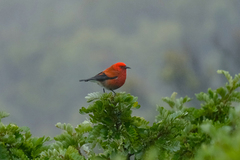
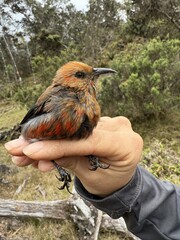
The ʻapapane ( AH-pah-PAH-nay;) (Himatione sanguinea) is a small, crimson species of Hawaiian honeycreeper endemic to the Hawaiian Islands. They are the most abundant and widely distributed honeycreeper and are found on the islands of Hawaiʻi, Maui, Lānaʻi, Kauaʻi, Molokaʻi and Oʻahu.

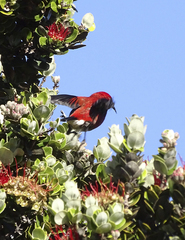
ʻApapane commonly forage in the canopies of ʻōhiʻa (Metrosideros polymorpha) trees, drinking nectar from the flowers and serving as important pollinators. Hawaiians primarily used red feathers from ʻiʻiwi, but also some from ʻapapane, to adorn the ʻahuʻula (capes), mahiole (helmets), and nā lei hulu (feather leis) of aliʻi (Hawaiian nobility).

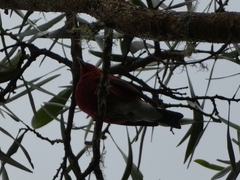
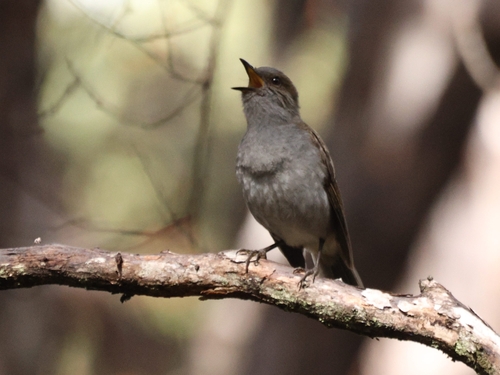
ʻApapane are small at 13 cm (5.1 in) when fully grown. They are sexually dimorphic in size: male ʻapapane have a mass of 16 g (0.56 oz), while females average 14.4 g (0.51 oz). Adult ʻapapane are overall bright crimson, with distinct white undertail-coverts and lower abdomen feathers. They have black primaries and retricies. Juvenile ʻapapane are yellow-brown and gray, with the same white plumage as adults, and molt into crimson plumage over the course of two years. 'Apapane are often seen in a tail-up posture, showing off their white feathers...

Wikipedia →

Global Distribution

Parks Where Found

# Park Country Daily sighting probability
1 Hawaii Volcanoes National Park 🇺🇸 United States
>90%
2 Haleakala National Park 🇺🇸 United States
~90%

Before you go

What are the chances of seeing a ʻApapane in Hawaii Volcanoes National Park?

Very likely

Over 90% of wildlife watchers report a ʻApapane sighting in Hawaii Volcanoes National Park on a given day, based on 1,973 verified sightings from GBIF citizen-science data from 2019 to 2026. It is the most-seen of the 29 birds we can rate there.

When is the best time to see a ʻApapane in Hawaii Volcanoes National Park?

April–June and September–February

In those months over 90% of wildlife watchers report a ʻApapane in Hawaii Volcanoes National Park on a given day, against about 90% in March and July–August, the lowest months.

What time of day is best to see a ʻApapane?

Between 10 am and 1 pm

Across all the parks we cover, that three-hour window holds the most ʻApapane sightings with a recorded time, and about 8 in 10 of them come between 6 am and 6 pm: it is a daytime animal.

Is Hawaii Volcanoes National Park the best place to see a ʻApapane?

Yes

Of the 2 parks where we can rate ʻApapane sightings, Hawaii Volcanoes National Park has the highest daily chance: over 90%. Next come Haleakala National Park (United States, about 90%).

Which relatives of the ʻApapane live in Hawaii Volcanoes National Park?

Same family: Fringillidae

The closest relatives of the ʻApapane that you can see in Hawaii Volcanoes National Park (family Fringillidae, Finches, Euphonias, and Allies) are Hawaii 'Amakihi (about 70%), Yellow-fronted Canary (about 50%) and House Finch (about 40%), with each one's daily chance of a sighting.

Where does the ʻApapane sighting chance come from?

GBIF citizen-science records

It is estimated from how often the ʻApapane is recorded against all the birds logged in Hawaii Volcanoes National Park (1,973 verified sightings from 2019 to 2026), calibrated against known sighting rates. Figures are rounded to the nearest 10% because citizen-science data supports honest approximations, not decimals, and months with records from fewer than five people show "—". How it works.

← Back to Hawaii Volcanoes National Park