Trinidad Euphonia

Trinidad Euphonia

Euphonia trinitatis

Silhouette: Sheatherius · PhyloPic

LCLeast ConcernNTVUENCR
Daily sighting probability ~10% · With luck
at Henri Pittier National Park

In 3 days ~20% in a week ~50%

51 Verified sightings at Henri Pittier National Park From 2019 to 2026
416 In all 3 parks
January Best month
☀️ Diurnal When it's spotted

About the Trinidad Euphonia

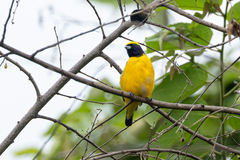
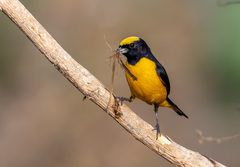
The Trinidad euphonia (Euphonia trinitatis) is a species of bird in the family Fringillidae. It is common in northern Colombia and northern Venezuela and uncommon to rare on the Caribbean island of Trinidad. Like all euphonias, it is small, stocky, and short-tailed; unlike some, it is sexually dimorphic. The male is glossy blue-black on the head, back, throat, and upper breast, with a bright yellow forehead and crown, and bright yellow underparts. The female is olive-green above and yellow-olive below, with a grayer patch running down the center of her breast and abdomen, and bright yellow undertail coverts. Its calls are high-pitched, plaintive whistles: the two most common are a single-pitched, double-noted "pee pee" or "tee dee", or a rising, double-noted "puwee", "cooleee" or "duu dee". Its song is a short, jumbled mix of musical and nonmusical notes.

It is primarily a fruit-eater, specializing on mistletoe berries, but also eating other fruits, as well as occasional seeds and invertebrates. Pairs are monogamous, and stay together year round. Both parents build a globular nest of dried grass and stems, lined with finer material and with a side entrance. The female lays three to four cream-colored, brown-splotched eggs, which she alone incubates. Both parents feed the hatched chicks. English ornithologist Hugh Edwin Strickland first described the Trinidad euphonia in 1851. It has no subspecies. Across its range, it is considered a species of least concern, though it is rare on Trinidad due to overtrapping for the caged bird trade. Wikipedia →

Sounds

Call0:22

Colombia · 2021

© Peter Boesman · XC693512 · CC BY-NC-ND 4.0

Song0:50

Venezuela · 2015

© Eduardo Freitez Gassán / Fernando Freitez Gassàn · XC211590 · CC BY-NC-SA 4.0

Recording0:16

Colombia · 1996

© Mauricio Álvarez-Rebolledo · XC525035 · CC BY-NC-SA 4.0

Global Distribution

Parks Where Found

# Park Country Daily sighting probability
1 Tayrona National Natural Park 🇨🇴 Colombia
~20%
2 Henri Pittier National Park 🇻🇪 Venezuela
~10%
3 Caroni Swamp 🇹🇹 Trinidad and Tobago
<5%

Cities Where Found

# City Country Daily sighting probability
1 Caracas 🇻🇪 Venezuela
~20%
2 Valencia 🇻🇪 Venezuela
~10%

Zoos & Centres Where Found

# Zoo / Centre Country
1 Aviario Nacional de Colombia 🇨🇴 Colombia In captivity

Before you go

What are the chances of seeing a Trinidad Euphonia in Henri Pittier National Park?

With luck

About 10% of wildlife watchers report a Trinidad Euphonia sighting in Henri Pittier National Park on a given day, based on 51 verified sightings from GBIF citizen-science data from 2019 to 2026. It is the 150th most-seen of the 358 birds we can rate there. Over three days the chance rises to about 20%, and over a week to about 50%, if each day is a fresh chance.

When is the best time to see a Trinidad Euphonia in Henri Pittier National Park?

January

In that month about 20% of wildlife watchers report a Trinidad Euphonia in Henri Pittier National Park on a given day, against under 5% in February, July–August and December, the lowest months.

What time of day is best to see a Trinidad Euphonia?

Between 7 and 10 am

Across all the parks we cover, that three-hour window holds the most Trinidad Euphonia sightings with a recorded time, and about 9 in 10 of them come between 6 am and 6 pm: it is a daytime animal.

Is Henri Pittier National Park the best place to see a Trinidad Euphonia?

2nd of 3

Of the 3 parks where we can rate Trinidad Euphonia sightings, Henri Pittier National Park ranks 2nd at about 10%. The best odds are in Tayrona National Natural Park (Colombia, about 20%).

Which relatives of the Trinidad Euphonia live in Henri Pittier National Park?

Same genus: Euphonia

The closest relatives of the Trinidad Euphonia that you can see in Henri Pittier National Park (genus Euphonia, Typical Euphonias) are Orange-bellied Euphonia (about 30%) and Thick-billed Euphonia (about 10%), with each one's daily chance of a sighting.

Where does the Trinidad Euphonia sighting chance come from?

GBIF citizen-science records

It is estimated from how often the Trinidad Euphonia is recorded against all the birds logged in Henri Pittier National Park (51 verified sightings from 2019 to 2026), calibrated against known sighting rates. Figures are rounded to the nearest 10% because citizen-science data supports honest approximations, not decimals, and months with records from fewer than five people show "—". How it works.

← Back to Henri Pittier National Park