Yellow Oriole

Yellow Oriole

Icterus nigrogularis

Silhouette: Matt Wilkins · PhyloPic

LCLeast ConcernNTVUENCR
Daily sighting probability ~10% · With luck
at Henri Pittier National Park

In 3 days ~30% in a week ~60%

63 Verified sightings at Henri Pittier National Park From 2019 to 2026
579 In all 4 parks
May Best month
☀️ Diurnal When it's spotted

About the Yellow Oriole

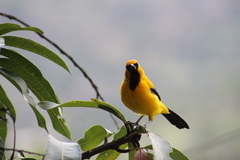
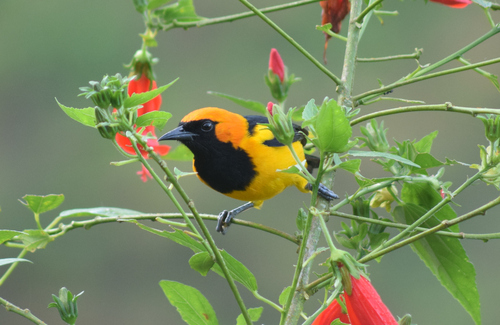
The yellow oriole (Icterus nigrogularis) is a passerine bird in the family Icteridae, the oropendolas, New World orioles, and New World blackbirds. It is found in Aruba, Bonaire, Brazil, Colombia, Curaçao, French Guiana, Guyana, Suriname, Trinidad, and Venezuela.

The yellow oriole was formally described in 1819 with the binomial Xanthornis nigrogularis. In the years since then it was given the binomials Xanthornus xanthornus, Xanthornus linnaei, Oriolus xanthorus, Agelaius xanthornus, Psarocolius xanthornis, and Icterus xanthornus before is current assignment in Icterus.

The yellow oriole has these four subspecies: The yellow oriole is 20 to 21 cm (7.9 to 8.3 in) long and weighs about 38 g (1.3 oz). Adult males of the nominate subspecies I. n. nigrogularis are mostly bright yellow though somewhat paler on the belly. They have black lores, a black... Wikipedia →

Sounds

Song0:37

Colombia · 2022

© Frank Lambert · XC1140425 · CC BY-NC-ND 4.0

Call0:24

Colombia · 2021

© Peter Boesman · XC693629 · CC BY-NC-ND 4.0

Begging call0:44

Colombia · 2020

© Jerome Fischer · XC568031 · CC BY-NC-SA 4.0

Global Distribution

Parks Where Found

# Park Country Daily sighting probability
1 Caroni Swamp 🇹🇹 Trinidad and Tobago
~30%
2 Tayrona National Natural Park 🇨🇴 Colombia
~20%
3 Henri Pittier National Park 🇻🇪 Venezuela
~10%
4 Farallones de Cali National Natural Park 🇨🇴 Colombia
<5%

Cities Where Found

# City Country Daily sighting probability
1 Cali 🇨🇴 Colombia
~40%
2 Maracaibo 🇻🇪 Venezuela
~40%
3 Barranquilla 🇨🇴 Colombia
~40%
4 Valencia 🇻🇪 Venezuela
~20%
5 Caracas 🇻🇪 Venezuela
~20%
6 Medellín 🇨🇴 Colombia
<5%
7 Bogota 🇨🇴 Colombia
<5%

Zoos & Centres Where Found

# Zoo / Centre Country
1 Walsrode World Bird Park 🇩🇪 Germany In captivity
2 Singapore Zoo 🇸🇬 Singapore In captivity
3 Wilhelma 🇩🇪 Germany In captivity
4 Bird Paradise 🇸🇬 Singapore In captivity
5 Rainforest Wild Asia 🇸🇬 Singapore In captivity
6 Parque de la Conservación 🇨🇴 Colombia In captivity
7 Cali Zoo 🇨🇴 Colombia In captivity

Before you go

What are the chances of seeing a Yellow Oriole in Henri Pittier National Park?

With luck

About 10% of wildlife watchers report a Yellow Oriole sighting in Henri Pittier National Park on a given day, based on 63 verified sightings from GBIF citizen-science data from 2019 to 2026. It is the 109th most-seen of the 358 birds we can rate there. Over three days the chance rises to about 30%, and over a week to about 60%, if each day is a fresh chance.

When is the best time to see a Yellow Oriole in Henri Pittier National Park?

April and May

In those months about 30% of wildlife watchers report a Yellow Oriole in Henri Pittier National Park on a given day, against under 5% in August, the lowest month.

What time of day is best to see a Yellow Oriole?

Between 8 and 11 am

Across all the parks we cover, that three-hour window holds the most Yellow Oriole sightings with a recorded time, and about 9 in 10 of them come between 6 am and 6 pm: it is a daytime animal.

Is Henri Pittier National Park the best place to see a Yellow Oriole?

3rd of 4

Of the 4 parks where we can rate Yellow Oriole sightings, Henri Pittier National Park ranks 3rd at about 10%. The best odds are in Caroni Swamp (Trinidad and Tobago, about 30%) and Tayrona National Natural Park (Colombia, about 20%).

Where does the Yellow Oriole sighting chance come from?

GBIF citizen-science records

It is estimated from how often the Yellow Oriole is recorded against all the birds logged in Henri Pittier National Park (63 verified sightings from 2019 to 2026), calibrated against known sighting rates. Figures are rounded to the nearest 10% because citizen-science data supports honest approximations, not decimals, and months with records from fewer than five people show "—". How it works.

← Back to Henri Pittier National Park