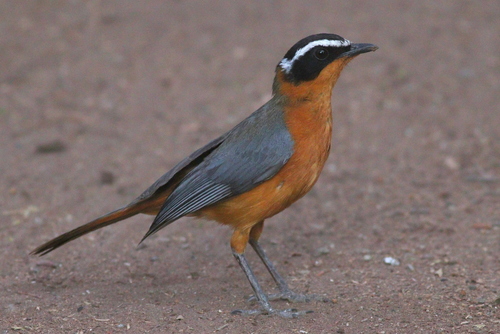
White-Throated Robin-Chat

White-Throated Robin-Chat

Cossypha humeralis

Silhouette: Martin Bulla, based on François Desbordes' illustration · PhyloPic

Daily sighting probability ~10% · With luck
at Hluhluwe-Imfolozi Park

In 3 days ~30% in a week ~60%

47 Verified sightings at Hluhluwe-Imfolozi Park From 2019 to 2026
1,118 In all 5 parks
April Best month
☀️ Diurnal When it's spotted

About the White-Throated Robin-Chat

The white-throated robin-chat or white-throated robin (Dessonornis humeralis) is a species of bird in the family Muscicapidae. It is endemic to Botswana, Eswatini, Mozambique, South Africa, and Zimbabwe. Its natural habitats are dry savannah and subtropical or tropical dry shrubland.

The white-throated robin-chat is found in dry savannah woodland and shrubland. The white-throated robin-chat is mainly insectivorous but also eats small vertebrates and some plant material. Its diet includes beetles, termites, ants, crickets, caterpillars, bugs, spiders and millipedes. It also consumes the fruits of the woolly caper-bush (Capparis tomentosa), the tassel-berry (Antidesma venosum), the sand raisin (Grewia microthyrsa), the magic guarrie (Euclea divinorum) and the dune guarrie (Euclea racemosa).

Breeding takes place in the spring, principally in October and November. The nest is usually on or near the ground, in a hollow stump, near the root of a vine or in a discarded utensil. It is cup-shaped and composed of twigs, dry grasses and leaves and lined with rootlets, tendrils, stalks and fragments of leaves. There are usually two or three eggs and... Wikipedia →

Sounds

Song0:44

South Africa · 2026

© Marna Buys · XC1102359 · CC BY-NC-SA 4.0

Imitation1:11

South Africa · 2023

© Marc Anderson · XC877001 · CC BY-NC-ND 4.0

Song0:31

South Africa · 2025

© Ehren Eksteen · XC1028092 · CC BY-NC-SA 4.0

Global Distribution

Parks Where Found

# Park Country Daily sighting probability
1 Pilanesberg National Park 🇿🇦 South Africa
~30%
2 uMkhuze Game Reserve 🇿🇦 South Africa
~20%
3 Hluhluwe-Imfolozi Park 🇿🇦 South Africa
~10%
4 Kruger National Park 🇿🇦 South Africa
~10%
5 iSimangaliso Wetland Park 🇿🇦 South Africa
<5%

Cities Where Found

# City Country Daily sighting probability
1 Pretoria 🇿🇦 South Africa
<5%
2 Harare 🇿🇼 Zimbabwe
<5%

Before you go

What are the chances of seeing a White-Throated Robin-Chat in Hluhluwe-Imfolozi Park?

With luck

About 10% of wildlife watchers report a White-Throated Robin-Chat sighting in Hluhluwe-Imfolozi Park on a given day, based on 47 verified sightings from GBIF citizen-science data from 2019 to 2026. It is the 98th most-seen of the 220 birds we can rate there. Over three days the chance rises to about 30%, and over a week to about 60%, if each day is a fresh chance.

When is the best time to see a White-Throated Robin-Chat in Hluhluwe-Imfolozi Park?

April, July and November

In those months about 20% of wildlife watchers report a White-Throated Robin-Chat in Hluhluwe-Imfolozi Park on a given day, against under 5% in January and May, the lowest months.

What time of day is best to see a White-Throated Robin-Chat?

Between 8 and 11 am

Across all the parks we cover, that three-hour window holds the most White-Throated Robin-Chat sightings with a recorded time, and about 8 in 10 of them come between 6 am and 6 pm: it is a daytime animal.

Is Hluhluwe-Imfolozi Park the best place to see a White-Throated Robin-Chat?

3rd of 5

Of the 5 parks where we can rate White-Throated Robin-Chat sightings, Hluhluwe-Imfolozi Park ranks 3rd at about 10%. The best odds are in Pilanesberg National Park (South Africa, about 30%) and uMkhuze Game Reserve (South Africa, about 20%).

Where does the White-Throated Robin-Chat sighting chance come from?

GBIF citizen-science records

It is estimated from how often the White-Throated Robin-Chat is recorded against all the birds logged in Hluhluwe-Imfolozi Park (47 verified sightings from 2019 to 2026), calibrated against known sighting rates. Figures are rounded to the nearest 10% because citizen-science data supports honest approximations, not decimals, and months with records from fewer than five people show "—". How it works.

← Back to Hluhluwe-Imfolozi Park