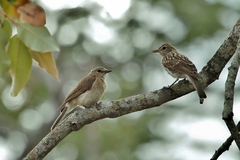
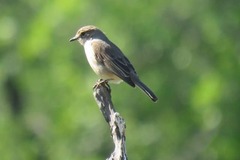
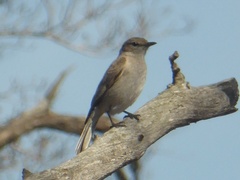
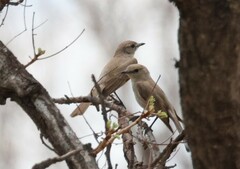

Pale Flycatcher

Pale Flycatcher

Bradornis pallidus

Silhouette: Martin Bulla, based on François Desbordes' illustration · PhyloPic

LCLeast ConcernNTVUENCR
Daily sighting probability ~10% · With luck
at Hluhluwe-Imfolozi Park

In 3 days ~30% in a week ~50%

55 Verified sightings at Hluhluwe-Imfolozi Park From 2019 to 2026
1,471 In all 32 parks
April Best month
☀️ Diurnal When it's spotted

About the Pale Flycatcher

The pale flycatcher (Agricola pallidus) is a passerine bird of the Old World flycatcher family Muscicapidae, native to Sub-Saharan Africa. The pale flycatcher was previously placed in the genus Bradornis but was moved to Melaenornis based on the results of a molecular phylogenetic study published in 2010. It was subsequently moved to the genus Agricola based on a study published in 2023.

It is widely present across Sub-Saharan Africa, although absent in the Congo Basin and Southern Africa. Its natural habitats are subtropical or tropical dry forests, dry savanna, and subtropical or tropical dry shrubland.

Pale flycatcher - Species text in The Atlas of Southern African Birds. Wikipedia →

Global Distribution

Parks Where Found

# Park Country Daily sighting probability
1 Kidepo Valley National Park 🇺🇬 Uganda
~30%
2 uMkhuze Game Reserve 🇿🇦 South Africa
~20%
3 Akagera National Park 🇷🇼 Rwanda
~20%
4 Mikumi National Park 🇹🇿 Tanzania
~10%
5 Lake Nakuru National Park 🇰🇪 Kenya
~10%
6 Hluhluwe-Imfolozi Park 🇿🇦 South Africa
~10%
7 Murchison Falls National Park 🇺🇬 Uganda
~10%
8 Kafue National Park 🇿🇲 Zambia
~10%
9 Lake Manyara National Park 🇹🇿 Tanzania
~10%
10 Samburu National Reserve 🇰🇪 Kenya
~10%
11 Awash National Park 🇪🇹 Ethiopia
~10%
12 Meru National Park 🇰🇪 Kenya
~10%
13 Ruaha National Park 🇹🇿 Tanzania
~10%
14 Lake Mburo National Park 🇺🇬 Uganda
<5%
15 Masai Mara National Reserve 🇰🇪 Kenya
<5%
16 Virunga National Park 🇨🇩 Democratic Republic of the Congo
<5%
17 Tarangire National Park 🇹🇿 Tanzania
<5%
18 Volcanoes National Park 🇷🇼 Rwanda
<5%
19 Nairobi National Park 🇰🇪 Kenya
<5%
20 Gorongosa National Park 🇲🇿 Mozambique
<5%
21 iSimangaliso Wetland Park 🇿🇦 South Africa
<5%
22 Niokolo-Koba National Park 🇸🇳 Senegal
<5%
23 Serengeti National Park 🇹🇿 Tanzania
<5%
24 Kruger National Park 🇿🇦 South Africa
<5%
25 Pilanesberg National Park 🇿🇦 South Africa
<5%
26 Hwange National Park 🇿🇼 Zimbabwe
<5%
27 Nyungwe National Park 🇷🇼 Rwanda
<5%
28 Chobe National Park 🇧🇼 Botswana
<5%
29 Tsavo East National Park 🇰🇪 Kenya
<5%
30 Queen Elizabeth National Park 🇺🇬 Uganda
<5%
31 Bwindi Impenetrable National Park 🇺🇬 Uganda
<5%
32 Ngorongoro Conservation Area 🇹🇿 Tanzania
<5%

Cities Where Found

# City Country Daily sighting probability
1 Mombasa 🇰🇪 Kenya
~40%
2 Kigali 🇷🇼 Rwanda
~10%
3 Kampala 🇺🇬 Uganda
<5%
4 Nairobi 🇰🇪 Kenya
<5%

Before you go

What are the chances of seeing a Pale Flycatcher in Hluhluwe-Imfolozi Park?

With luck

About 10% of wildlife watchers report a Pale Flycatcher sighting in Hluhluwe-Imfolozi Park on a given day, based on 55 verified sightings from GBIF citizen-science data from 2019 to 2026. It is the 110th most-seen of the 220 birds we can rate there. Over three days the chance rises to about 30%, and over a week to about 50%, if each day is a fresh chance.

When is the best time to see a Pale Flycatcher in Hluhluwe-Imfolozi Park?

April

In that month about 20% of wildlife watchers report a Pale Flycatcher in Hluhluwe-Imfolozi Park on a given day, against under 5% in March, October and December, the lowest months.

What time of day is best to see a Pale Flycatcher?

Between 7 and 10 am

Across all the parks we cover, that three-hour window holds the most Pale Flycatcher sightings with a recorded time, and about 9 in 10 of them come between 6 am and 6 pm: it is a daytime animal.

Is Hluhluwe-Imfolozi Park the best place to see a Pale Flycatcher?

6th of 32

Of the 32 parks where we can rate Pale Flycatcher sightings, Hluhluwe-Imfolozi Park ranks 6th at about 10%. The best odds are in Kidepo Valley National Park (Uganda, about 30%), uMkhuze Game Reserve (South Africa, about 20%) and Akagera National Park (Rwanda, about 20%).

Which relatives of the Pale Flycatcher live in Hluhluwe-Imfolozi Park?

Same family: Muscicapidae

The closest relatives of the Pale Flycatcher that you can see in Hluhluwe-Imfolozi Park (family Muscicapidae, Old World Flycatchers, Robins, and Chats) are White-browed Scrub Robin (about 30%), Mocking Cliff Chat (about 30%) and African Stonechat (about 20%), with each one's daily chance of a sighting.

Where does the Pale Flycatcher sighting chance come from?

GBIF citizen-science records

It is estimated from how often the Pale Flycatcher is recorded against all the birds logged in Hluhluwe-Imfolozi Park (55 verified sightings from 2019 to 2026), calibrated against known sighting rates. Figures are rounded to the nearest 10% because citizen-science data supports honest approximations, not decimals, and months with records from fewer than five people show "—". How it works.

← Back to Hluhluwe-Imfolozi Park