Adder

Adder

Vipera berus

Silhouette: Beth Reinke · PhyloPic

LCLeast ConcernNTVUENCR
Daily sighting probability ~30% · Possible
at Hohe Tauern National Park

In 3 days ~70% in a week ~90%

17 Verified sightings at Hohe Tauern National Park From 2019 to 2026
646 In all 8 parks
June Best month
☀️ Diurnal When it's spotted

About the Adder

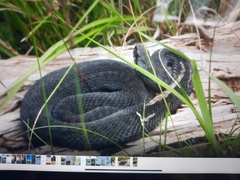
Vipera berus, commonly known as the common European adder and the common European viper, is a species of venomous snake in the family Viperidae. The species is extremely widespread, and thus can be found throughout much of Europe, and as far as East Asia. There are three recognised subspecies.

Known by a host of common names including common adder and common viper, the adder has been the subject of much folklore in Britain and other European countries. It is not regarded as especially dangerous; the snake is not aggressive and usually bites only when really provoked, stepped on, or picked up. Bites can be very painful, but are rarely fatal. The specific name, berus, is Neo-Latin and was at one time used to refer to a snake, possibly the grass snake, Natrix natrix.

The common adder is found in different terrains, habitat complexity being essential for different aspects of its behaviour. It feeds on small mammals, birds, lizards, and amphibians, and in some cases on spiders, worms, and insects. The common adder, like most other vipers, is ovoviviparous, giving birth to live young. Females breed once every two or three years and litters are usually born in late summer to early autumn in the Northern Hemisphere. Litters range in size from three to 20 with young staying with their mothers for a few days. Adults grow to a total length (including tail) of 60 to 90 cm (24 to 35 in) and a mass of 50 to 180 g (1.8 to 6.3 oz). Three subspecies are recognised, including the nominate subspecies, Vipera berus berus, described here. The snake is not considered to be threatened, though it is protected in some countries. Wikipedia →

Sounds

Recording0:25

Latvia · 2024

© osnaats · iNaturalist · CC BY-NC 4.0

Recording0:11

Russia · 2025

© roman2013 · iNaturalist · CC BY-NC 4.0

Global Distribution

Parks Where Found

# Park Country Daily sighting probability
1 Tatra National Park 🇸🇰 Slovakia
~50%
2 Triglav National Park 🇸🇮 Slovenia
~40%
3 Snowdonia National Park 🇬🇧 United Kingdom
~40%
4 Cairngorms National Park 🇬🇧 United Kingdom
~40%
5 Hohe Tauern National Park 🇦🇹 Austria
~30%
6 Bavarian Forest National Park 🇩🇪 Germany
~30%
7 Wadden Sea National Park 🇩🇪 Germany
~10%
8 Cévennes National Park 🇫🇷 France
~10%

Cities Where Found

# City Country Daily sighting probability
1 Stockholm 🇸🇪 Sweden
~10%
2 London 🇬🇧 United Kingdom
<5%

Zoos & Centres Where Found

# Zoo / Centre Country
1 Prague Zoo 🇨🇿 Czechia In captivity
2 Skansen 🇸🇪 Sweden In captivity
3 Chester Zoo 🇬🇧 United Kingdom In captivity
4 Wildpark Schwarze Berge 🇩🇪 Germany In captivity
5 Wilhelma 🇩🇪 Germany In captivity
6 Augsburg Zoo 🇩🇪 Germany In captivity
7 Wildwood Discovery Park 🇬🇧 United Kingdom In captivity
8 Zoo Sibiu 🇷🇴 Romania In captivity
9 British Wildlife Centre 🇬🇧 United Kingdom In captivity
10 Zagreb Zoo 🇭🇷 Croatia In captivity
11 AQUA Akvarium & Dyrepark 🇩🇰 Denmark In captivity
12 Alpenzoo Innsbruck 🇦🇹 Austria In captivity
13 Freiland-Aquarium und -Terrarium Stein 🇩🇪 Germany In captivity
14 Baltic Sea Science Center 🇸🇪 Sweden In captivity
15 Rákosův pavilon 🇨🇿 Czechia In captivity
16 Velemlokárium 🇨🇿 Czechia In captivity
17 Reptilienhaus Oberammergau 🇩🇪 Germany In captivity
18 Shaldon Zoo 🇬🇧 United Kingdom In captivity

Before you go

What are the chances of seeing an Adder in Hohe Tauern National Park?

Possible

About 30% of wildlife watchers report an Adder sighting in Hohe Tauern National Park on a given day, based on 17 verified sightings from GBIF citizen-science data from 2019 to 2026. Over three days the chance rises to about 70%, and over a week to about 90%, if each day is a fresh chance.

When is the best time to see an Adder in Hohe Tauern National Park?

June–July and September

In those months about 40% of wildlife watchers report an Adder in Hohe Tauern National Park on a given day, against about 10% in February–May and October, the lowest months. November and December have too few records to rate.

What time of day is best to see an Adder?

Between 11 am and 2 pm

Across all the parks we cover, that three-hour window holds the most Adder sightings with a recorded time, and nearly all of them come between 6 am and 6 pm: it is a daytime animal.

Where does the Adder sighting chance come from?

GBIF citizen-science records

It is estimated from how often the Adder is recorded against all the reptiles logged in Hohe Tauern National Park (17 verified sightings from 2019 to 2026), calibrated against known sighting rates. Figures are rounded to the nearest 10% because citizen-science data supports honest approximations, not decimals, and months with records from fewer than five people show "—". How it works.

← Back to Hohe Tauern National Park
