Shepherd's Fritillary

Shepherd's Fritillary

Boloria pales

Daily sighting probability ~20% · Possible
at Hohe Tauern National Park

In 3 days ~40% in a week ~70%

13 Verified sightings at Hohe Tauern National Park From 2019 to 2026
59 In all 5 parks
July Best month
☀️ Diurnal When it's spotted

About the Shepherd's Fritillary

Boloria pales, the shepherd's fritillary, is a butterfly of the family Nymphalidae. It is found from the Cantabrian Mountains and the Pyrenees through the Alps and Apennine Mountains east to the Balkan, Carpathian Mountains, the Caucasus and central Asia up to western China.

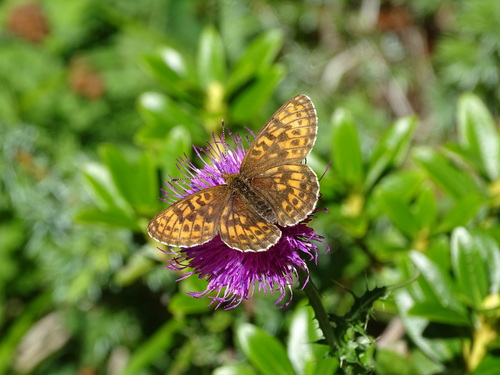
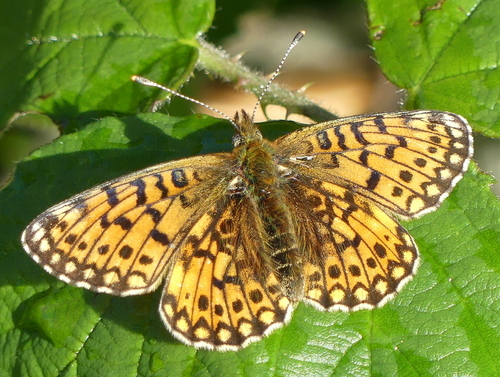
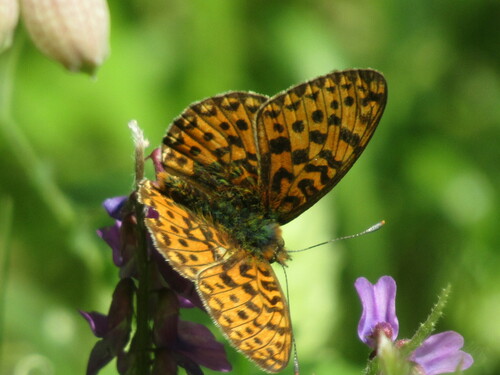
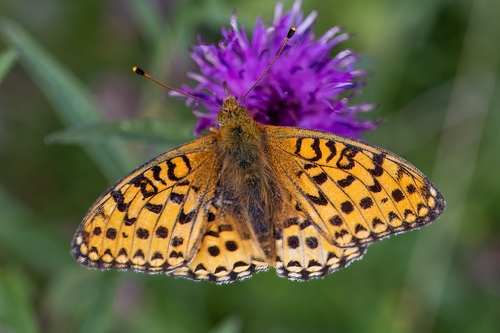
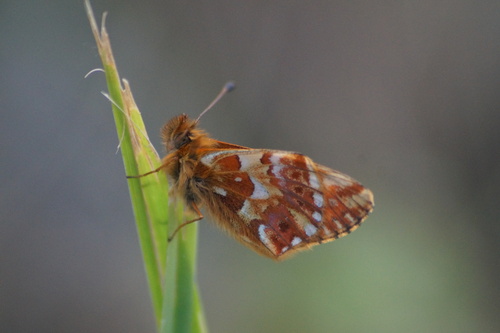
The wingspan is 25–30 mm. The wing tops of the relatively narrow forewings, are usually orange-brown and are traversed by a fine, black pattern consisting of dots and lines as are the hindwings. Slightly darkened or strongly melanistic moths are less common. Characteristic is the strong rust-red underside of the hind wings, which is very strong in this species and is only interrupted by a few irregular yellowish markings.

A. pales. Varying above from fiery red-yellow to nearly black, the markings also being very variable, all intergradations occurring between specimens with only vestiges of black and such with the black markings so heavy and confluent that the ground-colour is suppressed. Recognized by the characteristic underside of

the hindwing, and especially by the shape of the hindwing, which has a nearly straight costal margin forming almost a right angle with the outer margin... Wikipedia →
Global Distribution

Parks Where Found

# Park Country Daily sighting probability
1 Hohe Tauern National Park 🇦🇹 Austria
~20%
2 Mercantour National Park 🇫🇷 France
~10%
3 Vanoise National Park 🇫🇷 France
~10%
4 Ordesa y Monte Perdido National Park 🇪🇸 Spain
~10%
5 Pyrénées National Park 🇫🇷 France
~10%

Before you go

What are the chances of seeing a Shepherd's Fritillary in Hohe Tauern National Park?

Possible

About 20% of wildlife watchers report a Shepherd's Fritillary sighting in Hohe Tauern National Park on a given day, based on 13 verified sightings from GBIF citizen-science data from 2019 to 2026. It is the 61st most-seen of the 165 insects we can rate there. Over three days the chance rises to about 40%, and over a week to about 70%, if each day is a fresh chance.

When is the best time to see a Shepherd's Fritillary in Hohe Tauern National Park?

July

In that month about 30% of wildlife watchers report a Shepherd's Fritillary in Hohe Tauern National Park on a given day, against under 5% in February–June and September–October, the lowest months. December has too few records to rate.

What time of day is best to see a Shepherd's Fritillary?

Between 1 and 4 pm

Across all the parks we cover, that three-hour window holds the most Shepherd's Fritillary sightings with a recorded time, and about 9 in 10 of them come between 6 am and 6 pm: it is a daytime animal.

Is Hohe Tauern National Park the best place to see a Shepherd's Fritillary?

Yes

Of the 5 parks where we can rate Shepherd's Fritillary sightings, Hohe Tauern National Park has the highest daily chance: about 20%. Next come Mercantour National Park (France, about 10%) and Vanoise National Park (France, about 10%).

Which relatives of the Shepherd's Fritillary live in Hohe Tauern National Park?

Same genus: Boloria

The closest relatives of the Shepherd's Fritillary that you can see in Hohe Tauern National Park (genus Boloria, Lesser Fritillaries) are Mountain Fritillary (about 20%), Thor's Fritillary (about 10%) and Eurasian Silver-Bordered Fritillary (about 10%), with each one's daily chance of a sighting.

Where does the Shepherd's Fritillary sighting chance come from?

GBIF citizen-science records

It is estimated from how often the Shepherd's Fritillary is recorded against all the insects logged in Hohe Tauern National Park (13 verified sightings from 2019 to 2026), calibrated against known sighting rates. Figures are rounded to the nearest 10% because citizen-science data supports honest approximations, not decimals, and months with records from fewer than five people show "—". How it works.

← Back to Hohe Tauern National Park