Ceylon Hanging-Parrot

Ceylon Hanging-Parrot

Loriculus beryllinus

Silhouette: Farelli (photo), John E. McCormack, Michael G. Harvey, Brant C. Faircloth, Nicholas G. Crawford, Travis C. Glenn, Robb T. Brumfield & T. Michael Keesey · PhyloPic

LCLeast ConcernNTVUENCR Endemic
Daily sighting probability <5% · Rare
at Horton Plains National Park

In 3 days ~10% in a week ~20%

14 Verified sightings at Horton Plains National Park From 2019 to 2026
1,573 In all 4 parks
June Best month
🌅 Crepuscular When it's spotted

About the Ceylon Hanging-Parrot

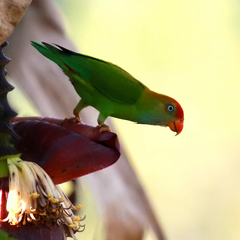
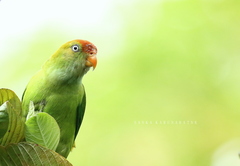
The Sri Lanka hanging parrot (Loriculus beryllinus) is a small parrot which is a resident endemic breeder in Sri Lanka. The Sri Lanka hanging parrot is a small hanging parrot that is 13 cm long with a short tail. The adult has a red crown and rump. The nape and back have on orange tint. The chin and throat are pale blue. The beak is red and the irises are white.

Immature birds lack the orange hue to the back, have a duller rump, and have only a hint of orange on the crown. They have a faint blue throat. They have orange beaks and brown irises. Sri Lanka hanging parrot is less gregarious than some of its relatives, and is usually alone or in small groups outside the breeding season. Its flight is swift and direct, and the call is a sharp whistled twiwittwit..twitwitwit. It undergoes local movements, driven mainly by the availability of the fruit, seeds, buds and blossoms that make up its diet.

Sri Lanka hanging parrot is a bird of open forest. It is strictly arboreal, never descending to the ground. It nests in holes in trees, laying 2–3 eggs. Females are involved in building the nest while males mostly remain close, observing the females. Breeding... Wikipedia →

Sounds

Call1:16

Sri Lanka · 2017

© Phil Gregory · XC619052 · CC BY-NC-SA 4.0

Flight call0:09

Sri Lanka · 2014

© Marc Anderson · XC380569 · CC BY-NC-ND 4.0

Call1:06

Sri Lanka · 2007

© Jelle Scharringa · XC604553 · CC BY-NC-SA 4.0

Global Distribution

Parks Where Found

# Park Country Daily sighting probability
1 Sinharaja Forest Reserve 🇱🇰 Sri Lanka
~70%
2 Udawalawe National Park 🇱🇰 Sri Lanka
~10%
3 Horton Plains National Park 🇱🇰 Sri Lanka
<5%
4 Yala National Park 🇱🇰 Sri Lanka
<5%

Cities Where Found

# City Country Daily sighting probability
1 Colombo [Sri Jayawardenepura Kotte] 🇱🇰 Sri Lanka
<5%

Closest Relatives at Horton Plains National Park

No species of the same family or order lives in Horton Plains National Park, so these are its closest relatives here: other birds.

Before you go

What are the chances of seeing a Ceylon Hanging-Parrot in Horton Plains National Park?

Rare

Under 5% of wildlife watchers report a Ceylon Hanging-Parrot sighting in Horton Plains National Park on a given day, based on 14 verified sightings from GBIF citizen-science data from 2019 to 2026. It is the 74th most-seen of the 102 birds we can rate there. Over three days the chance rises to about 10%, and over a week to about 20%, if each day is a fresh chance.

When is the best time to see a Ceylon Hanging-Parrot in Horton Plains National Park?

April, June and August–September

In those months about 10% of wildlife watchers report a Ceylon Hanging-Parrot in Horton Plains National Park on a given day, against under 5% in May, July and October–March, the lowest months.

What time of day is best to see a Ceylon Hanging-Parrot?

Between 2 and 5 am

Across all the parks we cover, that three-hour window holds the most Ceylon Hanging-Parrot sightings with a recorded time, and about 6 in 10 of them come between 6 am and 6 pm: it is most active around dawn and dusk.

Is Horton Plains National Park the best place to see a Ceylon Hanging-Parrot?

3rd of 4

Of the 4 parks where we can rate Ceylon Hanging-Parrot sightings, Horton Plains National Park ranks 3rd at under 5%. The best odds are in Sinharaja Forest Reserve (Sri Lanka, about 70%) and Udawalawe National Park (Sri Lanka, about 10%).

Where does the Ceylon Hanging-Parrot sighting chance come from?

GBIF citizen-science records

It is estimated from how often the Ceylon Hanging-Parrot is recorded against all the birds logged in Horton Plains National Park (14 verified sightings from 2019 to 2026), calibrated against known sighting rates. Figures are rounded to the nearest 10% because citizen-science data supports honest approximations, not decimals, and months with records from fewer than five people show "—". How it works.

← Back to Horton Plains National Park