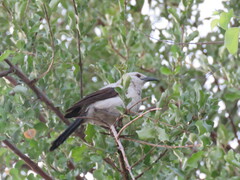
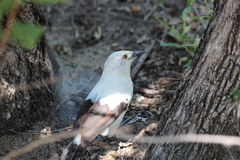
Southern Pied-Babbler

Southern Pied-Babbler

Turdoides bicolor

Silhouette: Sheatherius · PhyloPic

LCLeast ConcernNTVUENCR
Daily sighting probability ~30% · Possible
at Hwange National Park

In 3 days ~60% in a week ~90%

126 Verified sightings at Hwange National Park From 2019 to 2026
489 In all 7 parks
October Best month
☀️ Diurnal When it's spotted

About the Southern Pied-Babbler

The southern pied babbler (Turdoides bicolor) is a species of bird in the family Leiothrichidae, found in dry savannah of Botswana, Namibia, South Africa, and Zimbabwe. The southern pied babbler is a medium-sized 75 to 95 grams (2.6 to 3.4 oz) cooperatively breeding passerine bird. Groups range in size from 2-16 adults, but pairs are rare. The species is sexually monomorphic, with males and females indistinguishable from physical characteristics. Each group comprises a dominant breeding pair that monopolise access to breeding opportunities. Recent genetic research has confirmed that these dominant pairs are responsible for more than 95% of young hatched. Occasional mixed parentage has been observed, but is predictable in most cases: subordinates primarily gain parentage when a new (unrelated) immigrant disperses into the group, or a new group is founded. All group members cooperate to help raise the young hatched from a single clutch. Clutch size varies between two and five, with a modal clutch size of three.

Cooperative behaviours include: provisioning young (both in the nest and post-fledging), sentinel behaviour, territory border defense, teaching behaviour and... Wikipedia →

Sounds

Call0:42

South Africa · 2022

© Tony Archer · XC715767 · CC BY-NC-SA 4.0

Song1:00

South Africa · 2013

© Peter Boesman · XC280785 · CC BY-NC-ND 4.0

Call0:31

South Africa · 2015

© Lynette Rudman · XC302182 · CC BY-NC-SA 4.0

Global Distribution

Parks Where Found

# Park Country Daily sighting probability
1 Hwange National Park 🇿🇼 Zimbabwe
~30%
2 Waterberg Plateau Park 🇳🇦 Namibia
~10%
3 Pilanesberg National Park 🇿🇦 South Africa
~10%
4 Moremi Game Reserve 🇧🇼 Botswana
~10%
5 Etosha National Park 🇳🇦 Namibia
~10%
6 Chobe National Park 🇧🇼 Botswana
~10%
7 Kruger National Park 🇿🇦 South Africa
<5%

Before you go

What are the chances of seeing a Southern Pied-Babbler in Hwange National Park?

Possible

About 30% of wildlife watchers report a Southern Pied-Babbler sighting in Hwange National Park on a given day, based on 126 verified sightings from GBIF citizen-science data from 2019 to 2026. It is the 43rd most-seen of the 308 birds we can rate there. Over three days the chance rises to about 60%, and over a week to about 90%, if each day is a fresh chance.

When is the best time to see a Southern Pied-Babbler in Hwange National Park?

October

In that month about 50% of wildlife watchers report a Southern Pied-Babbler in Hwange National Park on a given day, against about 10% in April, the lowest month. That is one of Hwange National Park's driest months, with about 5 mm of rain against 150 mm in January.

What time of day is best to see a Southern Pied-Babbler?

Between 7 and 10 am

Across all the parks we cover, that three-hour window holds the most Southern Pied-Babbler sightings with a recorded time, and about 8 in 10 of them come between 6 am and 6 pm: it is a daytime animal.

Is Hwange National Park the best place to see a Southern Pied-Babbler?

Yes

Of the 7 parks where we can rate Southern Pied-Babbler sightings, Hwange National Park has the highest daily chance: about 30%. Next come Waterberg Plateau Park (Namibia, about 10%) and Pilanesberg National Park (South Africa, about 10%).

Where does the Southern Pied-Babbler sighting chance come from?

GBIF citizen-science records

It is estimated from how often the Southern Pied-Babbler is recorded against all the birds logged in Hwange National Park (126 verified sightings from 2019 to 2026), calibrated against known sighting rates. Figures are rounded to the nearest 10% because citizen-science data supports honest approximations, not decimals, and months with records from fewer than five people show "—". How it works.

← Back to Hwange National Park