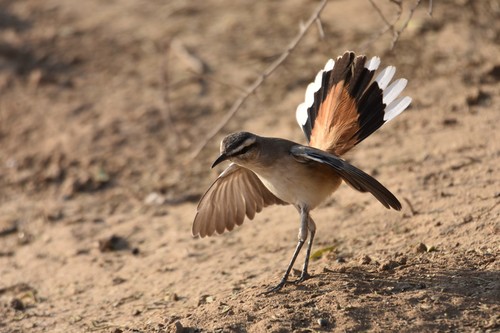
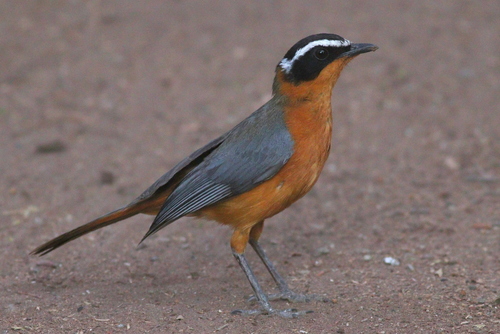
White-headed Black-Chat

White-headed Black-Chat

Pentholaea arnotti

LCLeast ConcernNTVUENCR
Daily sighting probability <5% · Rare
at Hwange National Park

In 3 days ~10% in a week ~20%

16 Verified sightings at Hwange National Park From 2019 to 2026
1,049 In all 13 parks
July Best month

About the White-headed Black-Chat

Arnot's chat (Myrmecocichla arnotti), also known as the white-headed black-chat, is a species of bird in the chat and flycatcher family Muscicapidae. The species is found in southern Africa from Rwanda and Angola to South Africa.

Arnot's chat was formally described and illustrated in 1869 as Saxicola arnotti by English clergyman and ornithologist Henry Baker Tristram based upon a specimen collected at the Victoria Falls in modern-day Zimbabwe. Tristram wrote that he named the species after the collector, a Mr. Arnott, but the man was actually named David Arnot. For this reason, it was suggested in 1965 that the name should be spelled arnoti instead. However, since there is no evidence in Tristram's original paper that the name was misspelled, the rules of the International Code of Zoological Nomenclature mandate that the spelling arnotti should be maintained. Arnot's chat is now placed in the genus Myrmecocichla that was introduced in 1851 by the German ornithologist Jean Cabanis. Along with the white-fronted black chat this species is sometimes separated into the genus Pentholaea.

Three subspecies are recognised: Wikipedia →

Sounds

Call0:32

Zambia · 2024

© Dries Van de Loock · XC932697 · CC BY-NC-ND 4.0

Song0:46

Botswana · 1986

© Nature sounds by Simply Birding · XC648119 · CC BY-NC-ND 4.0

Call0:29

Zambia · 2021

© Hans Matheve · XC699386 · CC BY-NC-ND 4.0

Global Distribution

Parks Where Found

# Park Country Daily sighting probability
1 Mikumi National Park 🇹🇿 Tanzania
~30%
2 Akagera National Park 🇷🇼 Rwanda
~30%
3 Nyungwe National Park 🇷🇼 Rwanda
~20%
4 Liwonde National Park 🇲🇼 Malawi
~20%
5 Kafue National Park 🇿🇲 Zambia
~20%
6 Moremi Game Reserve 🇧🇼 Botswana
~10%
7 Mana Pools National Park 🇿🇼 Zimbabwe
~10%
8 Lower Zambezi National Park 🇿🇲 Zambia
<5%
9 Gonarezhou National Park 🇿🇼 Zimbabwe
<5%
10 Hwange National Park 🇿🇼 Zimbabwe
<5%
11 South Luangwa National Park 🇿🇲 Zambia
<5%
12 Kruger National Park 🇿🇦 South Africa
<5%
13 Chobe National Park 🇧🇼 Botswana
<5%

Cities Where Found

# City Country Daily sighting probability
1 Kigali 🇷🇼 Rwanda
<5%

Before you go

What are the chances of seeing a White-headed Black-Chat in Hwange National Park?

Rare

Under 5% of wildlife watchers report a White-headed Black-Chat sighting in Hwange National Park on a given day, based on 16 verified sightings from GBIF citizen-science data from 2019 to 2026. It is the 250th most-seen of the 308 birds we can rate there. Over three days the chance rises to about 10%, and over a week to about 20%, if each day is a fresh chance.

When is the best time to see a White-headed Black-Chat in Hwange National Park?

July and October

In those months about 10% of wildlife watchers report a White-headed Black-Chat in Hwange National Park on a given day, against under 5% in August–September and November–June, the lowest months. Those are among Hwange National Park's driest months, with almost no rain against 150 mm in January.

Is Hwange National Park the best place to see a White-headed Black-Chat?

10th of 13

Of the 13 parks where we can rate White-headed Black-Chat sightings, Hwange National Park ranks 10th at under 5%. The best odds are in Mikumi National Park (Tanzania, about 30%), Akagera National Park (Rwanda, about 30%) and Nyungwe National Park (Rwanda, about 20%).

Which relatives of the White-headed Black-Chat live in Hwange National Park?

Same family: Muscicapidae

The closest relatives of the White-headed Black-Chat that you can see in Hwange National Park (family Muscicapidae, Old World Flycatchers, Robins, and Chats) are White-browed Scrub Robin (about 20%), Spotted Flycatcher (about 10%) and Mariqua Flycatcher (about 10%), with each one's daily chance of a sighting.

Where does the White-headed Black-Chat sighting chance come from?

GBIF citizen-science records

It is estimated from how often the White-headed Black-Chat is recorded against all the birds logged in Hwange National Park (16 verified sightings from 2019 to 2026), calibrated against known sighting rates. Figures are rounded to the nearest 10% because citizen-science data supports honest approximations, not decimals, and months with records from fewer than five people show "—". How it works.

← Back to Hwange National Park