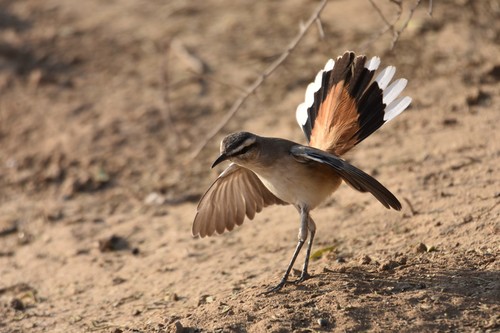
Southern Black Flycatcher

Southern Black Flycatcher

Melaenornis pammelaina

Silhouette: Martin Bulla, based on François Desbordes' illustration · PhyloPic

LCLeast ConcernNTVUENCR
Daily sighting probability ~10% · With luck
at Hwange National Park

In 3 days ~20% in a week ~40%

31 Verified sightings at Hwange National Park From 2019 to 2026
3,249 In all 34 parks
February Best month
☀️ Diurnal When it's spotted

About the Southern Black Flycatcher

The southern black flycatcher (Melaenornis pammelaina) is a small passerine bird of the genus Melaenornis in the flycatcher family, Muscicapidae, native to open and lightly wooded areas of eastern and southern Africa. This species has a large range, with an estimated global extent of occurrence of 4,000,000 square kilometres (1,500,000 sq mi). The global population size has not been quantified but the bird is listed by the IUCN as being of "Least concern".

The southern black flycatcher is entirely black, with a black beak and black legs. The iris of the eye is brown and this, along with the square-cut tail, helps distinguish it from the otherwise similar fork-tailed drongo (Dicrurus adsimilis) which has a red iris and long forked tail.

The southern black flycatcher is native to eastern and southern Africa. It has been recorded from Somalia, Kenya, Uganda, Tanzania, Rwanda, Burundi, Congo, the Democratic Republic of the Congo, Angola, Namibia, Eswatini, Botswana, Malawi, Mozambique, Zambia, Zimbabwe, Lesotho and South Africa. It is typically found in habitats with open areas and light woodland, riparian corridors, the edges of plantations... Wikipedia →

Sounds

Song0:52

Zambia · 2025

© Dries Van de Loock · XC1046987 · CC BY-NC-ND 4.0

Call0:19

South Africa · 2019

© Tony Archer · XC463806 · CC BY-NC-SA 4.0

Begging call1:18

South Africa · 2015

© Faansie Peacock · XC307194 · CC BY-NC-SA 4.0

Global Distribution

Parks Where Found

# Park Country Daily sighting probability
1 uMkhuze Game Reserve 🇿🇦 South Africa
~40%
2 Mkomazi National Park 🇹🇿 Tanzania
~30%
3 Mikumi National Park 🇹🇿 Tanzania
~20%
4 Hluhluwe-Imfolozi Park 🇿🇦 South Africa
~20%
5 Meru National Park 🇰🇪 Kenya
~20%
6 Gorongosa National Park 🇲🇿 Mozambique
~20%
7 Liwonde National Park 🇲🇼 Malawi
~20%
8 Kruger National Park 🇿🇦 South Africa
~20%
9 Gonarezhou National Park 🇿🇼 Zimbabwe
~20%
10 Pilanesberg National Park 🇿🇦 South Africa
~20%
11 Kafue National Park 🇿🇲 Zambia
~10%
12 iSimangaliso Wetland Park 🇿🇦 South Africa
~10%
13 Samburu National Reserve 🇰🇪 Kenya
~10%
14 Tsavo West National Park 🇰🇪 Kenya
~10%
15 South Luangwa National Park 🇿🇲 Zambia
~10%
16 Nairobi National Park 🇰🇪 Kenya
~10%
17 Lower Zambezi National Park 🇿🇲 Zambia
~10%
18 Hwange National Park 🇿🇼 Zimbabwe
~10%
19 Mana Pools National Park 🇿🇼 Zimbabwe
~10%
20 Amboseli National Park 🇰🇪 Kenya
~10%
21 Lake Mburo National Park 🇺🇬 Uganda
<5%
22 Tsavo East National Park 🇰🇪 Kenya
<5%
23 Akagera National Park 🇷🇼 Rwanda
<5%
24 Moremi Game Reserve 🇧🇼 Botswana
<5%
25 Lake Manyara National Park 🇹🇿 Tanzania
<5%
26 Addo Elephant National Park 🇿🇦 South Africa
<5%
27 Chobe National Park 🇧🇼 Botswana
<5%
28 Lake Nakuru National Park 🇰🇪 Kenya
<5%
29 Arusha National Park 🇹🇿 Tanzania
<5%
30 Tarangire National Park 🇹🇿 Tanzania
<5%
31 Serengeti National Park 🇹🇿 Tanzania
<5%
32 Nyungwe National Park 🇷🇼 Rwanda
<5%
33 Ngorongoro Conservation Area 🇹🇿 Tanzania
<5%
34 Queen Elizabeth National Park 🇺🇬 Uganda
<5%

Cities Where Found

# City Country Daily sighting probability
1 Durban 🇿🇦 South Africa
~40%
2 Harare 🇿🇼 Zimbabwe
~30%
3 Maputo 🇲🇿 Mozambique
~10%
4 Lusaka 🇿🇲 Zambia
<5%
5 Kigali 🇷🇼 Rwanda
<5%
6 Nairobi 🇰🇪 Kenya
<5%
7 Pretoria 🇿🇦 South Africa
<5%

Before you go

What are the chances of seeing a Southern Black Flycatcher in Hwange National Park?

With luck

About 10% of wildlife watchers report a Southern Black Flycatcher sighting in Hwange National Park on a given day, based on 31 verified sightings from GBIF citizen-science data from 2019 to 2026. It is the 158th most-seen of the 308 birds we can rate there. Over three days the chance rises to about 20%, and over a week to about 40%, if each day is a fresh chance.

When is the best time to see a Southern Black Flycatcher in Hwange National Park?

February–March and October

In those months about 20% of wildlife watchers report a Southern Black Flycatcher in Hwange National Park on a given day, against under 5% in April–June and August–September, the lowest months. Those are among Hwange National Park's wettest months, with about 70 mm of rain a month against almost none in July.

What time of day is best to see a Southern Black Flycatcher?

Between 10 am and 1 pm

Across all the parks we cover, that three-hour window holds the most Southern Black Flycatcher sightings with a recorded time, and about 9 in 10 of them come between 6 am and 6 pm: it is a daytime animal.

Which relatives of the Southern Black Flycatcher live in Hwange National Park?

Same family: Muscicapidae

The closest relatives of the Southern Black Flycatcher that you can see in Hwange National Park (family Muscicapidae, Old World Flycatchers, Robins, and Chats) are White-browed Scrub Robin (about 20%), Spotted Flycatcher (about 10%) and Mariqua Flycatcher (about 10%), with each one's daily chance of a sighting.

Where does the Southern Black Flycatcher sighting chance come from?

GBIF citizen-science records

It is estimated from how often the Southern Black Flycatcher is recorded against all the birds logged in Hwange National Park (31 verified sightings from 2019 to 2026), calibrated against known sighting rates. Figures are rounded to the nearest 10% because citizen-science data supports honest approximations, not decimals, and months with records from fewer than five people show "—". How it works.

← Back to Hwange National Park