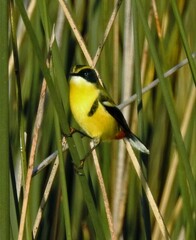
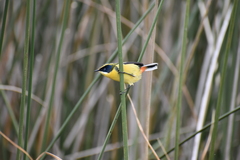

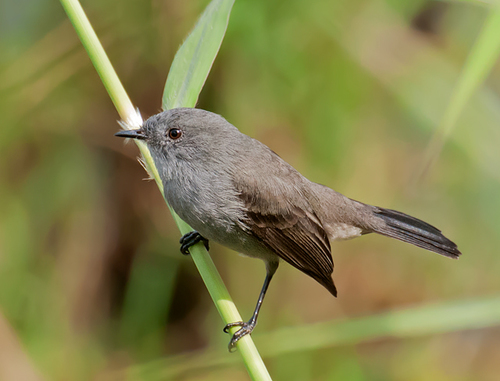
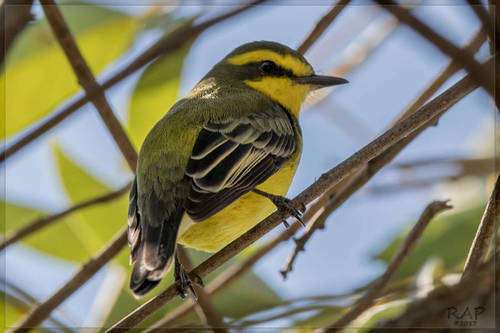
Many-colored Rush Tyrant

Many-colored Rush Tyrant

Tachuris rubrigastra

Silhouette: Emily Willoughby · PhyloPic

LCLeast ConcernNTVUENCR
Daily sighting probability <5% · Rare
at Iberá National Park

In 3 days <5%

5 Verified sightings at Iberá National Park From 2019 to 2026
5 In 1 park
June Best month
☀️ Diurnal When it's spotted

About the Many-colored Rush Tyrant

The many-colored rush tyrant or many-coloured rush tyrant (Tachuris rubrigastra) is a small passerine bird of South America belonging to the tyrant flycatcher family Tyrannidae. It is found in Argentina, Bolivia, Brazil, Chile, Paraguay, Peru, and Uruguay.

A 2013 DNA-based study of South American suboscines found that the many-colored rush tyrant belonged to an isolated lineage that had been separated from other suboscines for around 25 million years. The authors proposed that it should be placed in its own monotypic family Tachurididae. It was subsequently suggested that the name should be Tachurisidae. Edward Dickinson and Leslie Christidis placed it in Tachurisidae in the fourth edition of the Howard and Moore Complete Checklist of the Birds of the World. As of late 2024 the South American Classification Committee of the American Ornithological Society classifies it as incertae sedis and is seeking a proposal to clarify its status. Other taxonomic systems retain it in Tyrannidae.

The many-colored rush tyrant is the only member of its genus and has these four subspecies: Wikipedia →

Sounds

Call0:19

Chile · 2018

© Peter Boesman · XC450169 · CC BY-NC-ND 4.0

Song0:18

Brazil · 2002

© Jeremy Minns · XC81720 · CC BY-NC-SA 3.0

Call0:10

Peru · 2009

© Andrew Spencer · XC47185 · CC BY-NC-ND 2.5

Global Distribution

Parks Where Found

# Park Country Daily sighting probability
1 Iberá National Park 🇦🇷 Argentina
<5%

More parks will be added in future updates.

Cities Where Found

# City Country Daily sighting probability
1 Lima 🇵🇪 Peru
~20%
2 Rosario 🇦🇷 Argentina
~10%
3 Cochabamba 🇧🇴 Bolivia
~10%
4 La Paz 🇧🇴 Bolivia
~10%
5 Buenos Aires 🇦🇷 Argentina
<5%
6 Montevideo 🇺🇾 Uruguay
<5%
7 Santiago 🇨🇱 Chile
<5%

Before you go

What are the chances of seeing a Many-colored Rush Tyrant in Iberá National Park?

Rare

Under 5% of wildlife watchers report a Many-colored Rush Tyrant sighting in Iberá National Park on a given day, based on 5 verified sightings from GBIF citizen-science data from 2019 to 2026. It is the 279th most-seen of the 284 birds we can rate there. Over three days the chance rises to under 5%, if each day is a fresh chance.

When is the best time to see a Many-colored Rush Tyrant in Iberá National Park?

Any time of year

In every month with enough records, under 5% of wildlife watchers report a Many-colored Rush Tyrant in Iberá National Park on a given day, so our monthly data shows no clear season.

What time of day is best to see a Many-colored Rush Tyrant?

Between 9 am and noon

Across all the parks we cover, that three-hour window holds the most Many-colored Rush Tyrant sightings with a recorded time, and nearly all of them come between 6 am and 6 pm: it is a daytime animal.

Where else can you see a Many-colored Rush Tyrant?

Only Iberá National Park, in our data

Iberá National Park is the only park on Wallace's Line with enough records to rate Many-colored Rush Tyrant sightings: under 5% of wildlife watchers there report one on a given day.

Which relatives of the Many-colored Rush Tyrant live in Iberá National Park?

Same family: Tyrannidae

The closest relatives of the Many-colored Rush Tyrant that you can see in Iberá National Park (family Tyrannidae, Tyrant Flycatchers) are Great Kiskadee (about 80%), Cattle Tyrant (about 70%) and Strange-tailed Tyrant (about 50%), with each one's daily chance of a sighting.

Where does the Many-colored Rush Tyrant sighting chance come from?

GBIF citizen-science records

It is estimated from how often the Many-colored Rush Tyrant is recorded against all the birds logged in Iberá National Park (5 verified sightings from 2019 to 2026), calibrated against known sighting rates. Figures are rounded to the nearest 10% because citizen-science data supports honest approximations, not decimals, and months with records from fewer than five people show "—". How it works.

← Back to Iberá National Park