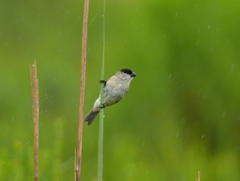
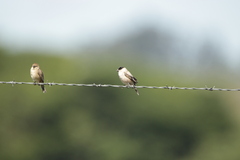
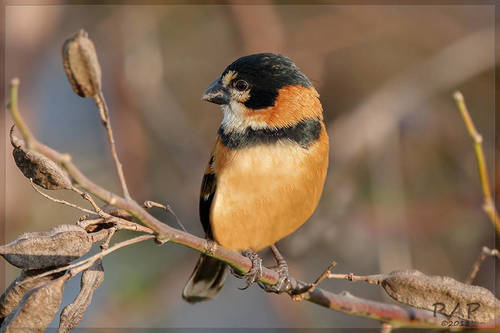
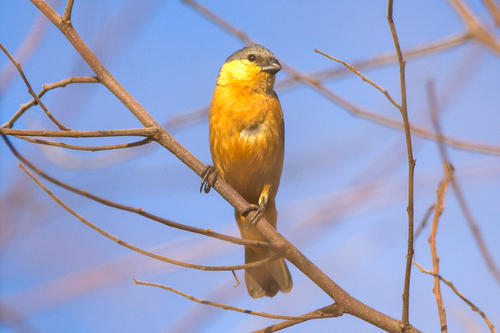
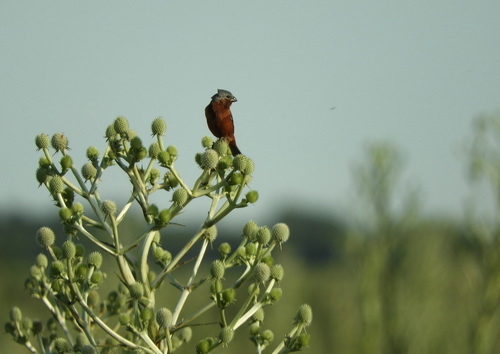
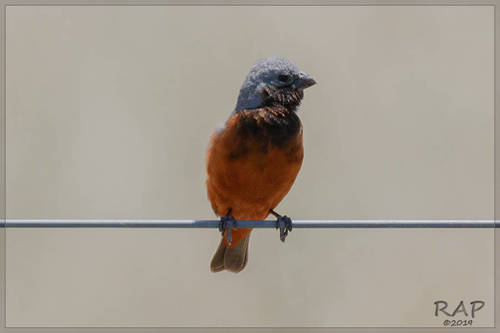
Pearly-bellied Seedeater

Pearly-bellied Seedeater

Sporophila pileata

Silhouette: Sheatherius · PhyloPic

LCLeast ConcernNTVUENCR
Daily sighting probability <5% · Rare
at Iberá National Park

In 3 days ~10% in a week ~20%

59 Verified sightings at Iberá National Park From 2019 to 2026
150 In all 3 parks
November Best month
☀️ Diurnal When it's spotted

About the Pearly-bellied Seedeater

The pearly–bellied seedeater (Sporophila pileata) is a species of bird in the family Thraupidae. It was lumped with the copper seedeater (S. bouvreuil) and known together as the capped seedeater before being split in February 2012.

It is found in southern Brazil, Paraguay, northern Uruguay, and northeastern Argentina. Its natural habitat is dry savanna. Like other capuchinos, which is the term used for them in Spanish, the pearly-bellied seedeater faces significant population declines. These declines are attributed to illegal trapping for the pet trade and the conversion of grasslands for agricultural purposes, leading to habitat loss.

South American Classification Committee (February 8, 2012). "Proposal (#502) to South American Classification Committee – Split Sporophila pileata from S. bouvreuil". Archived from the original on April 8, 2012. Retrieved February 8, 2012.

Freitas M., Medolago C., Costa M., et al. (2018). First description of nests, eggs, and nestlings of the Pearly-bellied Seedeater ( Sporophila pileata ). The Wilson Journal of Ornithology., 130(3), 823–828. Machado, E. & Silveira, L.F. (2010) Geographical and seasonal distribution of the Seedeaters... Wikipedia →

Sounds

Call0:08

Brazil · 2023

© JAYRSON ARAUJO DE OLIVEIRA · XC858523 · CC BY-NC-SA 4.0

Song0:35

Brazil · 2018

© Guilherme de Melo Becher · XC454619 · CC BY-NC-SA 4.0

Call0:20

Brazil · 2023

© Fernando Igor de Godoy · XC789159 · CC BY-NC-SA 4.0

Global Distribution

Parks Where Found

# Park Country Daily sighting probability
1 Serra da Canastra National Park 🇧🇷 Brazil
~10%
2 Emas National Park 🇧🇷 Brazil
~10%
3 Iberá National Park 🇦🇷 Argentina
<5%

Before you go

What are the chances of seeing a Pearly-bellied Seedeater in Iberá National Park?

Rare

Under 5% of wildlife watchers report a Pearly-bellied Seedeater sighting in Iberá National Park on a given day, based on 59 verified sightings from GBIF citizen-science data from 2019 to 2026. It is the 205th most-seen of the 284 birds we can rate there. Over three days the chance rises to about 10%, and over a week to about 20%, if each day is a fresh chance.

When is the best time to see a Pearly-bellied Seedeater in Iberá National Park?

November and December

In those months about 10% of wildlife watchers report a Pearly-bellied Seedeater in Iberá National Park on a given day, against under 5% in January to October, the lowest months.

What time of day is best to see a Pearly-bellied Seedeater?

Between 9 am and noon

Across all the parks we cover, that three-hour window holds the most Pearly-bellied Seedeater sightings with a recorded time, and about 8 in 10 of them come between 6 am and 6 pm: it is a daytime animal.

Is Iberá National Park the best place to see a Pearly-bellied Seedeater?

3rd of 3

Of the 3 parks where we can rate Pearly-bellied Seedeater sightings, Iberá National Park ranks 3rd at under 5%. The best odds are in Serra da Canastra National Park (Brazil, about 10%) and Emas National Park (Brazil, about 10%).

Which relatives of the Pearly-bellied Seedeater live in Iberá National Park?

Same genus: Sporophila

The closest relatives of the Pearly-bellied Seedeater that you can see in Iberá National Park (genus Sporophila, Typical Seedeaters and Seed-Finches) are Rusty-collared Seedeater (about 30%), Double-collared Seedeater (about 20%) and Iberá Seedeater (about 20%), with each one's daily chance of a sighting.

Where does the Pearly-bellied Seedeater sighting chance come from?

GBIF citizen-science records

It is estimated from how often the Pearly-bellied Seedeater is recorded against all the birds logged in Iberá National Park (59 verified sightings from 2019 to 2026), calibrated against known sighting rates. Figures are rounded to the nearest 10% because citizen-science data supports honest approximations, not decimals, and months with records from fewer than five people show "—". How it works.

← Back to Iberá National Park