Speckled Teal

Speckled Teal

Anas flavirostris

Silhouette: Edwin Price · PhyloPic

LCLeast ConcernNTVUENCR
Daily sighting probability <5% · Rare
at Iberá National Park

In 3 days <5%

6 Verified sightings at Iberá National Park From 2019 to 2026
2,022 In all 7 parks
November Best month
☀️ Diurnal When it's spotted

About the Speckled Teal

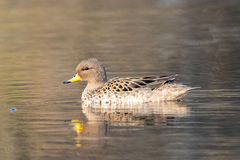
The yellow-billed teal (Anas flavirostris) is a South American species of duck. Like other teals, it belongs to the diverse genus Anas; more precisely it is one of the "true" teals of subgenus Nettion. It occurs in Argentina, the Falkland Islands, Chile, Peru, Bolivia, Uruguay, and Brazil. It has also established itself in South Georgia, where it was first recorded breeding in 1971, and has been recorded as far east as Tristan da Cunha. It inhabits freshwater wetlands, preferring palustrine habitat to rivers. Considering its wide range and local abundance, it is not considered threatened by the IUCN.

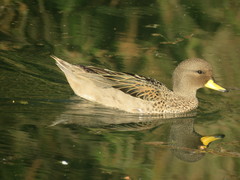
The namesake bill is bright yellow with a black tip and a black band along the ridge of the culmen. The species is somewhat similar to the larger yellow-billed pintail, but has a darker head, shorter neck and plain grayish sides.

Mitochondrial DNA sequence data is most similar to that of the very different-looking green-winged teal. Apart from the mystifying relationship with the red-and-green-headed teals, it altogether most resembles the Indian Ocean radiation of teals. However, the yellow-billed teal's unicolored underside and namesake bill are unique... Wikipedia →
Sounds

Call0:41

Argentina · 2023

© Bernard BOUSQUET · XC827141 · CC BY-NC-SA 4.0

Alarm call0:16

Argentina · 2022

© Franco Vushurovich · XC742736 · CC BY-NC-SA 4.0

Song0:09

Peru · 2006

© Israel Aragon · XC14621 · CC BY-NC-ND 2.5

Global Distribution

Parks Where Found

# Park Country Daily sighting probability
1 Lauca National Park 🇨🇱 Chile
~60%
2 Tierra del Fuego National Park 🇦🇷 Argentina
~30%
3 Torres del Paine National Park 🇨🇱 Chile
~20%
4 Nahuel Huapi National Park 🇦🇷 Argentina
~20%
5 Vicente Pérez Rosales National Park 🇨🇱 Chile
~10%
6 El Palmar National Park 🇦🇷 Argentina
~10%
7 Iberá National Park 🇦🇷 Argentina
<5%

Cities Where Found

# City Country Daily sighting probability
1 Rosario 🇦🇷 Argentina
~40%
2 Buenos Aires 🇦🇷 Argentina
~30%
3 Cordoba 🇦🇷 Argentina
~20%
4 Montevideo 🇺🇾 Uruguay
~10%
5 Cochabamba 🇧🇴 Bolivia
~10%
6 Arequipa 🇵🇪 Peru
~10%
7 Santiago 🇨🇱 Chile
~10%
8 La Paz 🇧🇴 Bolivia
~10%
9 Lima 🇵🇪 Peru
<5%
10 São Paulo 🇧🇷 Brazil
<5%

Zoos & Centres Where Found

# Zoo / Centre Country
1 Temaikén 🇦🇷 Argentina In captivity
2 Gramado Zoo 🇧🇷 Brazil In captivity
3 Bioparque Municipal Vesty Pakos 🇧🇴 Bolivia In captivity
4 Cologne Zoological Garden 🇩🇪 Germany In captivity
5 Ecopark 🇦🇷 Argentina In captivity
6 Seville Zoo 🇪🇸 Spain In captivity
7 Bioparque Educativo Quillón 🇨🇱 Chile In captivity
8 Zoológico de Oruro 🇧🇴 Bolivia In captivity
9 Cologne Zoo Aquarium 🇩🇪 Germany In captivity

Before you go

What are the chances of seeing a Speckled Teal in Iberá National Park?

Rare

Under 5% of wildlife watchers report a Speckled Teal sighting in Iberá National Park on a given day, based on 6 verified sightings from GBIF citizen-science data from 2019 to 2026. It is the 275th most-seen of the 284 birds we can rate there. Over three days the chance rises to under 5%, if each day is a fresh chance.

When is the best time to see a Speckled Teal in Iberá National Park?

Any time of year

In every month with enough records, under 5% of wildlife watchers report a Speckled Teal in Iberá National Park on a given day, so our monthly data shows no clear season.

What time of day is best to see a Speckled Teal?

Between 10 am and 1 pm

Across all the parks we cover, that three-hour window holds the most Speckled Teal sightings with a recorded time, and about 9 in 10 of them come between 6 am and 6 pm: it is a daytime animal.

Where does the Speckled Teal sighting chance come from?

GBIF citizen-science records

It is estimated from how often the Speckled Teal is recorded against all the birds logged in Iberá National Park (6 verified sightings from 2019 to 2026), calibrated against known sighting rates. Figures are rounded to the nearest 10% because citizen-science data supports honest approximations, not decimals, and months with records from fewer than five people show "—". How it works.

← Back to Iberá National Park