Spotted Nothura

Spotted Nothura

Nothura maculosa

Silhouette: George Edward Lodge · PhyloPic

LCLeast ConcernNTVUENCR
Daily sighting probability ~40% · Likely
at Iberá National Park

In 3 days ~80% in a week >90%

758 Verified sightings at Iberá National Park From 2019 to 2026
998 In all 5 parks
January Best month
☀️ Diurnal When it's spotted

About the Spotted Nothura

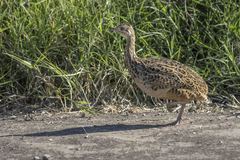
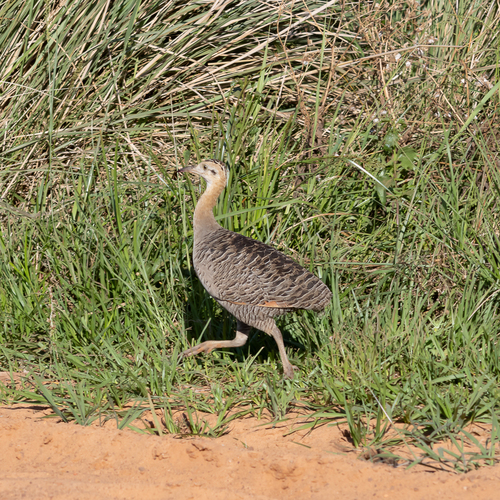
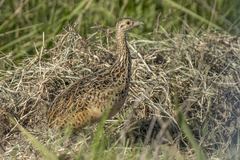
The spotted nothura (Nothura maculosa) is a species of tinamou. This bird is native to grassy habitats in eastern and southern Brazil, Paraguay, Bolivia, Uruguay, and eastern and northern Argentina. The spotted nothura is approximately 24 to 25.5 cm (9.4–10.0 in) in length. The upper parts are brown with streaked buff. The under parts are buff streaked with black and brown on the breast, with barring to the flanks. Its crown is black streaked with buff and the throat is white. The overall hue in colour varies greatly over its range; in part caused by the differences in soil at the specific localities. It and the closely related Chaco nothura, N. chacoensis, are the only nothuras with barring to both webs of the primaries. The legs are dull yellowish-grey or brown.

The call of the spotted nothura is a series of brief high-pitched notes. The spotted nothura eats plants, typically seeds, and animal matter. In Argentina they seem to eat more of the animal matter then they do in other locations.

This species can reproduce rapidly, as the female is mature within 2 months and can have five to six broods per year. The male does... Wikipedia →

Sounds

Song0:14

Brazil · 2021

© João Vitor Oliveira de Souza · XC744960 · CC BY-NC-SA 4.0

Alarm (take off)0:06

Argentina · 2008

© Bernabe Lopez-Lanus · XC45566 · CC BY-NC-SA 3.0

Call1:00

Brazil · 2009

© Ricardo Gagliardi · XC45046 · CC BY-NC-ND 2.5

Global Distribution

Parks Where Found

# Park Country Daily sighting probability
1 Iberá National Park 🇦🇷 Argentina
~40%
2 Serra da Canastra National Park 🇧🇷 Brazil
~30%
3 El Palmar National Park 🇦🇷 Argentina
~10%
4 Emas National Park 🇧🇷 Brazil
~10%
5 Chapada Diamantina National Park 🇧🇷 Brazil
<5%

Cities Where Found

# City Country Daily sighting probability
1 Curitiba 🇧🇷 Brazil
<5%
2 Asuncion 🇵🇾 Paraguay
<5%
3 Buenos Aires 🇦🇷 Argentina
<5%

Zoos & Centres Where Found

# Zoo / Centre Country
1 Curitiba Zoo 🇧🇷 Brazil In captivity

Before you go

What are the chances of seeing a Spotted Nothura in Iberá National Park?

Likely

About 40% of wildlife watchers report a Spotted Nothura sighting in Iberá National Park on a given day, based on 758 verified sightings from GBIF citizen-science data from 2019 to 2026. It is the 48th most-seen of the 284 birds we can rate there. Over three days the chance rises to about 80%, and over a week to over 90%, if each day is a fresh chance.

When is the best time to see a Spotted Nothura in Iberá National Park?

January, May–June and October

In those months about 50% of wildlife watchers report a Spotted Nothura in Iberá National Park on a given day, against about 20% in August, the lowest month.

What time of day is best to see a Spotted Nothura?

Between 4 and 7 pm

Across all the parks we cover, that three-hour window holds the most Spotted Nothura sightings with a recorded time, and about 9 in 10 of them come between 6 am and 6 pm: it is a daytime animal.

Is Iberá National Park the best place to see a Spotted Nothura?

Yes

Of the 5 parks where we can rate Spotted Nothura sightings, Iberá National Park has the highest daily chance: about 40%. Next come Serra da Canastra National Park (Brazil, about 30%) and El Palmar National Park (Argentina, about 10%).

Where does the Spotted Nothura sighting chance come from?

GBIF citizen-science records

It is estimated from how often the Spotted Nothura is recorded against all the birds logged in Iberá National Park (758 verified sightings from 2019 to 2026), calibrated against known sighting rates. Figures are rounded to the nearest 10% because citizen-science data supports honest approximations, not decimals, and months with records from fewer than five people show "—". How it works.

← Back to Iberá National Park