Red-winged Tinamou

Red-winged Tinamou

Rhynchotus rufescens

Silhouette: George Edward Lodge · PhyloPic

LCLeast ConcernNTVUENCR
Daily sighting probability ~40% · Likely
at Iberá National Park

In 3 days ~70% in a week >90%

659 Verified sightings at Iberá National Park From 2019 to 2026
1,335 In all 8 parks
October Best month
☀️ Diurnal When it's spotted

About the Red-winged Tinamou

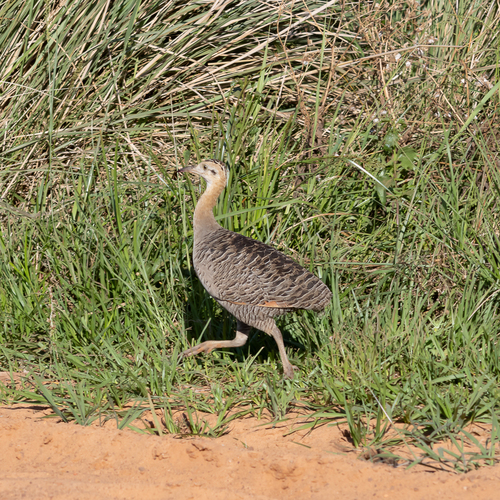
The red-winged tinamou (Rhynchotus rufescens) is a medium-sized ground-living bird from central and eastern South America. Other common names for the species include perdiz grande, rufous tinamou, and ynambu. The red-winged tinamou was formally described in 1815 by the Dutch zoologist Coenraad Jacob Temminck under the binomial name Tinamus rufescens. Temminck based his account on the "Ynambu-guazu" from Brazil that had been described in 1805 by the Spanish naturalist Félix de Azara. The type locality was restricted to São Paulo in Brazil by Carl Eduard Hellmayr in 1929. The specific epithet rufescens is Latin meaning "reddish". The red-winged tinamou is now placed with the huayco tinamou in the genus Rhynchotus that was introduced in 1825 by Johann Baptist von Spix. Its common name refers to the bright rufous primaries, which mainly are visible in flight.

Three subspecies are recognised: All tinamou are from the family Tinamidae, and in the larger... Wikipedia →

Sounds

Song0:04

Brazil · 2026

© JAYRSON ARAUJO DE OLIVEIRA · XC1162122 · CC BY-NC-SA 4.0

?0:35

Brazil · 2006

© Robson Silva e Silva · XC18508 · CC BY-NC-ND 2.5

Song0:06

Argentina · 2022

© Marcos E. Sosa · XC1012162 · CC BY-NC-SA 4.0

Global Distribution

Parks Where Found

# Park Country Daily sighting probability
1 Emas National Park 🇧🇷 Brazil
~50%
2 Iberá National Park 🇦🇷 Argentina
~40%
3 Serra da Canastra National Park 🇧🇷 Brazil
~30%
4 El Palmar National Park 🇦🇷 Argentina
~20%
5 Chapada Diamantina National Park 🇧🇷 Brazil
~10%
6 Chapada dos Guimarães National Park 🇧🇷 Brazil
~10%
7 Iguazú National Park 🇦🇷 Argentina
<5%
8 Iguaçu National Park 🇧🇷 Brazil
<5%

Cities Where Found

# City Country Daily sighting probability
1 Santa Cruz de la Sierra 🇧🇴 Bolivia
~10%
2 Curitiba 🇧🇷 Brazil
<5%
3 Campo Grande 🇧🇷 Brazil
<5%

Zoos & Centres Where Found

# Zoo / Centre Country
1 Parque das Aves 🇧🇷 Brazil In captivity
2 Temaikén 🇦🇷 Argentina In captivity
3 Parque Zoobotânico Arruda Câmara (BICA) 🇧🇷 Brazil In captivity
4 Granja los Pibes 🇦🇷 Argentina In captivity

Before you go

What are the chances of seeing a Red-winged Tinamou in Iberá National Park?

Likely

About 40% of wildlife watchers report a Red-winged Tinamou sighting in Iberá National Park on a given day, based on 659 verified sightings from GBIF citizen-science data from 2019 to 2026. It is the 58th most-seen of the 284 birds we can rate there. Over three days the chance rises to about 70%, and over a week to over 90%, if each day is a fresh chance.

When is the best time to see a Red-winged Tinamou in Iberá National Park?

October

In that month about 60% of wildlife watchers report a Red-winged Tinamou in Iberá National Park on a given day, against about 10% in March and April, the lowest months.

What time of day is best to see a Red-winged Tinamou?

Between 8 and 11 am

Across all the parks we cover, that three-hour window holds the most Red-winged Tinamou sightings with a recorded time, and about 8 in 10 of them come between 6 am and 6 pm: it is a daytime animal.

Is Iberá National Park the best place to see a Red-winged Tinamou?

2nd of 8

Of the 8 parks where we can rate Red-winged Tinamou sightings, Iberá National Park ranks 2nd at about 40%. The best odds are in Emas National Park (Brazil, about 50%). All parks ranked.

Where does the Red-winged Tinamou sighting chance come from?

GBIF citizen-science records

It is estimated from how often the Red-winged Tinamou is recorded against all the birds logged in Iberá National Park (659 verified sightings from 2019 to 2026), calibrated against known sighting rates. Figures are rounded to the nearest 10% because citizen-science data supports honest approximations, not decimals, and months with records from fewer than five people show "—". How it works.
← Back to Iberá National Park