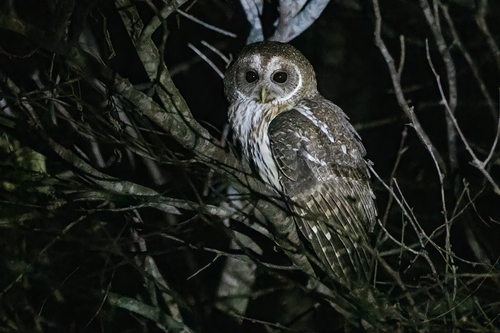
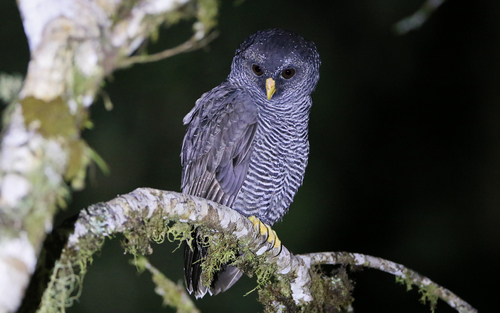
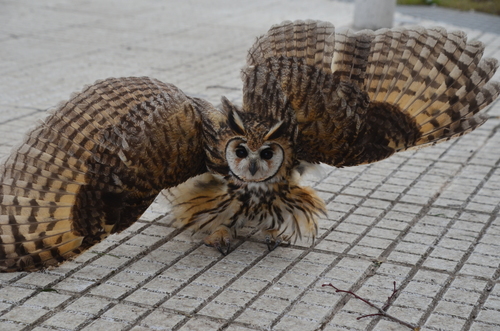
Black-capped Screech-Owl

Black-capped Screech-Owl

Megascops atricapilla

Silhouette: Jason Dilworth · PhyloPic

LCLeast ConcernNTVUENCR
Daily sighting probability <5% · Rare
at Iguazú National Park

In 3 days ~10%

166 Verified sightings at Iguazú National Park From 2019 to 2026
275 In all 3 parks
October Best month
🌙 Nocturnal When it's spotted

About the Black-capped Screech-Owl

The black-capped screech owl (Megascops atricapilla), or variable screech owl, is a species of owl in the family Strigidae. It is found in Argentina, Brazil, and Paraguay. The black-capped screech owl is monotypic. It is part of a complex of species that includes the Santa Marta screech owl (M. gilesi), West Peruvian screech owl (M. roboratus), tawny-bellied screech owl (M. watsonii), and perhaps other undescribed species.

The black-capped screech owl is 22 to 23 cm (8.7 to 9.1 in) long. Males weigh 115 to 140 g (4.1 to 4.9 oz) and females up to 160 g (5.6 oz). It occurs in brown, rufous, and gray morphs. All have a light facial disc with a distinct dark border, a blackish crown, and prominent "ear" tufts. Their eye color ranges from dark brown to amber. The brown morph's upperparts are dark brown with pale mottling and vermiculation. The folded wing shows a line of pale spots. The underparts are paler with irregular markings. The other two morphs are redder and grayer respectively.

The black-capped screech owl is found in southeastern Brazil, southeastern Paraguay, and extreme northeastern Argentina. It... Wikipedia →

Sounds

Song0:56

Brazil · 2025

© Joost van Bruggen · XC1050432 · CC BY-NC-ND 4.0

Call0:16

Brazil · 2012

© Glauco Kohler · XC93622 · CC BY-NC-ND 2.5

Song0:19

Brazil · 2023

© JAYRSON ARAUJO DE OLIVEIRA · XC838526 · CC BY-NC-SA 4.0

Global Distribution

Parks Where Found

# Park Country Daily sighting probability
1 Iguazú National Park 🇦🇷 Argentina
<5%
2 Iguaçu National Park 🇧🇷 Brazil
<5%
3 Itatiaia National Park 🇧🇷 Brazil
<5%

Before you go

What are the chances of seeing a Black-capped Screech-Owl in Iguazú National Park?

Rare

Under 5% of wildlife watchers report a Black-capped Screech-Owl sighting in Iguazú National Park on a given day, based on 166 verified sightings from GBIF citizen-science data from 2019 to 2026. It is the 219th most-seen of the 343 birds we can rate there. Over three days the chance rises to about 10%, if each day is a fresh chance.

When is the best time to see a Black-capped Screech-Owl in Iguazú National Park?

October

In that month about 10% of wildlife watchers report a Black-capped Screech-Owl in Iguazú National Park on a given day, against under 5% in November to September, the lowest months. That is one of Iguazú National Park's wettest months, with about 240 mm of rain against 90 mm in August.

What time of day is best to see a Black-capped Screech-Owl?

Between 7 and 10 pm

Across all the parks we cover, that three-hour window holds the most Black-capped Screech-Owl sightings with a recorded time, and about 9 in 10 of them come between 6 pm and 6 am: it is mostly seen at night.

Is Iguazú National Park the best place to see a Black-capped Screech-Owl?

Yes

Of the 3 parks where we can rate Black-capped Screech-Owl sightings, Iguazú National Park has the highest daily chance: under 5%. Next come Iguaçu National Park (Brazil, under 5%) and Itatiaia National Park (Brazil, under 5%).

Where does the Black-capped Screech-Owl sighting chance come from?

GBIF citizen-science records

It is estimated from how often the Black-capped Screech-Owl is recorded against all the birds logged in Iguazú National Park (166 verified sightings from 2019 to 2026), calibrated against known sighting rates. Figures are rounded to the nearest 10% because citizen-science data supports honest approximations, not decimals, and months with records from fewer than five people show "—". How it works.

← Back to Iguazú National Park