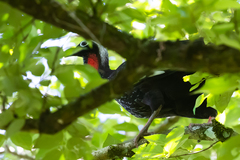
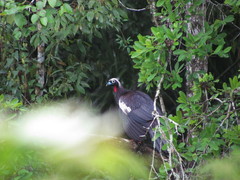
Black-fronted Piping-Guan

Black-fronted Piping-Guan

Pipile jacutinga

Silhouette: Sheatherius · PhyloPic

LCNTVUENEndangeredCR
Daily sighting probability ~10% · With luck
at Iguazú National Park

In 3 days ~30% in a week ~50%

667 Verified sightings at Iguazú National Park From 2019 to 2026
1,158 In all 2 parks
September Best month
☀️ Diurnal When it's spotted

About the Black-fronted Piping-Guan

The black-fronted piping guan (Pipile jacutinga) or jacutinga in Brazilian Portuguese is a bird in the chachalaca, guan, and curassow family Cracidae. It is native to the Serra do Mar coastal forests, Paraguay and northeastern Argentina.

The taxonomies of the International Ornithological Committee (IOC), The Clements Checklist of Birds of the World, and Handbook of the Birds of the World treat the black-fronted piping guan as one of four species in genus Pipile. Though also agreeing with this treatment, the South American Classification Committee of the American Ornithological Society notes that "evidence for species rank for the four species of Pipile is weak". Various authors have proposed instead that the genus contains one, two, or three species, or that it should be subsumed entirely into genus Aburria with the wattled guan (A. aburri).

As currently accepted, the black-fronted piping guan is monotypic. The black-fronted piping guan is 63.5 to 74 cm (2.08 to 2.43 ft) long and weighs 1,100 to 1,400 g (2.4 to 3.1 lb). It is similar in general appearance to a slim turkey, with a thin neck and small head. It is mainly black with a bluish... Wikipedia →

Sounds

Call0:41

Argentina · 2024

© Marcos E. Sosa · XC1019102 · CC BY-NC-SA 4.0

Song1:00

Brazil · 2015

© Eduardo Patrial · XC268229 · CC BY-NC-SA 4.0

Alarm call0:08

Brazil · 2011

© Robson Silva e Silva · XC72021 · CC BY-NC-ND 2.5

Global Distribution

Parks Where Found

# Park Country Daily sighting probability
1 Iguaçu National Park 🇧🇷 Brazil
~10%
2 Iguazú National Park 🇦🇷 Argentina
~10%

Zoos & Centres Where Found

# Zoo / Centre Country
1 Parque das Aves 🇧🇷 Brazil In captivity
2 Curitiba Zoo 🇧🇷 Brazil In captivity
3 Rio de Janeiro Zoological Garden 🇧🇷 Brazil In captivity
4 Zoo das Aves 🇧🇷 Brazil In captivity
5 Bauru Zoo 🇧🇷 Brazil In captivity
6 Parque Zoológico Bosque Guarani 🇧🇷 Brazil In captivity
7 Zoológico 🇧🇷 Brazil In captivity
8 GüiráOga 🇦🇷 Argentina In captivity
9 Zooparque Itatiba 🇧🇷 Brazil In captivity

Before you go

What are the chances of seeing a Black-fronted Piping-Guan in Iguazú National Park?

With luck

About 10% of wildlife watchers report a Black-fronted Piping-Guan sighting in Iguazú National Park on a given day, based on 667 verified sightings from GBIF citizen-science data from 2019 to 2026. It is the 124th most-seen of the 343 birds we can rate there. Over three days the chance rises to about 30%, and over a week to about 50%, if each day is a fresh chance.

When is the best time to see a Black-fronted Piping-Guan in Iguazú National Park?

September

In that month about 20% of wildlife watchers report a Black-fronted Piping-Guan in Iguazú National Park on a given day, against about 10% in October to August, the lowest months.

What time of day is best to see a Black-fronted Piping-Guan?

Between 7 and 10 am

Across all the parks we cover, that three-hour window holds the most Black-fronted Piping-Guan sightings with a recorded time, and about 9 in 10 of them come between 6 am and 6 pm: it is a daytime animal.

Is Iguazú National Park the best place to see a Black-fronted Piping-Guan?

Among the best

Of the 2 parks where we can rate Black-fronted Piping-Guan sightings, Iguazú National Park ranks 2nd at about 10%, level with the leaders once rounded. The best odds are in Iguaçu National Park (Brazil, about 10%).

Where does the Black-fronted Piping-Guan sighting chance come from?

GBIF citizen-science records

It is estimated from how often the Black-fronted Piping-Guan is recorded against all the birds logged in Iguazú National Park (667 verified sightings from 2019 to 2026), calibrated against known sighting rates. Figures are rounded to the nearest 10% because citizen-science data supports honest approximations, not decimals, and months with records from fewer than five people show "—". How it works.

← Back to Iguazú National Park