Spot-winged Wood Quail

Spot-winged Wood Quail

Odontophorus capueira

Silhouette: Sheatherius · PhyloPic

LCLeast ConcernNTVUENCR
Daily sighting probability <5% · Rare
at Iguazú National Park

In 3 days ~10% in a week ~20%

182 Verified sightings at Iguazú National Park From 2019 to 2026
495 In all 4 parks
June Best month
☀️ Diurnal When it's spotted

About the Spot-winged Wood Quail

The spot-winged wood quail (Odontophorus capueira) is a species of bird in the family Odontophoridae. It is found in Brazil, Argentina and Paraguay, and formerly in Uruguay. In Portuguese and Spanish the bird is called uru (Corcovado Urú).

Its natural habitats are subtropical or tropical dry lowland forests. Its population is thought to be declining but at a moderate rate, so the International Union for Conservation of Nature has assessed it as being a "least-concern species".

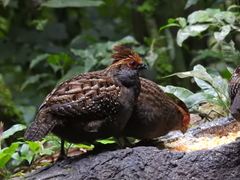
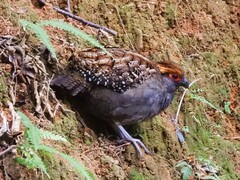
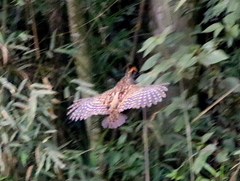
Male and female spot-winged wood quails are similar in appearance but the female is slightly smaller. The bird has a reddish-brown crown with a loose crest, speckled with buff. The supercilium (stripe above the eye) and the chest-band are reddish-cinnamon. The upper parts are greyish-brown, with dark vermiculations and speckling, with the individual feathers on neck, mantle, back and scapulars having white streaks beside the shaft. The sides of the head, throat and underparts are slatey-grey. The legs are dark grey, the bill is blackish, the iris brown and the bare area around the eyes red. The length range is about 26 to 30 cm (10 to 12 in). Juveniles are similar in colouring but have reddish... Wikipedia →

Sounds

Song1:23

Brazil · 2025

© Joost van Bruggen · XC1050613 · CC BY-NC-ND 4.0

Alarm call0:20

Brazil · 2023

© JAYRSON ARAUJO DE OLIVEIRA · XC843450 · CC BY-NC-SA 4.0

Uncertain0:30

Argentina · 2022

© Fernando Pocho Cabral · XC710427 · CC BY-NC-SA 4.0

Global Distribution

Parks Where Found

# Park Country Daily sighting probability
1 Serra dos Órgãos National Park 🇧🇷 Brazil
~10%
2 Itatiaia National Park 🇧🇷 Brazil
~10%
3 Iguazú National Park 🇦🇷 Argentina
<5%
4 Iguaçu National Park 🇧🇷 Brazil
<5%

Cities Where Found

# City Country Daily sighting probability
1 São Paulo 🇧🇷 Brazil
<5%

Before you go

What are the chances of seeing a Spot-winged Wood Quail in Iguazú National Park?

Rare

Under 5% of wildlife watchers report a Spot-winged Wood Quail sighting in Iguazú National Park on a given day, based on 182 verified sightings from GBIF citizen-science data from 2019 to 2026. It is the 193rd most-seen of the 343 birds we can rate there. Over three days the chance rises to about 10%, and over a week to about 20%, if each day is a fresh chance.

When is the best time to see a Spot-winged Wood Quail in Iguazú National Park?

June and July

In those months about 10% of wildlife watchers report a Spot-winged Wood Quail in Iguazú National Park on a given day, against under 5% in August to May, the lowest months.

What time of day is best to see a Spot-winged Wood Quail?

Between 4 and 7 pm

Across all the parks we cover, that three-hour window holds the most Spot-winged Wood Quail sightings with a recorded time, and about 8 in 10 of them come between 6 am and 6 pm: it is a daytime animal.

Is Iguazú National Park the best place to see a Spot-winged Wood Quail?

3rd of 4

Of the 4 parks where we can rate Spot-winged Wood Quail sightings, Iguazú National Park ranks 3rd at under 5%. The best odds are in Serra dos Órgãos National Park (Brazil, about 10%) and Itatiaia National Park (Brazil, about 10%).

Which relatives of the Spot-winged Wood Quail live in Iguazú National Park?

Same order: Galliformes

The closest relatives of the Spot-winged Wood Quail that you can see in Iguazú National Park (order Galliformes, Landfowl) are Black-fronted Piping-Guan (about 10%) and Rusty-margined Guan (about 10%), with each one's daily chance of a sighting.

Where does the Spot-winged Wood Quail sighting chance come from?

GBIF citizen-science records

It is estimated from how often the Spot-winged Wood Quail is recorded against all the birds logged in Iguazú National Park (182 verified sightings from 2019 to 2026), calibrated against known sighting rates. Figures are rounded to the nearest 10% because citizen-science data supports honest approximations, not decimals, and months with records from fewer than five people show "—". How it works.

← Back to Iguazú National Park