Honey Badger

Honey Badger

Mellivora capensis

Silhouette: Steven Traver · PhyloPic

LCLeast ConcernNTVUENCR
Daily sighting probability ~10% · With luck
at iSimangaliso Wetland Park

In 3 days ~20% in a week ~40%

6 Verified sightings at iSimangaliso Wetland Park From 2019 to 2026
200 In all 8 parks
September Best month
🌅 Crepuscular When it's spotted

About the Honey Badger

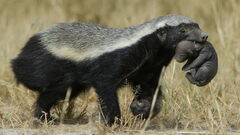
The honey badger (Mellivora capensis), also known as the ratel ( or ), is a mammal widely distributed across Africa, Southwest Asia, and the Indian subcontinent. It is the sole living representative of the Mellivorinae subfamily of the Mustelidae.

It has a fairly long body, with a distinctly thick-set and broad back, and remarkably loose skin, allowing the badger to turn and twist freely within it. The largest terrestrial mustelid in Africa, the honey badger measures 55 to 77 cm (22 to 30 in) long and weighs up to 16 kg (35 lb). Sexual dimorphism has been recorded in this species, with males being larger and heavier than females. It has two pairs of mammae, and an eversible anal pouch.

The honey badger is a solitary animal that can be active at any time of day, depending on the location. It is primarily a carnivorous species and has few natural predators because of its thick skin, strength and ferocious defensive abilities. Adults maintain large home ranges, and display scent-marking behavior. The species has no fixed breeding period. After a gestation of 50–70 days, a female will give birth to an average of one to two cubs that will remain under her care for 1–1+1⁄4 years. Because of its wide range and occurrence in a variety of habitats, it is listed as least concern on the IUCN Red List. In popular media, the honey badger is best known as an aggressive, intelligent animal that is fearless and tough in nature. Wikipedia →

Global Distribution

Parks Where Found

# Park Country Daily sighting probability
1 Waterberg Plateau Park 🇳🇦 Namibia
~40%
2 Etosha National Park 🇳🇦 Namibia
~20%
3 Kgalagadi Transfrontier Park 🇿🇦 South Africa
~20%
4 Moremi Game Reserve 🇧🇼 Botswana
~20%
5 Kruger National Park 🇿🇦 South Africa
~10%
6 Chobe National Park 🇧🇼 Botswana
~10%
7 Ngorongoro Conservation Area 🇹🇿 Tanzania
~10%
8 iSimangaliso Wetland Park 🇿🇦 South Africa
~10%

Zoos & Centres Where Found

# Zoo / Centre Country
1 San Diego Zoo 🇺🇸 United States In captivity
2 Prague Zoo 🇨🇿 Czechia In captivity
3 Tierpark Berlin 🇩🇪 Germany In captivity
4 Nandankanan Zoological Park 🇮🇳 India In captivity
5 Nehru Zoological Park 🇮🇳 India In captivity
6 Johannesburg Zoo 🇿🇦 South Africa In captivity
7 Kano Zoo 🇳🇬 Nigeria In captivity
8 Oklahoma City Zoo and Botanical Garden 🇺🇸 United States In captivity
9 Tanganyika Wildlife Park 🇺🇸 United States In captivity
10 Havana Zoo 🇨🇺 Cuba In captivity
11 Naples Zoo 🇺🇸 United States In captivity
12 Belgrade Zoo 🇷🇸 Serbia In captivity
13 Living Treasures "Wild" Animal Park 🇺🇸 United States In captivity
14 World of Birds Wildlife Sanctuary and Monkey Park 🇿🇦 South Africa In captivity
15 Hartbeespoort Dam Snake and Animal Park 🇿🇦 South Africa In captivity
16 Rákosův pavilon 🇨🇿 Czechia In captivity
17 Velemlokárium 🇨🇿 Czechia In captivity
18 Audu Bako Zoo 🇳🇬 Nigeria In captivity
19 Jukani Wildlife Sanctuary 🇿🇦 South Africa In captivity
20 Moholoholo Wildlife Rehabilitation Centre 🇿🇦 South Africa In captivity
21 フクロウとキタキツネの森 🇯🇵 Japan In captivity

Before you go

What are the chances of seeing a Honey Badger in iSimangaliso Wetland Park?

With luck

About 10% of wildlife watchers report a Honey Badger sighting in iSimangaliso Wetland Park on a given day, based on 6 verified sightings from GBIF citizen-science data from 2019 to 2026. It is the 33rd most-seen of the 34 mammals we can rate there. Over three days the chance rises to about 20%, and over a week to about 40%, if each day is a fresh chance.

When is the best time to see a Honey Badger in iSimangaliso Wetland Park?

September

In that month about 20% of wildlife watchers report a Honey Badger in iSimangaliso Wetland Park on a given day, against under 5% in August and December–June, the lowest months.

What time of day is best to see a Honey Badger?

Between 6 and 9 am

Across all the parks we cover, that three-hour window holds the most Honey Badger sightings with a recorded time, and about half of them come between 6 am and 6 pm: it is most active around dawn and dusk.

Which relatives of the Honey Badger live in iSimangaliso Wetland Park?

Same order: Carnivora

The closest relatives of the Honey Badger that you can see in iSimangaliso Wetland Park (order Carnivora, Carnivorans) are Banded Mongoose (about 20%), Leopard (about 10%) and Lion (about 10%), with each one's daily chance of a sighting.

Where does the Honey Badger sighting chance come from?

GBIF citizen-science records

It is estimated from how often the Honey Badger is recorded against all the mammals logged in iSimangaliso Wetland Park (6 verified sightings from 2019 to 2026), calibrated against known sighting rates. Figures are rounded to the nearest 10% because citizen-science data supports honest approximations, not decimals, and months with records from fewer than five people show "—". How it works.

← Back to iSimangaliso Wetland Park
