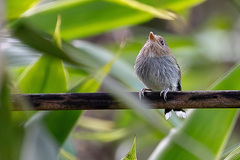
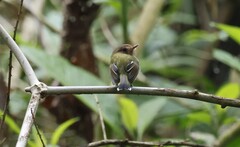
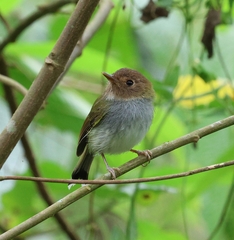

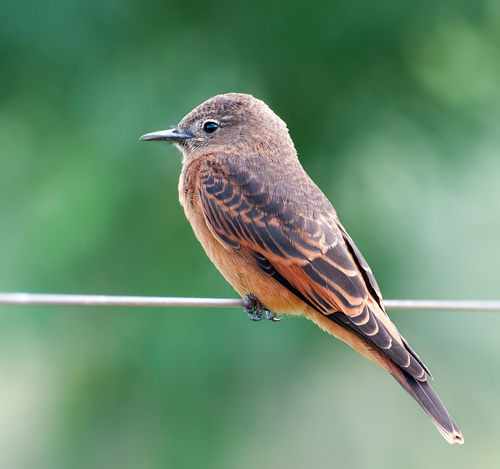
Fork-tailed Pygmy-Tyrant

Fork-tailed Pygmy-Tyrant

Hemitriccus furcatus

Silhouette: Emily Willoughby · PhyloPic

LCLeast ConcernNTVUENCR Endemic
Daily sighting probability ~10% · With luck
at Itatiaia National Park

In 3 days ~40% in a week ~70%

247 Verified sightings at Itatiaia National Park From 2019 to 2026
247 In 1 park
September Best month
☀️ Diurnal When it's spotted

About the Fork-tailed Pygmy-Tyrant

The fork-tailed tody-tyrant or fork-tailed pygmy tyrant (Hemitriccus furcatus) is a species of bird in the family Tyrannidae, the tyrant flycatchers. It is endemic to Brazil. The fork-tailed tody-tyrant was originally described in 1846 as Todirostrum furcatum. During part of the twentieth century some authors placed it by itself in genus Ceratotriccus, which by about 1980 was merged into Hemitriccus. Its closest relative appears to be Kaempfer's tody-tyrant (H. kaempferi).

The fork-tailed tody-tyrant is monotypic. The fork-tailed tody-tyrant is about 11 cm (4.3 in) long. Adults have a distinctive tail whose outer feathers are longer than the inner ones and curve slightly inwards; males' tails are somewhat more deeply forked than females'. The sexes otherwise have the same plumage. They have a bright cinnamon-brown forehead and a brownish olive crown and nape. They have a pale cinnamon-buff spot above the lores and a pale cinnamon buff eye-ring on an otherwise cocoa-brown to cinnamon face. Their back and rump are bright olive. Their wings are bright olive with bright cinnamon edges on the inner flight feathers and wide creamy outer webs... Wikipedia →

Sounds

Song0:42

Brazil · 2021

© Lucas Lombardo · XC992992 · CC BY-NC-SA 4.0

Canto0:16

Brazil · 2016

© Caio Brito · XC427450 · CC BY-NC-SA 4.0

Call0:11

Brazil · 2015

© Jerome Fischer · XC366911 · CC BY-NC-SA 4.0

Global Distribution

Parks Where Found

# Park Country Daily sighting probability
1 Itatiaia National Park 🇧🇷 Brazil
~10%

More parks will be added in future updates.

Before you go

What are the chances of seeing a Fork-tailed Pygmy-Tyrant in Itatiaia National Park?

With luck

About 10% of wildlife watchers report a Fork-tailed Pygmy-Tyrant sighting in Itatiaia National Park on a given day, based on 247 verified sightings from GBIF citizen-science data from 2019 to 2026. It is the 131st most-seen of the 352 birds we can rate there. Over three days the chance rises to about 40%, and over a week to about 70%, if each day is a fresh chance.

When is the best time to see a Fork-tailed Pygmy-Tyrant in Itatiaia National Park?

April, June, September–October and December

In those months about 20% of wildlife watchers report a Fork-tailed Pygmy-Tyrant in Itatiaia National Park on a given day, against under 5% in January, the lowest month.

What time of day is best to see a Fork-tailed Pygmy-Tyrant?

Between 8 and 11 am

Across all the parks we cover, that three-hour window holds the most Fork-tailed Pygmy-Tyrant sightings with a recorded time, and about 8 in 10 of them come between 6 am and 6 pm: it is a daytime animal.

Where else can you see a Fork-tailed Pygmy-Tyrant?

Only Itatiaia National Park, in our data

Itatiaia National Park is the only park on Wallace's Line with enough records to rate Fork-tailed Pygmy-Tyrant sightings: about 10% of wildlife watchers there report one on a given day.

Which relatives of the Fork-tailed Pygmy-Tyrant live in Itatiaia National Park?

Same genus: Hemitriccus

The closest relatives of the Fork-tailed Pygmy-Tyrant that you can see in Itatiaia National Park (genus Hemitriccus, Tody-Tyrants and Bamboo-Tyrants) are Brown-breasted Pygmy-Tyrant (about 10%) and Drab-breasted Pygmy-Tyrant (about 10%), with each one's daily chance of a sighting.

Where does the Fork-tailed Pygmy-Tyrant sighting chance come from?

GBIF citizen-science records

It is estimated from how often the Fork-tailed Pygmy-Tyrant is recorded against all the birds logged in Itatiaia National Park (247 verified sightings from 2019 to 2026), calibrated against known sighting rates. Figures are rounded to the nearest 10% because citizen-science data supports honest approximations, not decimals, and months with records from fewer than five people show "—". How it works.

← Back to Itatiaia National Park