
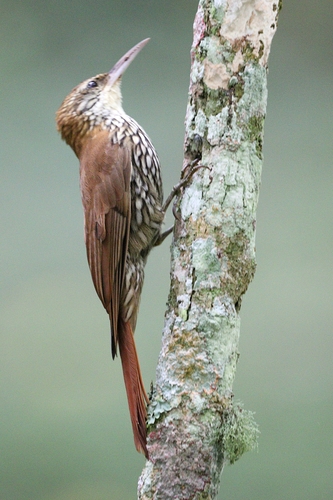
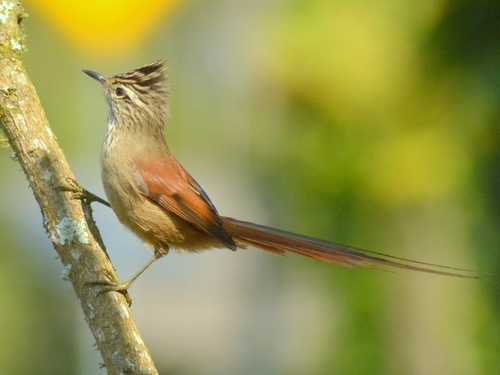
Gray-bellied Spinetail

Gray-bellied Spinetail

Synallaxis cinerascens

Silhouette: Sheatherius · PhyloPic

LCLeast ConcernNTVUENCR
Daily sighting probability <5% · Rare
at Itatiaia National Park

In 3 days ~10% in a week ~30%

78 Verified sightings at Itatiaia National Park From 2019 to 2026
137 In all 3 parks
April Best month
☀️ Diurnal When it's spotted

About the Gray-bellied Spinetail

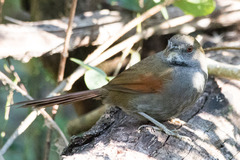
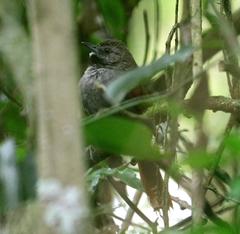
The grey-bellied spinetail (Synallaxis cinerascens) is a species of bird in the Furnariinae subfamily of the ovenbird family Furnariidae. It is found in Argentina, Brazil, Paraguay, and Uruguay. The grey-bellied spinetail is monotypic. It and the ochre-cheeked spinetail (S. scutata) are sister species.

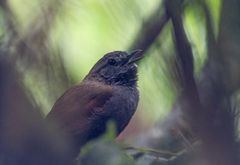
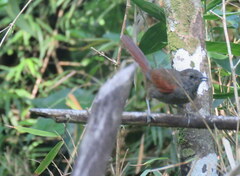
The grey-bellied spinetail is 13.5 to 15 cm (5.3 to 5.9 in) long and weighs 10 to 14 g (0.35 to 0.49 oz). The sexes have the same plumage. Adults have blackish lores and a faint gray line behind the eye on an otherwise gray-brown face. Their forehead is dark grayish brown, their crown dark brownish olive, and their back, rump, and uppertail coverts are richer brown. Their wings are mostly rich reddish chestnut. Their tail is dark chestnut; the tips of the feathers have no barbs giving a spiny appearance. Their chin is whitish, their upper throat mottled black and pale gray, and their lower throat black. Their underparts are mostly brownish gray with a paler and grayer center to the belly and browner flanks and undertail coverts. Their iris is reddish brown, their bill black (sometimes with a gray base to the mandible), and their legs and... Wikipedia →

Sounds

Call0:12

Brazil · 2025

© JAYRSON ARAUJO DE OLIVEIRA · XC1053052 · CC BY-NC-SA 4.0

Song1:15

Brazil · 2025

© Joost van Bruggen · XC1050499 · CC BY-NC-ND 4.0

Alarm call1:17

Brazil · 2013

© Ricardo Gagliardi · XC472267 · CC BY-NC-SA 4.0

Global Distribution

Parks Where Found

# Park Country Daily sighting probability
1 Itatiaia National Park 🇧🇷 Brazil
<5%
2 Iguazú National Park 🇦🇷 Argentina
<5%
3 Iguaçu National Park 🇧🇷 Brazil
<5%

Cities Where Found

# City Country Daily sighting probability
1 Porto Alegre 🇧🇷 Brazil
~10%
2 Curitiba 🇧🇷 Brazil
<5%

Before you go

What are the chances of seeing a Gray-bellied Spinetail in Itatiaia National Park?

Rare

Under 5% of wildlife watchers report a Gray-bellied Spinetail sighting in Itatiaia National Park on a given day, based on 78 verified sightings from GBIF citizen-science data from 2019 to 2026. It is the 200th most-seen of the 352 birds we can rate there. Over three days the chance rises to about 10%, and over a week to about 30%, if each day is a fresh chance.

When is the best time to see a Gray-bellied Spinetail in Itatiaia National Park?

April

In that month about 20% of wildlife watchers report a Gray-bellied Spinetail in Itatiaia National Park on a given day, against under 5% in January–February, June–July and September–November, the lowest months.

What time of day is best to see a Gray-bellied Spinetail?

Between 8 and 11 am

Across all the parks we cover, that three-hour window holds the most Gray-bellied Spinetail sightings with a recorded time, and about 8 in 10 of them come between 6 am and 6 pm: it is a daytime animal.

Is Itatiaia National Park the best place to see a Gray-bellied Spinetail?

Yes

Of the 3 parks where we can rate Gray-bellied Spinetail sightings, Itatiaia National Park has the highest daily chance: under 5%. Next come Iguazú National Park (Argentina, under 5%) and Iguaçu National Park (Brazil, under 5%).

Which relatives of the Gray-bellied Spinetail live in Itatiaia National Park?

Same genus: Synallaxis

The closest relatives of the Gray-bellied Spinetail that you can see in Itatiaia National Park (genus Synallaxis, Synallaxis Spinetails) are Rufous-capped Spinetail (about 40%) and Spix's Spinetail (about 20%), with each one's daily chance of a sighting.

Where does the Gray-bellied Spinetail sighting chance come from?

GBIF citizen-science records

It is estimated from how often the Gray-bellied Spinetail is recorded against all the birds logged in Itatiaia National Park (78 verified sightings from 2019 to 2026), calibrated against known sighting rates. Figures are rounded to the nearest 10% because citizen-science data supports honest approximations, not decimals, and months with records from fewer than five people show "—". How it works.

← Back to Itatiaia National Park