
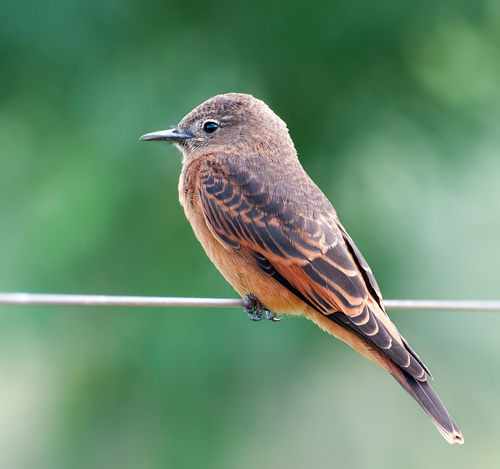
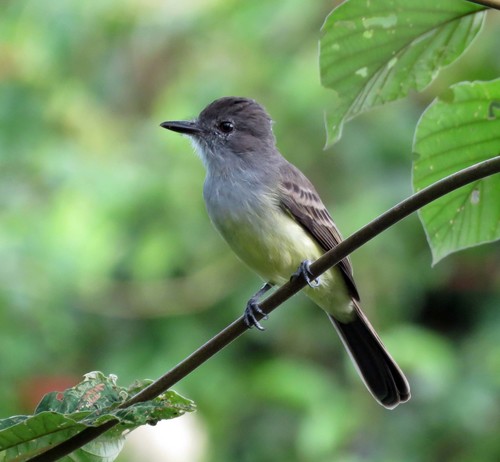
Gray-hooded Attila

Gray-hooded Attila

Attila rufus

Silhouette: Emily Willoughby · PhyloPic

LCLeast ConcernNTVUENCR Endemic
Daily sighting probability ~20% · Possible
at Itatiaia National Park

In 3 days ~40% in a week ~70%

265 Verified sightings at Itatiaia National Park From 2019 to 2026
575 In all 2 parks
September Best month
☀️ Diurnal When it's spotted

About the Gray-hooded Attila

The grey-hooded attila (Attila rufus) is a species of bird in the family Tyrannidae, the tyrant flycatchers. It is endemic to Brazil. The grey-hooded attila was originally described as Tyrannus rufus. From early in the twentieth century until the 1970s many authors classified genus Attila in family Cotingidae; after that it was recognized as belonging to family Tyrannidae.

The grey-hooded attila is 20 to 21 cm (7.9 to 8.3 in) long and weighs 36.5 to 51.5 g (1.3 to 1.8 oz). The sexes have the same plumage. Adults of the nominate subspecies have a gray head and nape. Their upperparts are mostly deep rufous with a paler cinnamon-rufous rump and tail. Their wings are mostly deep rufous with blackish primaries. Their chin is gray with white streaks. Their breast is rufous and their belly a paler yellowish rufous. Subspecies A. r. hellmayri has a whitish chin and rufous throat. Adults of both subspecies have a dark iris, a longish bill with a dark maxilla and a whitish to grayish mandible, and gray legs and feet. Juveniles... Wikipedia →

Sounds

Song0:13

Brazil · 2026

© Fabrício Grigolin · XC1088387 · CC BY-NC-SA 4.0

Call0:22

Brazil · 2025

© Ricardo José Mitidieri · XC1064980 · CC BY-NC-SA 4.0

Begging call0:30

Brazil · 2024

© Augusto Matheus dos Santos · XC950382 · CC BY-NC-SA 4.0

Global Distribution

Parks Where Found

# Park Country Daily sighting probability
1 Serra dos Órgãos National Park 🇧🇷 Brazil
~50%
2 Itatiaia National Park 🇧🇷 Brazil
~20%

Cities Where Found

# City Country Daily sighting probability
1 Santos 🇧🇷 Brazil
~10%
2 São Paulo 🇧🇷 Brazil
<5%

Before you go

What are the chances of seeing a Gray-hooded Attila in Itatiaia National Park?

Possible

About 20% of wildlife watchers report a Gray-hooded Attila sighting in Itatiaia National Park on a given day, based on 265 verified sightings from GBIF citizen-science data from 2019 to 2026. It is the 127th most-seen of the 352 birds we can rate there. Over three days the chance rises to about 40%, and over a week to about 70%, if each day is a fresh chance.

When is the best time to see a Gray-hooded Attila in Itatiaia National Park?

September

In that month about 30% of wildlife watchers report a Gray-hooded Attila in Itatiaia National Park on a given day, against under 5% in February and May–June, the lowest months.

What time of day is best to see a Gray-hooded Attila?

Between 7 and 10 am

Across all the parks we cover, that three-hour window holds the most Gray-hooded Attila sightings with a recorded time, and about 9 in 10 of them come between 6 am and 6 pm: it is a daytime animal.

Is Itatiaia National Park the best place to see a Gray-hooded Attila?

2nd of 2

Of the 2 parks where we can rate Gray-hooded Attila sightings, Itatiaia National Park ranks 2nd at about 20%. The best odds are in Serra dos Órgãos National Park (Brazil, about 50%).

Which relatives of the Gray-hooded Attila live in Itatiaia National Park?

Same family: Tyrannidae

The closest relatives of the Gray-hooded Attila that you can see in Itatiaia National Park (family Tyrannidae, Tyrant Flycatchers) are Cliff Flycatcher (about 60%), Great Kiskadee (about 50%) and Planalto Tyrannulet (about 40%), with each one's daily chance of a sighting.

Where does the Gray-hooded Attila sighting chance come from?

GBIF citizen-science records

It is estimated from how often the Gray-hooded Attila is recorded against all the birds logged in Itatiaia National Park (265 verified sightings from 2019 to 2026), calibrated against known sighting rates. Figures are rounded to the nearest 10% because citizen-science data supports honest approximations, not decimals, and months with records from fewer than five people show "—". How it works.

← Back to Itatiaia National Park