

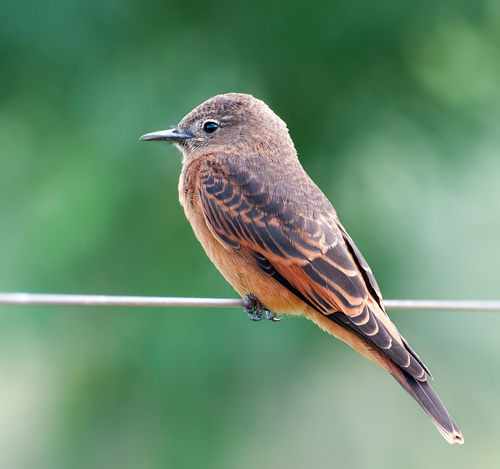

Olive-green Tanager

Olive-green Tanager

Orthogonys chloricterus

Silhouette: Sheatherius · PhyloPic

LCLeast ConcernNTVUENCR Endemic
Daily sighting probability ~20% · Possible
at Itatiaia National Park

In 3 days ~60% in a week ~80%

452 Verified sightings at Itatiaia National Park From 2019 to 2026
499 In all 3 parks
June Best month
☀️ Diurnal When it's spotted

About the Olive-green Tanager

The olive-green tanager (Orthogonys chloricterus) is a species of bird in the family Mitrospingidae. It is endemic to Brazil. The olive-green tanager and the three other species in family Mitrospingidae were previously placed in family Thraupidae, the "true" tanagers. A 2013 publication detailed how they did not belong there and proposed the new family for them. The International Ornithological Committee (IOC) followed suit in January 2018.

The olive-green tanager is the only member of its genus and has no subspecies. The olive-green tanager is 18 to 19 cm (7.1 to 7.5 in) long. The adult is olive green above and dull yellow below; it has a tinge of olive on the sides and flanks. The olive-green tanager is found only in southeastern Brazil, from Espírito Santo state south to eastern Santa Catarina and northeastern Rio Grande do Sul. It inhabits the interior and edges of humid montane forest at elevations of 900 to 1,800 m (3,000 to 5,900 ft).... Wikipedia →

Sounds

Call0:08

Brazil · 2022

© Miguel Angelo Biz · XC734947 · CC BY-NC-SA 4.0

Song1:24

Brazil · 2021

© Daniel Hinckley · XC677063 · CC BY-NC-SA 4.0

Canto0:37

Brazil · 2017

© Caio Brito · XC427730 · CC BY-NC-SA 4.0

Global Distribution

Parks Where Found

# Park Country Daily sighting probability
1 Itatiaia National Park 🇧🇷 Brazil
~20%
2 Serra dos Órgãos National Park 🇧🇷 Brazil
~10%
3 Tijuca National Park 🇧🇷 Brazil
<5%

Before you go

What are the chances of seeing an Olive-green Tanager in Itatiaia National Park?

Possible

About 20% of wildlife watchers report an Olive-green Tanager sighting in Itatiaia National Park on a given day, based on 452 verified sightings from GBIF citizen-science data from 2019 to 2026. It is the 83rd most-seen of the 352 birds we can rate there. Over three days the chance rises to about 60%, and over a week to about 80%, if each day is a fresh chance.

When is the best time to see an Olive-green Tanager in Itatiaia National Park?

June

In that month about 40% of wildlife watchers report an Olive-green Tanager in Itatiaia National Park on a given day, against under 5% in May, the lowest month. That is one of Itatiaia National Park's driest months, with about 45 mm of rain against 330 mm in December.

What time of day is best to see an Olive-green Tanager?

Between 10 am and 1 pm

Across all the parks we cover, that three-hour window holds the most Olive-green Tanager sightings with a recorded time, and about 9 in 10 of them come between 6 am and 6 pm: it is a daytime animal.

Is Itatiaia National Park the best place to see an Olive-green Tanager?

Yes

Of the 3 parks where we can rate Olive-green Tanager sightings, Itatiaia National Park has the highest daily chance: about 20%. Next come Serra dos Órgãos National Park (Brazil, about 10%) and Tijuca National Park (Brazil, under 5%).

Which relatives of the Olive-green Tanager live in Itatiaia National Park?

Same order: Passeriformes

The closest relatives of the Olive-green Tanager that you can see in Itatiaia National Park (order Passeriformes, Perching Birds) are Rufous-collared Sparrow (about 80%), Golden-crowned Warbler (about 70%) and Saffron Finch (about 60%), with each one's daily chance of a sighting.

Where does the Olive-green Tanager sighting chance come from?

GBIF citizen-science records

It is estimated from how often the Olive-green Tanager is recorded against all the birds logged in Itatiaia National Park (452 verified sightings from 2019 to 2026), calibrated against known sighting rates. Figures are rounded to the nearest 10% because citizen-science data supports honest approximations, not decimals, and months with records from fewer than five people show "—". How it works.

← Back to Itatiaia National Park