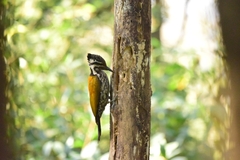

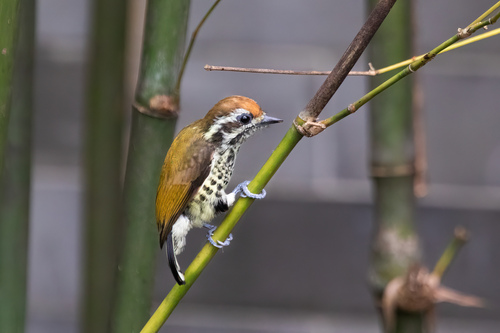
Himalayan Flameback

Himalayan Flameback

Dinopium shorii

Silhouette: Pepe Reigada · PhyloPic

LCLeast ConcernNTVUENCR
Daily sighting probability ~10% · With luck
at Jim Corbett National Park

In 3 days ~30% in a week ~60%

261 Verified sightings at Jim Corbett National Park From 2019 to 2026
720 In all 4 parks
February Best month
🌅 Crepuscular When it's spotted

About the Himalayan Flameback

The Himalayan flameback (Dinopium shorii), also known as the Himalayan goldenback, is a species of bird in the family Picidae. At the moment very little is known of this species and more fieldwork is required. The Himalayan flameback is not threatened but it is suspected that deforestation could severely affect the species population.

The Himalayan flameback is very similar in appearance to the Greater Goldenback (Chrysocolaptes lucidus) but they are not at all closely related. The primary differences are its smaller size and bill. The Himalayan flameback can be identified by its black hind neck, and the brownish center on its throat, which can go down the breast on some and is bordered by an irregular black spotting. They also have an indistinct divided moustachial stripe, the center of which is brownish, and sometimes reddish in males. The Himalayan flameback also has either reddish or brown eyes and three toes. The breast of the Himalayan flameback is irregularly streaked with black, but on occasion completely white. Their wings are coppery brown to red. Lastly, the males have a yellowish-red forehead that becomes more red on the crest. In contrast, the female... Wikipedia →

Sounds

Flight call0:25

Nepal · 1987

© Jelle Scharringa · XC606873 · CC BY-NC-SA 4.0

Call0:15

India · 2018

© Mandar Bhagat · XC417812 · CC BY-NC-ND 4.0

Call0:09

Myanmar · 2014

© Frank Lambert · XC208887 · CC BY-NC-ND 4.0

Global Distribution

Parks Where Found

# Park Country Daily sighting probability
1 Royal Bardia National Park 🇳🇵 Nepal
~30%
2 Chitwan National Park 🇳🇵 Nepal
~20%
3 Jim Corbett National Park 🇮🇳 India
~10%
4 Royal Manas National Park 🇧🇹 Bhutan
<5%

Cities Where Found

# City Country Daily sighting probability
1 Dehradun 🇮🇳 India
<5%

Before you go

What are the chances of seeing a Himalayan Flameback in Jim Corbett National Park?

With luck

About 10% of wildlife watchers report a Himalayan Flameback sighting in Jim Corbett National Park on a given day, based on 261 verified sightings from GBIF citizen-science data from 2019 to 2026. It is the 114th most-seen of the 368 birds we can rate there. Over three days the chance rises to about 30%, and over a week to about 60%, if each day is a fresh chance.

When is the best time to see a Himalayan Flameback in Jim Corbett National Park?

December to February

In those months about 20% of wildlife watchers report a Himalayan Flameback in Jim Corbett National Park on a given day, against under 5% in April and June–September, the lowest months. Those are among Jim Corbett National Park's driest months, with about 30 mm of rain a month against 360 mm in July.

What time of day is best to see a Himalayan Flameback?

Between 3 and 6 am

Across all the parks we cover, that three-hour window holds the most Himalayan Flameback sightings with a recorded time, and about half of them come between 6 am and 6 pm: it is most active around dawn and dusk.

Is Jim Corbett National Park the best place to see a Himalayan Flameback?

3rd of 4

Of the 4 parks where we can rate Himalayan Flameback sightings, Jim Corbett National Park ranks 3rd at about 10%. The best odds are in Royal Bardia National Park (Nepal, about 30%) and Chitwan National Park (Nepal, about 20%).

Where does the Himalayan Flameback sighting chance come from?

GBIF citizen-science records

It is estimated from how often the Himalayan Flameback is recorded against all the birds logged in Jim Corbett National Park (261 verified sightings from 2019 to 2026), calibrated against known sighting rates. Figures are rounded to the nearest 10% because citizen-science data supports honest approximations, not decimals, and months with records from fewer than five people show "—". How it works.

← Back to Jim Corbett National Park