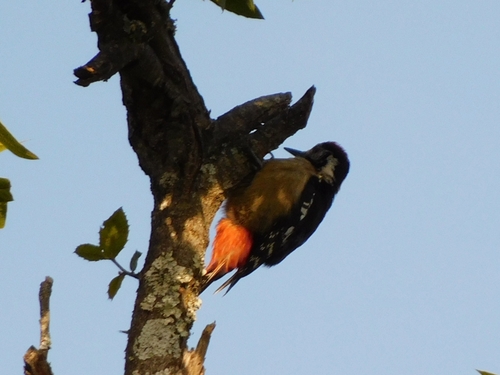
Fulvous-breasted Woodpecker

Fulvous-breasted Woodpecker

Dendrocopos macei

Silhouette: Steven Traver · PhyloPic

LCLeast ConcernNTVUENCR
Daily sighting probability ~20% · Possible
at Jim Corbett National Park

In 3 days ~50% in a week ~80%

508 Verified sightings at Jim Corbett National Park From 2019 to 2026
2,095 In all 8 parks
January Best month
☀️ Diurnal When it's spotted

About the Fulvous-breasted Woodpecker

The fulvous-breasted woodpecker (Dendrocopos macei) is a species of bird in the family Picidae. It is found in Bangladesh, Bhutan, Nepal, India and Myanmar. The freckle-breasted woodpecker was formerly considered conspecific with this species.

A medium-sized, pied woodpecker. Upperparts black, heavily barred white. Undertail red, breast and belly buff with light flank barring and slight side streaking. Withish cheeks partly bordered by black line. Crown red in male with orange forehead, black in female.

Its natural habitats are subtropical or tropical dry forest, subtropical or tropical moist lowland forest, and subtropical or tropical moist montane forest. Media related to Dendrocopos macei at Wikimedia Commons Wikipedia →

Sounds

Call0:49

China · 2026

© JJSUN · XC1086706 · CC BY-NC-SA 4.0

Call0:28

Bangladesh · 2024

© Ding Li Yong · XC910320 · CC BY-NC-ND 4.0

Call0:36

Nepal · 1992

© Scott Connop · XC581796 · CC BY-NC-SA 4.0

Global Distribution

Parks Where Found

# Park Country Daily sighting probability
1 Chitwan National Park 🇳🇵 Nepal
~30%
2 Manas National Park 🇮🇳 India
~30%
3 Sundarbans National Park 🇮🇳 India
~20%
4 Jim Corbett National Park 🇮🇳 India
~20%
5 Royal Manas National Park 🇧🇹 Bhutan
~10%
6 Royal Bardia National Park 🇳🇵 Nepal
~10%
7 Kaziranga National Park 🇮🇳 India
<5%
8 Namdapha National Park 🇮🇳 India
<5%

Cities Where Found

# City Country Daily sighting probability
1 Savar 🇧🇩 Bangladesh
~40%
2 Tamluk 🇮🇳 India
~30%
3 Dhaka 🇧🇩 Bangladesh
~30%
4 Guwahati 🇮🇳 India
~20%
5 Chattogram 🇧🇩 Bangladesh
~10%
6 Berhampore 🇮🇳 India
~10%
7 Kathmandu 🇳🇵 Nepal
~10%
8 Dehradun 🇮🇳 India
~10%
9 Kolkata 🇮🇳 India
<5%

Before you go

What are the chances of seeing a Fulvous-breasted Woodpecker in Jim Corbett National Park?

Possible

About 20% of wildlife watchers report a Fulvous-breasted Woodpecker sighting in Jim Corbett National Park on a given day, based on 508 verified sightings from GBIF citizen-science data from 2019 to 2026. It is the 61st most-seen of the 368 birds we can rate there. Over three days the chance rises to about 50%, and over a week to about 80%, if each day is a fresh chance.

When is the best time to see a Fulvous-breasted Woodpecker in Jim Corbett National Park?

December to February

In those months about 30% of wildlife watchers report a Fulvous-breasted Woodpecker in Jim Corbett National Park on a given day, against under 5% in July and September, the lowest months. Those are among Jim Corbett National Park's driest months, with about 30 mm of rain a month against 360 mm in July.

What time of day is best to see a Fulvous-breasted Woodpecker?

Between 7 and 10 am

Across all the parks we cover, that three-hour window holds the most Fulvous-breasted Woodpecker sightings with a recorded time, and about 9 in 10 of them come between 6 am and 6 pm: it is a daytime animal.

Is Jim Corbett National Park the best place to see a Fulvous-breasted Woodpecker?

4th of 8

Of the 8 parks where we can rate Fulvous-breasted Woodpecker sightings, Jim Corbett National Park ranks 4th at about 20%. The best odds are in Chitwan National Park (Nepal, about 30%), Manas National Park (India, about 30%) and Sundarbans National Park (India, about 20%).

Where does the Fulvous-breasted Woodpecker sighting chance come from?

GBIF citizen-science records

It is estimated from how often the Fulvous-breasted Woodpecker is recorded against all the birds logged in Jim Corbett National Park (508 verified sightings from 2019 to 2026), calibrated against known sighting rates. Figures are rounded to the nearest 10% because citizen-science data supports honest approximations, not decimals, and months with records from fewer than five people show "—". How it works.

← Back to Jim Corbett National Park