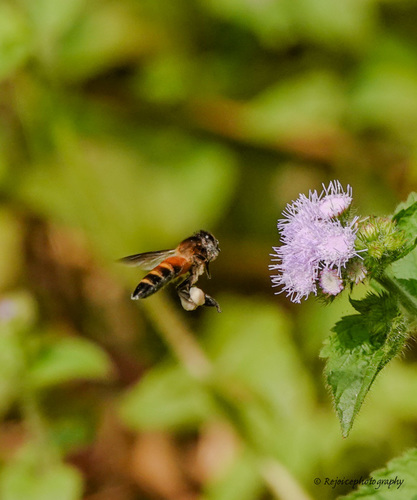
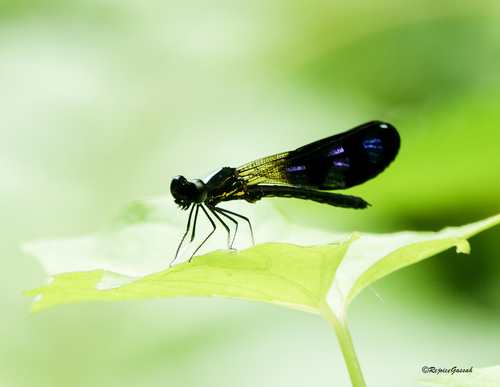
Tropical Tiger Moth

Tropical Tiger Moth

Asota caricae

Daily sighting probability ~20% · Possible
at Jim Corbett National Park

In 3 days ~40% in a week ~70%

5 Verified sightings at Jim Corbett National Park From 2019 to 2026
67 In all 5 parks
September Best month
🌙 Nocturnal When it's spotted

About the Tropical Tiger Moth

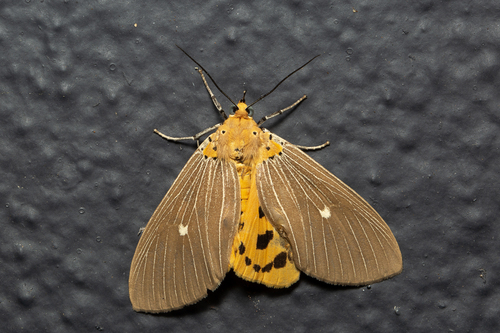
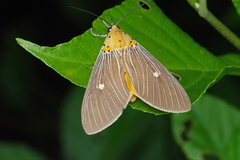
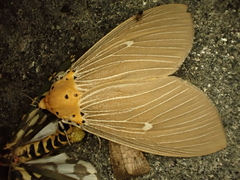
Asota caricae, the tropical tiger moth, is a species of noctuoid moth in the family Erebidae. It is found from the Indo-Australian tropics of India and Sri Lanka to Queensland, Malaysia and Vanuatu. The wingspan is 51–58 mm. Palpi with black spots on 1st and 2nd joints. Forewings brownish fuscous. There is a basal orange patch with two subbasal black spots and a series of three spots on its outer edge, that matches the coloration of the scales of the thorax. The veins are streaked with white. There is a white spot at lower angle of the discal cell. Hindwings are orange yellow, with a black spot at the end of the discal cell, one beyond, one below vein 2 and a submarginal irregular series which sometimes becomes a nearly complete marginal band. The veins crossing the band are yellowish. Larva black above, with two dorsal white bands, a sub-dorsal black spot on each somite. A series of lateral black specks present with sparse black hairs. Ventral coloration brown, head capsule is reddish.

The larvae have been recorded on Ficus, Broussonetia, Mesua, Tectona and Shorea species. Pupation is in a slight cocoon, fixed to a leaf. The species is found in forest... Wikipedia →

Global Distribution

Parks Where Found

# Park Country Daily sighting probability
1 Kanha National Park 🇮🇳 India
~30%
2 Jim Corbett National Park 🇮🇳 India
~20%
3 Cat Tien National Park 🇻🇳 Vietnam
~10%
4 Khao Yai National Park 🇹🇭 Thailand
~10%
5 Daintree National Park 🇦🇺 Australia
~10%

Cities Where Found

# City Country Daily sighting probability
1 Jamshedpur 🇮🇳 India
~50%
2 Kanpur 🇮🇳 India
~50%
3 Malang 🇮🇩 Indonesia
~30%
4 Kota 🇮🇳 India
~20%
5 Vadodara 🇮🇳 India
~20%
6 Kozhikode 🇮🇳 India
~20%
7 Thrissur 🇮🇳 India
~20%
8 Thiruvananthapuram 🇮🇳 India
~20%
9 Jabalpur 🇮🇳 India
~20%
10 Kolkata 🇮🇳 India
~20%

Before you go

What are the chances of seeing a Tropical Tiger Moth in Jim Corbett National Park?

Possible

About 20% of wildlife watchers report a Tropical Tiger Moth sighting in Jim Corbett National Park on a given day, based on 5 verified sightings from GBIF citizen-science data from 2019 to 2026. Over three days the chance rises to about 40%, and over a week to about 70%, if each day is a fresh chance.

When is the best time to see a Tropical Tiger Moth in Jim Corbett National Park?

September

In that month about 60% of wildlife watchers report a Tropical Tiger Moth in Jim Corbett National Park on a given day, against under 5% in May–July and October–March, the lowest months. That is one of Jim Corbett National Park's wettest months, with about 160 mm of rain against almost none in November.

What time of day is best to see a Tropical Tiger Moth?

Between 9 pm and midnight

Across all the parks we cover, that three-hour window holds the most Tropical Tiger Moth sightings with a recorded time, and about 8 in 10 of them come between 6 pm and 6 am: it is mostly seen at night.

Is Jim Corbett National Park the best place to see a Tropical Tiger Moth?

2nd of 5

Of the 5 parks where we can rate Tropical Tiger Moth sightings, Jim Corbett National Park ranks 2nd at about 20%. The best odds are in Kanha National Park (India, about 30%).

Where does the Tropical Tiger Moth sighting chance come from?

GBIF citizen-science records

It is estimated from how often the Tropical Tiger Moth is recorded against all the insects logged in Jim Corbett National Park (5 verified sightings from 2019 to 2026), calibrated against known sighting rates. Figures are rounded to the nearest 10% because citizen-science data supports honest approximations, not decimals, and months with records from fewer than five people show "—". How it works.

← Back to Jim Corbett National Park