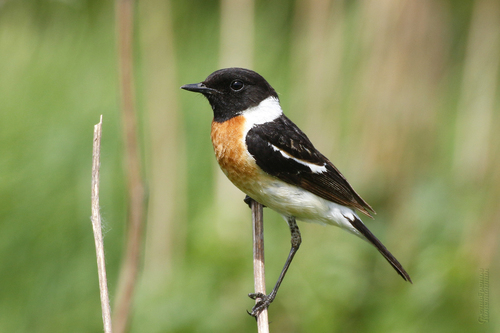
White-tailed Rubythroat

White-tailed Rubythroat

Luscinia pectoralis

Silhouette: Stephan Sprinz · PhyloPic

Daily sighting probability ~10% · With luck
at Jim Corbett National Park

In 3 days ~20% in a week ~40%

188 Verified sightings at Jim Corbett National Park From 2019 to 2026
222 In all 2 parks
December Best month
☀️ Diurnal When it's spotted

About the White-tailed Rubythroat

The Himalayan rubythroat (Calliope pectoralis) is a species of passerine bird in the family Muscicapidae. It is closely related to the Siberian rubythroat which however lacks the distinctive white tail-tips and white tail bases. It was also previously considered conspecific with the Chinese rubythroat, together called the white-tailed rubythroat. It is found along the Tien Shan and Himalayan ranges from Afghanistan to Myanmar. Three subspecies are recognized across its wide range.

The first formal description of the Himalayan rubythroat was by the English ornithologist and bird artist John Gould in 1837. He coined the binomial name Calliope pectoralis. The species was given the English name "white-tailed rubythroat" and moved to the genus Luscinia. A large molecular phylogenetic study published in 2010 found that the genus Luscinia was not monophyletic. The genus was therefore split and several species including the white-tailed rubythroat were returned to the reinstated genus Calliope. Another study published in 2016 compared the mitochondrial DNA, vocalization and morphology of several Calliope pectoralis subspecies. Based on their results the authors recommended... Wikipedia →

Global Distribution

Parks Where Found

# Park Country Daily sighting probability
1 Jim Corbett National Park 🇮🇳 India
~10%
2 Chitwan National Park 🇳🇵 Nepal
<5%

Cities Where Found

# City Country Daily sighting probability
1 Dehradun 🇮🇳 India
<5%
2 Kathmandu 🇳🇵 Nepal
<5%

Before you go

What are the chances of seeing a White-tailed Rubythroat in Jim Corbett National Park?

With luck

About 10% of wildlife watchers report a White-tailed Rubythroat sighting in Jim Corbett National Park on a given day, based on 188 verified sightings from GBIF citizen-science data from 2019 to 2026. It is the 142nd most-seen of the 368 birds we can rate there. Over three days the chance rises to about 20%, and over a week to about 40%, if each day is a fresh chance.

When is the best time to see a White-tailed Rubythroat in Jim Corbett National Park?

December and January

In those months about 20% of wildlife watchers report a White-tailed Rubythroat in Jim Corbett National Park on a given day, against under 5% in April to September, the lowest months. Those are among Jim Corbett National Park's driest months, with about 30 mm of rain a month against 360 mm in July.

What time of day is best to see a White-tailed Rubythroat?

Between 9 am and noon

Across all the parks we cover, that three-hour window holds the most White-tailed Rubythroat sightings with a recorded time, and about 9 in 10 of them come between 6 am and 6 pm: it is a daytime animal.

Is Jim Corbett National Park the best place to see a White-tailed Rubythroat?

Yes

Of the 2 parks where we can rate White-tailed Rubythroat sightings, Jim Corbett National Park has the highest daily chance: about 10%. Next come Chitwan National Park (Nepal, under 5%).

Where does the White-tailed Rubythroat sighting chance come from?

GBIF citizen-science records

It is estimated from how often the White-tailed Rubythroat is recorded against all the birds logged in Jim Corbett National Park (188 verified sightings from 2019 to 2026), calibrated against known sighting rates. Figures are rounded to the nearest 10% because citizen-science data supports honest approximations, not decimals, and months with records from fewer than five people show "—". How it works.

← Back to Jim Corbett National Park