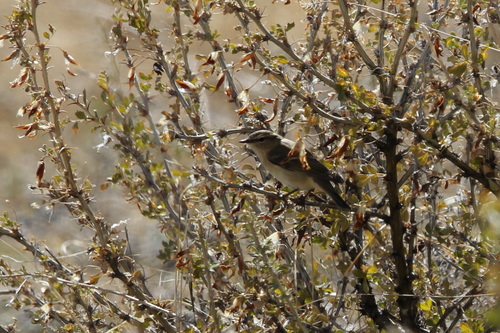
Blue Eared Pheasant

Blue Eared Pheasant

Crossoptilon auritum

Silhouette: painting Guo · PhyloPic

LCLeast ConcernNTVUENCR
Daily sighting probability ~30% · Possible
at Jiuzhaigou National Park

In 3 days ~60% in a week ~90%

44 Verified sightings at Jiuzhaigou National Park From 2019 to 2026
44 In 1 park
June Best month
🌅 Crepuscular When it's spotted

About the Blue Eared Pheasant

The blue eared pheasant (Crossoptilon auritum), also sometimes hyphenated as blue eared-pheasant, is a large pheasant endemic to China. Although it is considered rare, the blue eared pheasant is evaluated as of least concern.

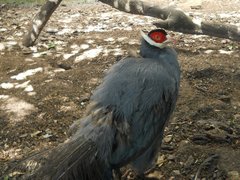
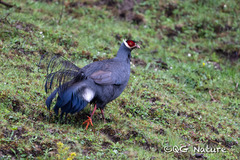
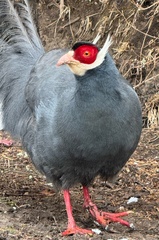
The blue eared pheasant is around 96 cm (38 in) long (including the 49–56 cm (19–22 in) tail); males weigh 1700–2110 g, and females 1450–1880 g. It has dark blue-grey plumage with velvet black crown, red facial wattles of bare skin surrounding the eyes, yellow iris, long white ear coverts below and behind the eyes, a pale pink bill, and crimson legs. Its tail of 24 elongated bluish-grey feathers is curved, loose, and dark-tipped, with the outer five pairs of tail feathers having a white base. Both sexes have similar plumage, though the male is slightly larger, and has short spurs on the legs.

The blue eared pheasant is found in the mountain forests of central China, preferring juniper scrub in alpine meadows at 2700–4400 m altitude. Its range is to the northeast of the closely related white eared pheasant C. crossoptilon, and southwest of the brown eared pheasant C. mantchuricum.

Its diet consists mainly (about... Wikipedia →

Sounds

Call0:09

China · 2023

© 王自堃 · XC817653 · CC BY-NC-SA 4.0

Song0:13

China · 2013

© Yong Ding Li · XC150119 · CC BY-NC-ND 3.0

Call0:55

China · 2019

© Peter Boesman · XC491204 · CC BY-NC-ND 4.0

Global Distribution

Parks Where Found

# Park Country Daily sighting probability
1 Jiuzhaigou National Park 🇨🇳 China
~30%

More parks will be added in future updates.

Zoos & Centres Where Found

# Zoo / Centre Country
1 Moscow Zoo 🇷🇺 Russia In captivity
2 Tierpark Berlin 🇩🇪 Germany In captivity
3 Beijing Wildlife Park 🇨🇳 China In captivity
4 Poznań Nowe Zoo 🇵🇱 Poland In captivity
5 Bronx Zoo 🇺🇸 United States In captivity
6 Tallinn Zoo 🇪🇪 Estonia In captivity
7 Shanghai Zoo 🇨🇳 China In captivity
8 Parc animalier de Gramat 🇫🇷 France In captivity
9 Карельский зоопарк 🇷🇺 Russia In captivity
10 Yerevan Zoo 🇦🇲 Armenia In captivity
11 Kyiv Zoo 🇺🇦 Ukraine In captivity
12 无锡动物园 🇨🇳 China In captivity
13 Emirates Park Zoo 🇦🇪 United Arab Emirates In captivity
14 Kharkiv Zoo 🇺🇦 Ukraine In captivity
15 Cleres Zoological Park 🇫🇷 France In captivity
16 Johnsons of Old Hurst 🇬🇧 United Kingdom In captivity
17 Zoopark Limpopo 🇷🇺 Russia In captivity
18 Santillana Zoo 🇪🇸 Spain In captivity
19 Міні-зоопарк 🇺🇦 Ukraine In captivity
20 Zoo Koki (Parque zoológico y botánico) 🇪🇸 Spain In captivity
21 Zoopark Nehvizdy 🇨🇿 Czechia In captivity
22 Avifauna 🇪🇸 Spain In captivity
23 Зоопарк 🇺🇦 Ukraine In captivity
24 Zoo de Lourosa 🇵🇹 Portugal In captivity
25 Kharkiv Dolphinarium 🇺🇦 Ukraine In captivity
26 Batu Secret Zoo 🇮🇩 Indonesia In captivity
27 Karelian Zoo 🇷🇺 Russia In captivity
28 Xining Zoo 🇨🇳 China In captivity

Before you go

What are the chances of seeing a Blue Eared Pheasant in Jiuzhaigou National Park?

Possible

About 30% of wildlife watchers report a Blue Eared Pheasant sighting in Jiuzhaigou National Park on a given day, based on 44 verified sightings from GBIF citizen-science data from 2019 to 2026. It is the 29th most-seen of the 131 birds we can rate there. Over three days the chance rises to about 60%, and over a week to about 90%, if each day is a fresh chance.

When is the best time to see a Blue Eared Pheasant in Jiuzhaigou National Park?

June

In that month about 40% of wildlife watchers report a Blue Eared Pheasant in Jiuzhaigou National Park on a given day, against about 10% in November, the lowest month. That is one of Jiuzhaigou National Park's wettest months, with about 160 mm of rain against 15 mm in December. January to March have too few records to rate.

What time of day is best to see a Blue Eared Pheasant?

Between 1 and 4 am

Across all the parks we cover, that three-hour window holds the most Blue Eared Pheasant sightings with a recorded time, and about 6 in 10 of them come between 6 pm and 6 am: it is most active around dawn and dusk.

Where else can you see a Blue Eared Pheasant?

Only Jiuzhaigou National Park, in our data

Jiuzhaigou National Park is the only park on Wallace's Line with enough records to rate Blue Eared Pheasant sightings: about 30% of wildlife watchers there report one on a given day.

Which relatives of the Blue Eared Pheasant live in Jiuzhaigou National Park?

Same family: Phasianidae

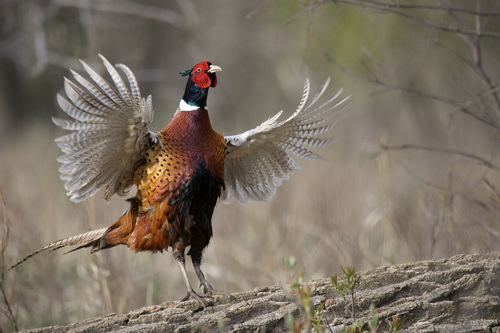
The closest relatives of the Blue Eared Pheasant that you can see in Jiuzhaigou National Park (family Phasianidae, Pheasants, Grouse, and Allies) are Blood Pheasant (about 20%), Tibetan Snowcock (about 10%) and Ring-necked Pheasant (about 10%), with each one's daily chance of a sighting.

Where does the Blue Eared Pheasant sighting chance come from?

GBIF citizen-science records

It is estimated from how often the Blue Eared Pheasant is recorded against all the birds logged in Jiuzhaigou National Park (44 verified sightings from 2019 to 2026), calibrated against known sighting rates. Figures are rounded to the nearest 10% because citizen-science data supports honest approximations, not decimals, and months with records from fewer than five people show "—". How it works.

← Back to Jiuzhaigou National Park