Lawrence's Goldfinch

Lawrence's Goldfinch

Spinus lawrencei

Silhouette: Andy Wilson · PhyloPic

LCLeast ConcernNTVUENCR
Daily sighting probability <5% · Rare
at Joshua Tree National Park

In 3 days <5% in a week ~10%

47 Verified sightings at Joshua Tree National Park From 2019 to 2026
448 In all 6 parks
September Best month
☀️ Diurnal When it's spotted

About the Lawrence's Goldfinch

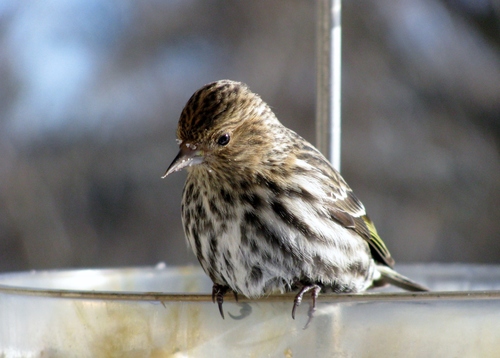
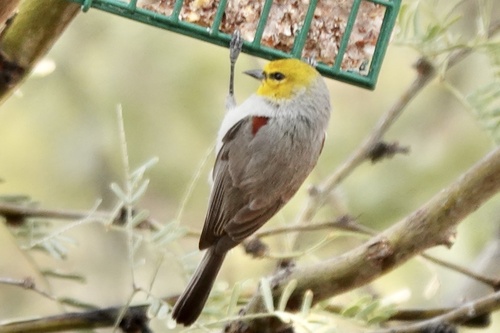
Lawrence's goldfinch (Spinus lawrencei) is a small songbird of erratic distribution that breeds in California and Baja California and winters in the southwestern United States and northern Mexico. At about 4.75 in (12.1 cm) long and weighing about 0.4 oz (11 g), it is slightly bigger than the lesser goldfinch and slightly smaller than the American goldfinch, with less yellow in the plumage than either. Adults of both sexes are gray with pink to grayish flesh-color bills, stubbier than other goldfinches'. They have yellow rumps and paired yellowish wing-bars, as well as yellow edges on the flight feathers and yellow on the breast. The tail is black, crossed by a white band. Plumage is duller in winter, brightening after a spring molt. Males are paler, with black caps and faces and larger areas of brighter yellow. Females are browner, have less and duller yellow, and lack the black. Juveniles resemble females but are even duller and have faint streaks on the upperparts and especially the underparts.

Calls include "a nasal too-err, also a sharp, high PIti and Itititi". The flight call, which is diagnostic, is given as "a high, clear ti-too" or tink-ul "reminiscent of... Wikipedia →

Sounds

Call0:20

United States · 2022

© Paul Marvin · XC750894 · CC BY-NC-SA 4.0

Imitation1:29

Mexico · 2021

© Richard E. Webster · XC661806 · CC BY-NC-SA 4.0

Song0:48

United States · 2019

© Lance A. M. Benner · XC483003 · CC BY-NC-SA 4.0

Global Distribution

Parks Where Found

# Park Country Daily sighting probability
1 Sequoia and Kings Canyon National Parks 🇺🇸 United States
~10%
2 Yosemite National Park 🇺🇸 United States
<5%
3 Joshua Tree National Park 🇺🇸 United States
<5%
4 Death Valley National Park 🇺🇸 United States
<5%
5 Channel Islands National Park 🇺🇸 United States
<5%
6 Saguaro National Park 🇺🇸 United States
<5%

Cities Where Found

# City Country Daily sighting probability
1 Los Angeles 🇺🇸 United States
<5%
2 San Diego 🇺🇸 United States
<5%
3 Sacramento 🇺🇸 United States
<5%
4 Phoenix 🇺🇸 United States
<5%
5 San Francisco 🇺🇸 United States
<5%

Before you go

What are the chances of seeing a Lawrence's Goldfinch in Joshua Tree National Park?

Rare

Under 5% of wildlife watchers report a Lawrence's Goldfinch sighting in Joshua Tree National Park on a given day, based on 47 verified sightings from GBIF citizen-science data from 2019 to 2026. It is the 112th most-seen of the 141 birds we can rate there. Over three days the chance rises to under 5%, and over a week to about 10%, if each day is a fresh chance.

When is the best time to see a Lawrence's Goldfinch in Joshua Tree National Park?

September

In that month about 10% of wildlife watchers report a Lawrence's Goldfinch in Joshua Tree National Park on a given day, against under 5% in October to August, the lowest months.

What time of day is best to see a Lawrence's Goldfinch?

Between 8 and 11 am

Across all the parks we cover, that three-hour window holds the most Lawrence's Goldfinch sightings with a recorded time, and about 9 in 10 of them come between 6 am and 6 pm: it is a daytime animal.

Is Joshua Tree National Park the best place to see a Lawrence's Goldfinch?

3rd of 6

Of the 6 parks where we can rate Lawrence's Goldfinch sightings, Joshua Tree National Park ranks 3rd at under 5%. The best odds are in Sequoia and Kings Canyon National Parks (United States, about 10%) and Yosemite National Park (United States, under 5%).

Where does the Lawrence's Goldfinch sighting chance come from?

GBIF citizen-science records

It is estimated from how often the Lawrence's Goldfinch is recorded against all the birds logged in Joshua Tree National Park (47 verified sightings from 2019 to 2026), calibrated against known sighting rates. Figures are rounded to the nearest 10% because citizen-science data supports honest approximations, not decimals, and months with records from fewer than five people show "—". How it works.

← Back to Joshua Tree National Park