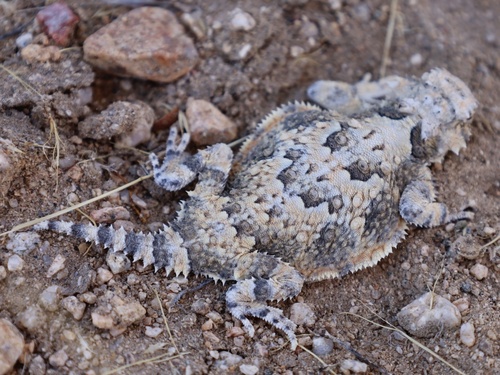
Southwestern Speckled Rattlesnake

Southwestern Speckled Rattlesnake

Crotalus pyrrhus

Silhouette: Bill Bouton (source photo) & T. Michael Keesey (vectorization) · PhyloPic

Daily sighting probability ~50% · Likely
at Joshua Tree National Park

In 3 days ~90% in a week >90%

361 Verified sightings at Joshua Tree National Park From 2019 to 2026
361 In 1 park
May Best month
🌅 Crepuscular When it's spotted

About the Southwestern Speckled Rattlesnake

Common names: southwestern speckled rattlesnake, Mitchell's rattlesnake, more. Crotalus pyrrhus is a venomous pitviper species found in the southwestern United States and northwestern Mexico. A medium-sized snake, it is found mostly in rocky country, active at night and feeding on small mammals. The coloration is variable and depends on the color of the rocks and soil of the habitat.

Adults grow to an average length of 3 feet (91 cm), but may sometimes exceed 4 feet (120 cm). The color pattern is variable, depending on the color of the rocks and soil of the habitat. The snake's ground color may be pink, brown, gray, yellow or nearly white, and speckled with black and white. The pattern (if present) may consist of rhombs, bands or blotches. The tail is ringed.

Southwestern speckled rattlesnake, bleached rattlesnake, Mitchell's rattlesnake, pale rattler, pallid rattlesnake, red rattlesnake, speckled rattlesnake, white rattlesnake. The species may also be referred to colloquially by locality phenotypic traits and an abbreviation of "speckled", to "speck" by snake enthusiasts and in the venomous snake commercial trade. Common versions include blue speck... Wikipedia →

Sounds

Recording0:03

United States · 2025

© mattstragalus · iNaturalist · CC BY-NC 4.0

Recording0:12

United States · 2020

© BJ Stacey · iNaturalist · CC BY-NC 4.0

Recording0:18

United States · 2022

© jalopy · iNaturalist · CC BY-NC 4.0

Global Distribution

Parks Where Found

# Park Country Daily sighting probability
1 Joshua Tree National Park 🇺🇸 United States
~50%

More parks will be added in future updates.

Cities Where Found

# City Country Daily sighting probability
1 Mesa 🇺🇸 United States
~10%
2 Phoenix 🇺🇸 United States
~10%

Zoos & Centres Where Found

# Zoo / Centre Country
1 San Diego Zoo 🇺🇸 United States In captivity
2 Denver Zoo 🇺🇸 United States In captivity
3 Skansen 🇸🇪 Sweden In captivity
4 North Carolina Zoo 🇺🇸 United States In captivity
5 Zoo Pilsen 🇨🇿 Czechia In captivity
6 Living Desert Zoo and Gardens 🇺🇸 United States In captivity
7 Bronx Zoo 🇺🇸 United States In captivity
8 Los Angeles Zoo 🇺🇸 United States In captivity
9 Phoenix Zoo 🇺🇸 United States In captivity
10 Dickerson Park Zoo 🇺🇸 United States In captivity
11 Fort Worth Zoo 🇺🇸 United States In captivity
12 Virginia Zoological Park 🇺🇸 United States In captivity
13 Houston Zoo 🇺🇸 United States In captivity
14 Arizona-Sonora Desert Museum 🇺🇸 United States In captivity
15 San Antonio Zoo 🇺🇸 United States In captivity
16 Philadelphia Zoo 🇺🇸 United States In captivity
17 Faunia 🇪🇸 Spain In captivity
18 Reptile Gardens 🇺🇸 United States In captivity
19 Orange County Zoo 🇺🇸 United States In captivity
20 Baltic Sea Science Center 🇸🇪 Sweden In captivity

Before you go

What are the chances of seeing a Southwestern Speckled Rattlesnake in Joshua Tree National Park?

Likely

About 50% of wildlife watchers report a Southwestern Speckled Rattlesnake sighting in Joshua Tree National Park on a given day, based on 361 verified sightings from GBIF citizen-science data from 2019 to 2026. It is the 9th most-seen of the 39 reptiles we can rate there. Over three days the chance rises to about 90%, and over a week to over 90%, if each day is a fresh chance.

When is the best time to see a Southwestern Speckled Rattlesnake in Joshua Tree National Park?

May

In that month about 70% of wildlife watchers report a Southwestern Speckled Rattlesnake in Joshua Tree National Park on a given day, against under 5% in February and December, the lowest months.

What time of day is best to see a Southwestern Speckled Rattlesnake?

Between 7 and 10 am

Across all the parks we cover, that three-hour window holds the most Southwestern Speckled Rattlesnake sightings with a recorded time, and about 6 in 10 of them come between 6 am and 6 pm: it is most active around dawn and dusk.

Where else can you see a Southwestern Speckled Rattlesnake?

Only Joshua Tree National Park, in our data

Joshua Tree National Park is the only park on Wallace's Line with enough records to rate Southwestern Speckled Rattlesnake sightings: about 50% of wildlife watchers there report one on a given day.

Which relatives of the Southwestern Speckled Rattlesnake live in Joshua Tree National Park?

Same genus: Crotalus

The closest relatives of the Southwestern Speckled Rattlesnake that you can see in Joshua Tree National Park (genus Crotalus, Rattlesnakes) are Sidewinder (about 20%), Western Rattlesnake (about 20%) and Mohave Rattlesnake (about 10%), with each one's daily chance of a sighting.

Where does the Southwestern Speckled Rattlesnake sighting chance come from?

GBIF citizen-science records

It is estimated from how often the Southwestern Speckled Rattlesnake is recorded against all the reptiles logged in Joshua Tree National Park (361 verified sightings from 2019 to 2026), calibrated against known sighting rates. Figures are rounded to the nearest 10% because citizen-science data supports honest approximations, not decimals, and months with records from fewer than five people show "—". How it works.

← Back to Joshua Tree National Park