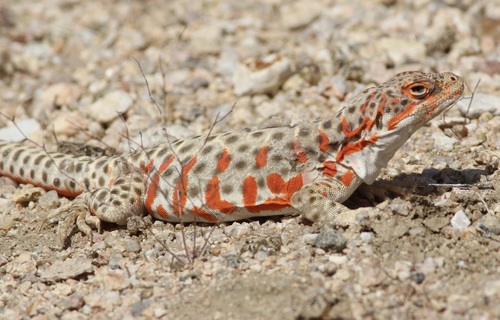
Desert Spiny Lizard

Desert Spiny Lizard

Sceloporus magister

Silhouette: SeismicShrimp · PhyloPic

LCLeast ConcernNTVUENCR
Daily sighting probability ~70% · Very likely
at Joshua Tree National Park

In 3 days >90%

1,010 Verified sightings at Joshua Tree National Park From 2019 to 2026
2,067 In all 5 parks
May Best month
☀️ Diurnal When it's spotted

About the Desert Spiny Lizard

Sceloporus magister, also known as the desert spiny lizard, is a lizard species of the family Phrynosomatidae, native to the Chihuahuan Desert and Sonoran Desert of North America. In the United States it is found in the states of Arizona, California, Texas, New Mexico, Nevada, and Utah. It is also found in the Mexican states of Sonora, Baja California, Chihuahua, Coahuila, and Durango.

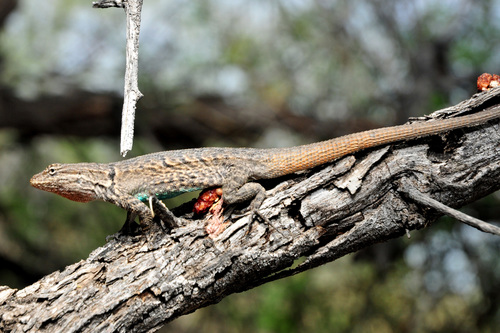
An adult male desert spiny lizard usually have conspicuous blue/violet patches on the belly and throat, and a green/blue color on their tails and sides. Females and juveniles have large combined dark spots on their back and belly areas, and the blue/violet and green/blue coloring is absent. Both sexes have brownish/yellow triangular spots on their shoulders. A female desert spiny lizard will lay anywhere from 4 to 24 eggs during the summertime. A fully grown desert spiny lizard will reach a body length of up to 5.6 inches. Besides their bright colors, the desert spiny lizard changes to darker colors during the winter to allow them to absorb more heat from the sunshine, and become lighter during the summer to reflect the Sun's radiation. It is frequently seen doing... Wikipedia →

Global Distribution

Parks Where Found

# Park Country Daily sighting probability
1 Joshua Tree National Park 🇺🇸 United States
~70%
2 Grand Canyon National Park 🇺🇸 United States
~50%
3 Saguaro National Park 🇺🇸 United States
~40%
4 Zion National Park 🇺🇸 United States
~40%
5 Death Valley National Park 🇺🇸 United States
~10%

Cities Where Found

# City Country Daily sighting probability
1 Phoenix 🇺🇸 United States
~40%
2 Mesa 🇺🇸 United States
~20%
3 Las Vegas 🇺🇸 United States
~10%

Zoos & Centres Where Found

# Zoo / Centre Country
1 Phoenix Zoo 🇺🇸 United States In captivity
2 Montgomery Zoo 🇺🇸 United States In captivity
3 Arizona-Sonora Desert Museum 🇺🇸 United States In captivity
4 Bergen County Zoological Park 🇺🇸 United States In captivity

Before you go

What are the chances of seeing a Desert Spiny Lizard in Joshua Tree National Park?

Very likely

About 70% of wildlife watchers report a Desert Spiny Lizard sighting in Joshua Tree National Park on a given day, based on 1,010 verified sightings from GBIF citizen-science data from 2019 to 2026. It is the 3rd most-seen of the 39 reptiles we can rate there. Over three days the chance rises to over 90%, if each day is a fresh chance.

When is the best time to see a Desert Spiny Lizard in Joshua Tree National Park?

April–June and August–September

In those months about 80% of wildlife watchers report a Desert Spiny Lizard in Joshua Tree National Park on a given day, against under 5% in December and January, the lowest months.

What time of day is best to see a Desert Spiny Lizard?

Between 9 am and noon

Across all the parks we cover, that three-hour window holds the most Desert Spiny Lizard sightings with a recorded time, and about 9 in 10 of them come between 6 am and 6 pm: it is a daytime animal.

Is Joshua Tree National Park the best place to see a Desert Spiny Lizard?

Yes

Of the 5 parks where we can rate Desert Spiny Lizard sightings, Joshua Tree National Park has the highest daily chance: about 70%. Next come Grand Canyon National Park (United States, about 50%) and Saguaro National Park (United States, about 40%). All parks ranked.

Where does the Desert Spiny Lizard sighting chance come from?

GBIF citizen-science records

It is estimated from how often the Desert Spiny Lizard is recorded against all the reptiles logged in Joshua Tree National Park (1,010 verified sightings from 2019 to 2026), calibrated against known sighting rates. Figures are rounded to the nearest 10% because citizen-science data supports honest approximations, not decimals, and months with records from fewer than five people show "—". How it works.

← Back to Joshua Tree National Park